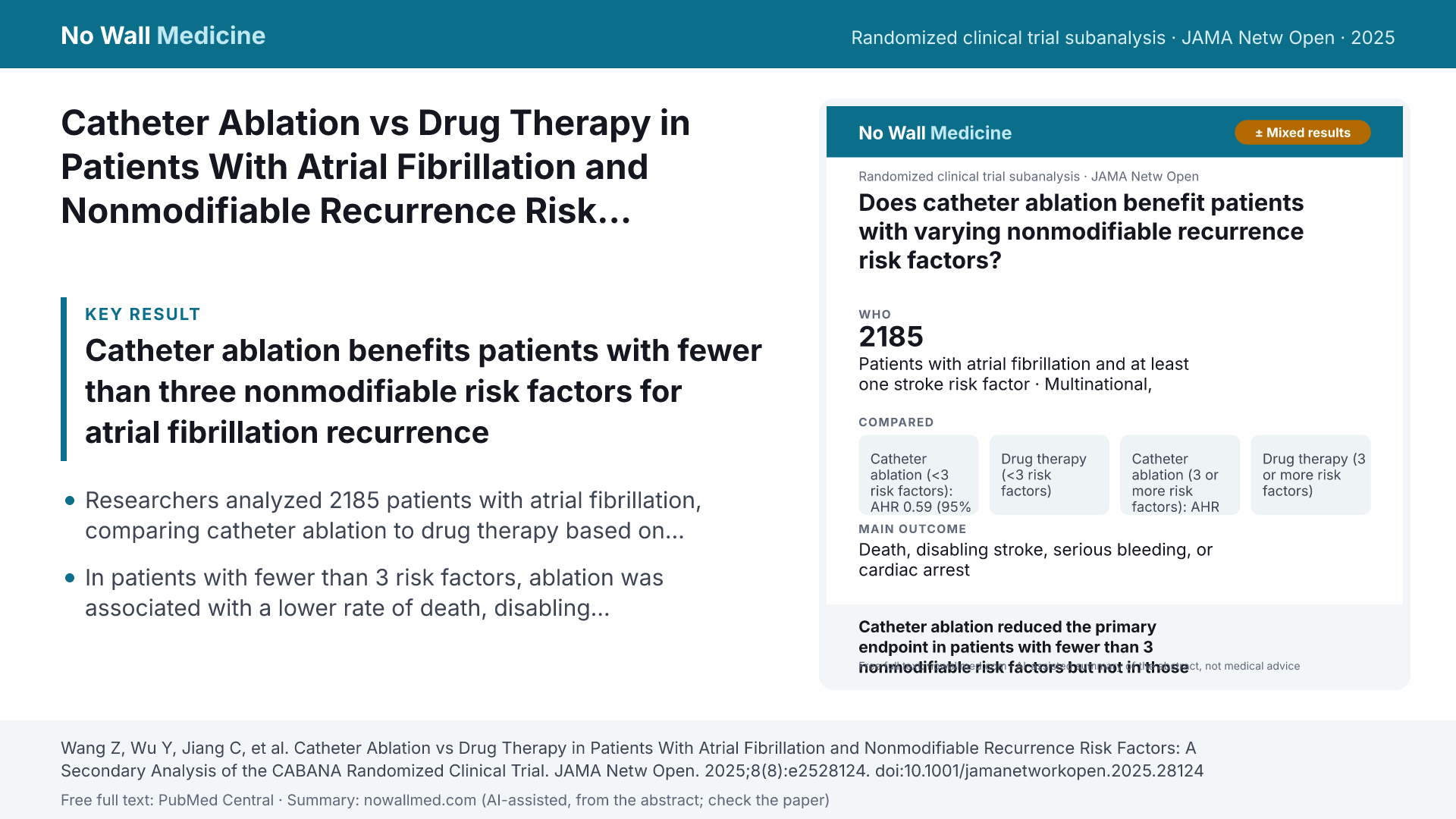
Catheter ablation benefits patients with fewer than three nonmodifiable risk factors for atrial fibrillation recurrence
Catheter Ablation vs Drug Therapy in Patients With Atrial Fibrillation and Nonmodifiable Recurrence Risk Factors: A Secondary Analysis of the CABANA Randomized Clinical Trial
Randomized clinical trial subanalysisMixed results
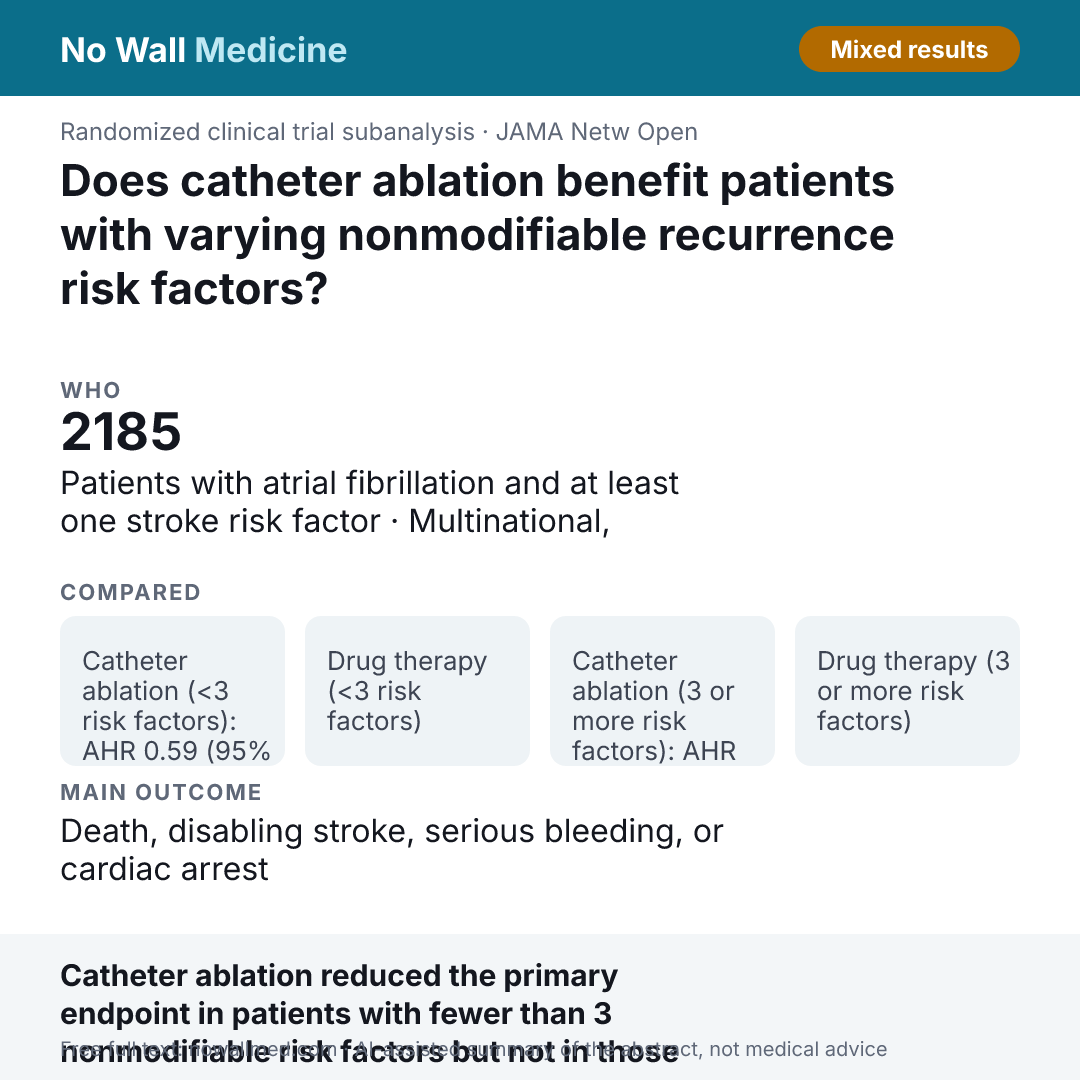
Does catheter ablation benefit patients with varying nonmodifiable recurrence risk factors?
Who
2185
Patients with atrial fibrillation and at least one stroke risk factor · Multinational, multicenter
Compared
Catheter ablation (<3 risk factors): AHR 0.59 (95% CI 0.41-0.86)
Drug therapy (<3 risk factors)
Catheter ablation (3 or more risk factors): AHR 1.55 (95% CI 0.93-2.58)
Drug therapy (3 or more risk factors)
Main outcome
Death, disabling stroke, serious bleeding, or cardiac arrest
Result: AHR 0.59 (95% CI 0.41-0.86) for <3 risk factors
Bottom line: Catheter ablation reduced the primary endpoint in patients with fewer than 3 nonmodifiable risk factors but not in those with 3 or more.
Limitation: This was a post hoc subanalysis of the CABANA randomized clinical trial.
JAMA Netw Open · 2025-08-01 · Save PNG
Same trial (NCT00911508)
Papers we list that report this registered trial, oldest first. Read a secondary analysis alongside the main results.
- Secondary analysis Key finding
Catheter ablation was associated with better outcomes than drug therapy for racial and ethnic minorities JACC 2021-07 - Main results Mixed results
Catheter ablation outcomes for atrial fibrillation varied depending on the age of the patient Circulation 2021-12 - Related analysis Benefit found
Catheter ablation improved quality of life more than drug therapy in men and women J Am Heart Assoc 2023-01 - Secondary analysis Key finding
Atrial fibrillation ablation was associated with better outcomes in patients likely to have heart failure with preserved ejection fraction JACC Heart Fail 2025-04 - Secondary analysis Mixed results
This paper JAMA Netw Open 2025-08 - Secondary analysis Mixed results
Time from atrial fibrillation diagnosis to ablation procedure showed complex links to clinical outcomes BMC Med 2026-01
Clinical question: Does catheter ablation benefit patients with varying nonmodifiable recurrence risk factors?
Why it matters: Large-scale randomized studies evaluating how catheter ablation impacts cardiovascular outcomes across different atrial fibrillation recurrence risk profiles are lacking.
Key points
- Researchers analyzed 2185 patients with atrial fibrillation, comparing catheter ablation to drug therapy based on their number of nonmodifiable recurrence risk factors.
- In patients with fewer than 3 risk factors, ablation was associated with a lower rate of death, disabling stroke, serious bleeding, or cardiac arrest.
- For patients with 3 or more risk factors, the difference in the primary end point was not statistically significant.
Headline and key points written with AI from the paper’s abstract, with every number checked against it. Read the paper before relying on them.
Was this summary helpful?
Subject terms
Headline, design, result, key points, caveat and citation as plain text.
Cite this article
Wang Z, Wu Y, Jiang C, et al. Catheter Ablation vs Drug Therapy in Patients With Atrial Fibrillation and Nonmodifiable Recurrence Risk Factors: A Secondary Analysis of the CABANA Randomized Clinical Trial. JAMA Netw Open. 2025;8(8):e2528124. doi:10.1001/jamanetworkopen.2025.28124
Spotted a mistake? Suggest a correction