Association between alcohol consumption and chronic pain: a systematic review and meta-analysis
Systematic review and meta-analysisBenefit found
Is alcohol intake related to chronic pain occurrence?
Who
642 587
Individuals in cohort and case-control studies
Compared
Any alcohol consumption: OR=0.76 (95% CI, 0.61-0.95)
No alcohol consumption
Main outcome
Occurrence of chronic pain
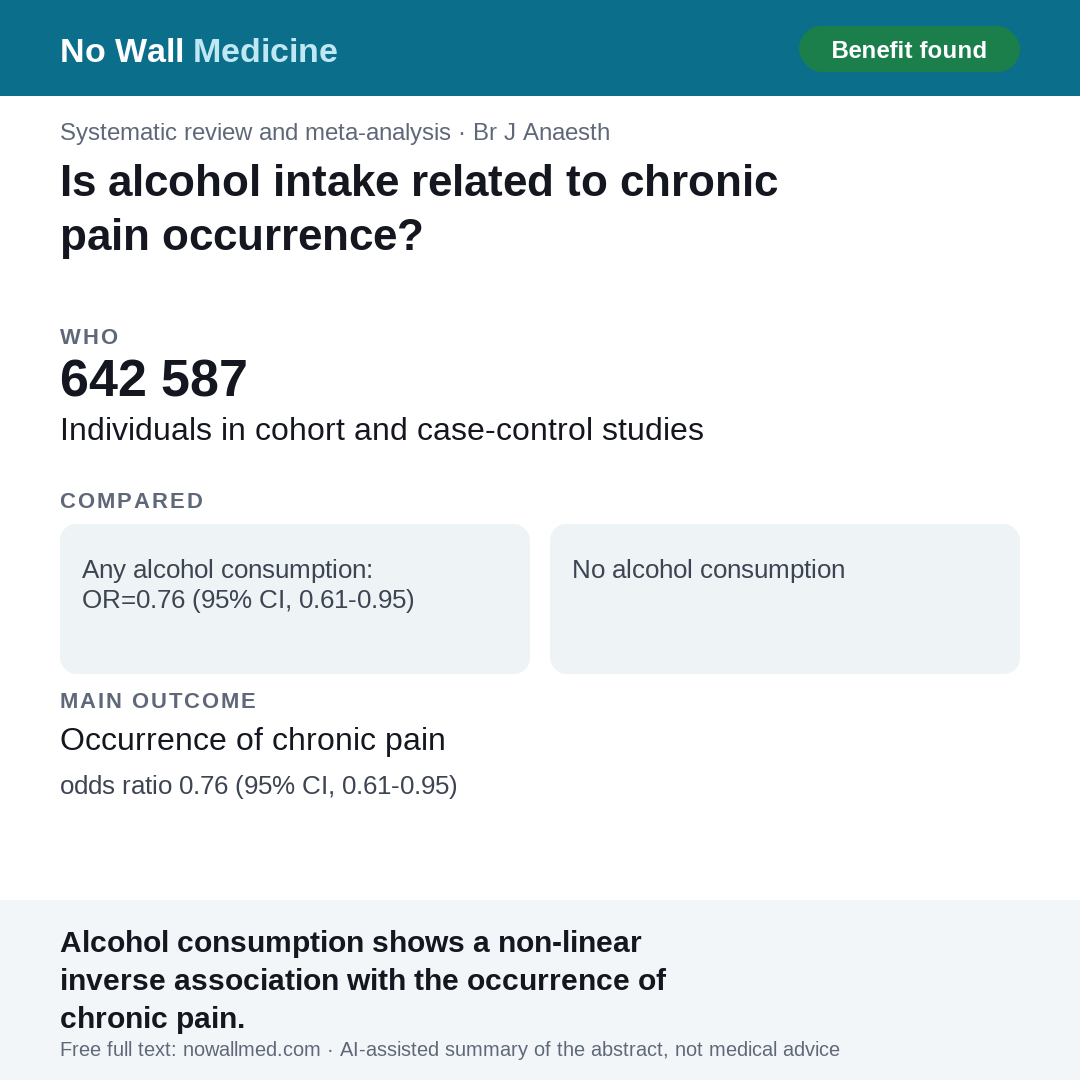
Result: odds ratio 0.76 (95% CI, 0.61-0.95)
Bottom line: Alcohol consumption shows a non-linear inverse association with the occurrence of chronic pain.
Limitation: Other explanations, including reverse causation, are probable.
Br J Anaesth · 2022-04-08Download image
Clinical question: Is alcohol intake related to chronic pain occurrence?
Abstract
Introduction
Chronic pain represents a global health problem with a considerable economic burden. The relation of alcohol intake and chronic pain conditions was assessed in several studies with conflicting results. We used dose-response meta-analysis techniques to answer the question of whether alcohol intake is related to chronic pain occurrence. Methods
We searched MEDLINE, Embase, and other databases to identify cohort and case-control studies on alcohol consumption and chronic pain. Sixteen studies were eligible with a total population of 642 587 individuals. Fixed-effects and random-effects pooled estimates were obtained by weighting log odds ratios (ORs) in case-control studies and log incidence rate ratios in cohort studies by the inverse of their variance. A heterogeneity assessment and a dose-response analysis were carried out. Quality scoring was also performed. Results
Our results show that any alcohol consumption was related to lower odds of chronic pain (pooled OR=0.76; 95% confidence interval [CI], 0.61-0.95). The association was non-linear. The ORs by quartile of alcohol doses were as follows: OR2nd quartile=0.74; 95% CI, 0.64-0.87; OR3rd quartile=0.67; 95% CI, 0.53-0.86; and OR4th quartile=0.75; 95% CI, 0.50-1.14. This association was observed for cohort studies (OR=0.77; 95% CI, 0.61-0.98) and European studies (OR=0.65; 95% CI, 0.48-0.87) only. Studies with complete adjustment for confounding factors showed a stronger relation than those with incomplete adjustment (OR=0.69; 95% CI, 0.48-0.99 and OR=0.85; 95% CI, 0.65-1.11, respectively). Conclusion
Alcohol consumption presents a non-linear inverse association with the occurrence of chronic pain. Although plausible mechanisms could explain this protective effect, other explanations, including reverse causation, are probable.
Subject terms
Cite this article
Karimi R, Mallah N, Nedjat S, Beasley MJ, Takkouche B. Association between alcohol consumption and chronic pain: a systematic review and meta-analysis. Br J Anaesth. 2022. doi:10.1016/j.bja.2022.03.010
Spotted a mistake? Suggest a correction
Top studies every Monday
The week’s key trials and guidelines in your specialties, plus any topics you follow. By email, free.
Get the weekly digest