Antiphospholipid antibodies were associated with higher risk of lung bleeding in systemic lupus erythematosus patients
Association between antiphospholipid antibodies and diffuse alveolar haemorrhage risk in systemic lupus erythematosus: a systematic review and meta-analysis
Systematic review and meta-analysisBenefit found
Is antiphospholipid antibody positivity associated with diffuse alveolar haemorrhage risk in systemic lupus erythematosus?
Who
7746
Patients with systemic lupus erythematosus
Compared
26.0%Antiphospholipid antibody positive
Antiphospholipid antibody negative
Main outcome
Diffuse alveolar haemorrhage
Result: odds ratio 1.76 (95% CI 1.24-2.49)
Bottom line: Antiphospholipid antibody positivity increases the risk of diffuse alveolar haemorrhage in patients with systemic lupus erythematosus.
Rheumatology · 2024-11-19Download image
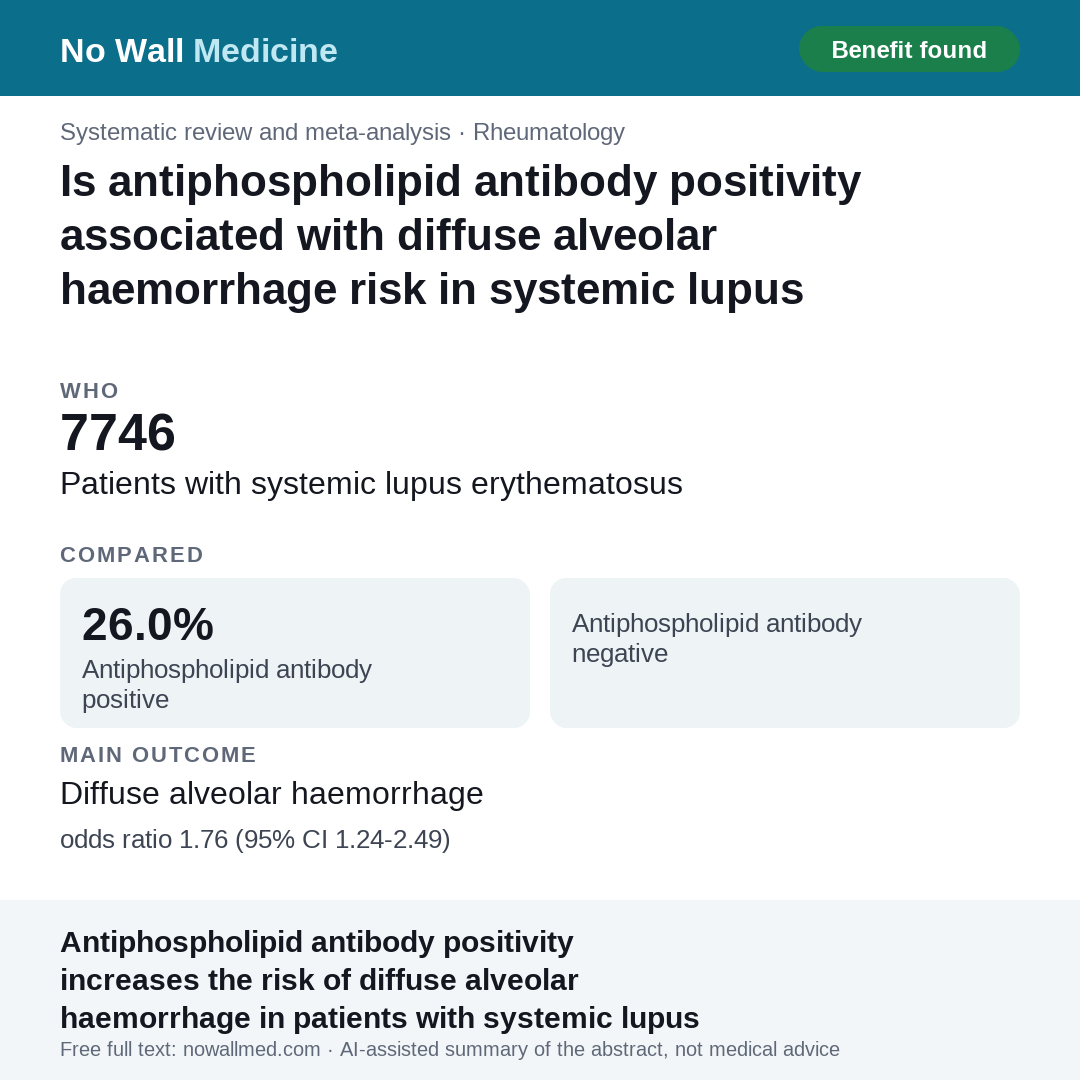
Clinical question: Is antiphospholipid antibody positivity associated with diffuse alveolar haemorrhage risk in systemic lupus erythematosus?
Why it matters: It was unknown how different types of antiphospholipid antibodies and antiphospholipid syndrome relate to the risk of diffuse alveolar haemorrhage in patients with systemic lupus erythematosus.
Key points
- A meta-analysis of nine studies involving 7746 patients with systemic lupus erythematosus found that 26.0% were positive for antiphospholipid antibodies and 2.1% had diffuse alveolar haemorrhage, which is severe bleeding in the lungs.
- Positive antiphospholipid antibodies were associated with a higher likelihood of lung bleeding (OR = 1.76, 95% CI 1.24-2.49), specifically for lupus anticoagulant (OR = 1.76, 95% CI 1.06-2.93) and anticardiolipin IgG (OR = 1.62, 95% CI 1.13-2.34).
- An antiphospholipid syndrome diagnosis was associated with a 2.5-fold increased likelihood of lung bleeding (OR = 2.46, 95% CI 1.23-4.92), while anti-beta2 glycoprotein I IgG was not significantly associated with the outcome.
Headline and key points written with AI from the paper’s abstract, with every number checked against it. Read the paper before relying on them.
Topics
Cite this article
González-Treviño M, Figueroa-Parra G, Yang JX, Prokop LJ, Gamal SM, García MA. Association between antiphospholipid antibodies and diffuse alveolar haemorrhage risk in systemic lupus erythematosus: a systematic review and meta-analysis. Rheumatology. 2024. doi:10.1093/rheumatology/keae632
Spotted a mistake? Suggest a correction
Top studies every Monday
The week’s key trials and guidelines in your specialties, by email. Free.
Get the weekly digest