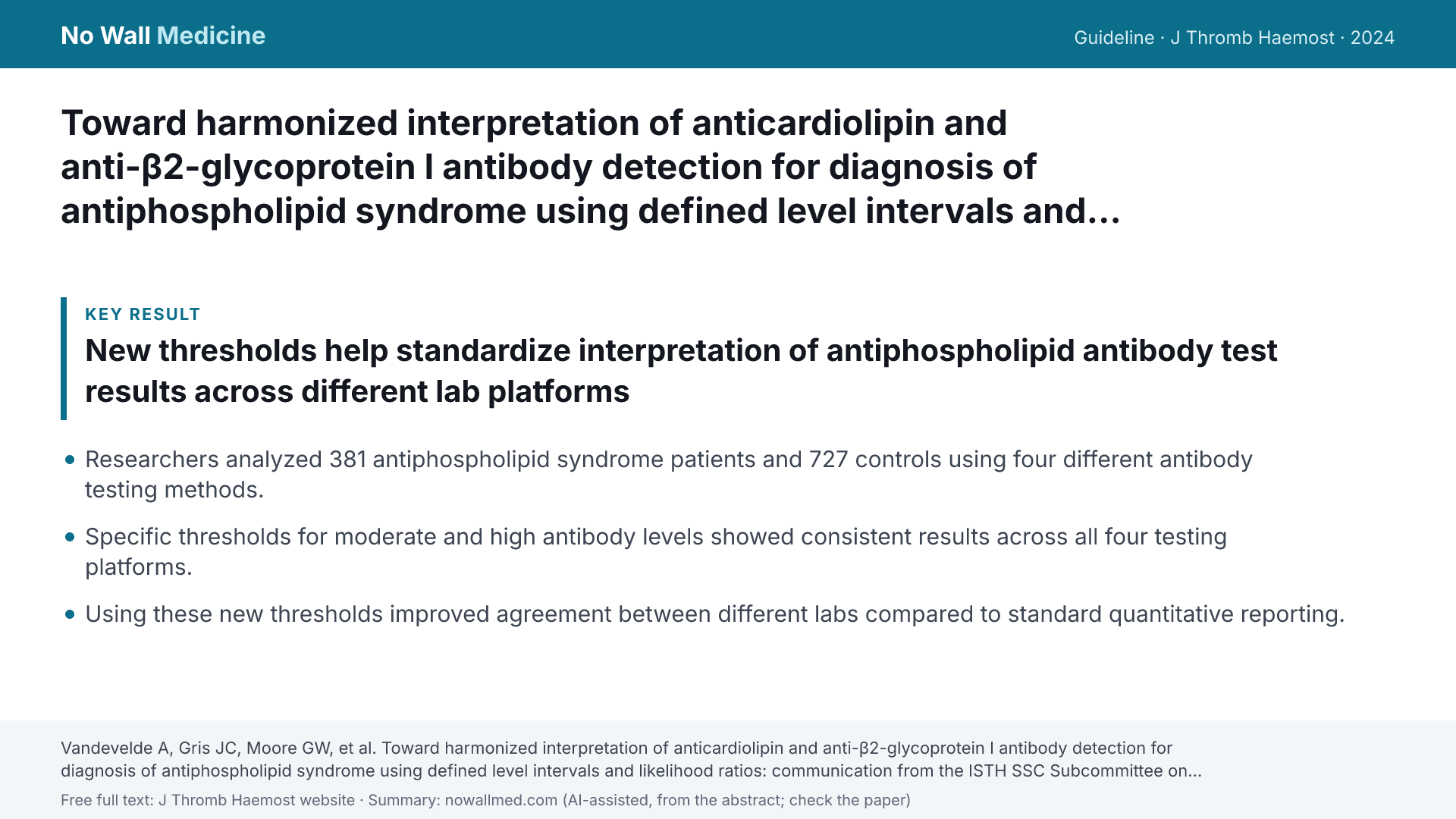
New antibody thresholds help standardize diagnosis of antiphospholipid syndrome across different laboratory testing platforms
Toward harmonized interpretation of anticardiolipin and anti-β2-glycoprotein I antibody detection for diagnosis of antiphospholipid syndrome using defined level intervals and likelihood ratios: communication from the ISTH SSC Subcommittee on Lupus Anticoagulant/Antiphospholipid Antibodies
Status not yet checked. We have not confirmed that this is still the issuing body's current recommendation. Check the issuing body before using it in practice.
Why it matters: Clinical interpretation of anticardiolipin and anti-beta2-glycoprotein I antibody levels lacks harmonization across different laboratory testing platforms for diagnosing antiphospholipid syndrome.
Key points
- Researchers studied 381 patients with antiphospholipid syndrome and 727 controls using four different laboratory testing systems for anticardiolipin and anti-beta2-glycoprotein I antibodies.
- The study found that using moderate and high thresholds for antibody levels improved agreement between different assays compared to using exact quantitative numbers.
- Likelihood ratios for these antibody levels were comparable across the four testing platforms, which helps standardize how results are interpreted.
Headline and key points written with AI from the paper’s abstract, with every number checked against it. Read the paper before relying on them.
Was this summary helpful?
Subject terms
Cite this article
Vandevelde A, Gris JC, Moore GW, et al. Toward harmonized interpretation of anticardiolipin and anti-β2-glycoprotein I antibody detection for diagnosis of antiphospholipid syndrome using defined level intervals and likelihood ratios: communication from the ISTH SSC Subcommittee on Lupus Anticoagulant/Antiphospholipid Antibodies. J Thromb Haemost. 2024. doi:10.1016/j.jtha.2024.04.016
Spotted a mistake? Suggest a correction