Toward harmonized interpretation of anticardiolipin and anti-β2-glycoprotein I antibody detection for diagnosis of antiphospholipid syndrome using defined level intervals and likelihood ratios: communication from the ISTH SSC Subcommittee on Lupus Anticoagulant/Antiphospholipid Antibodies
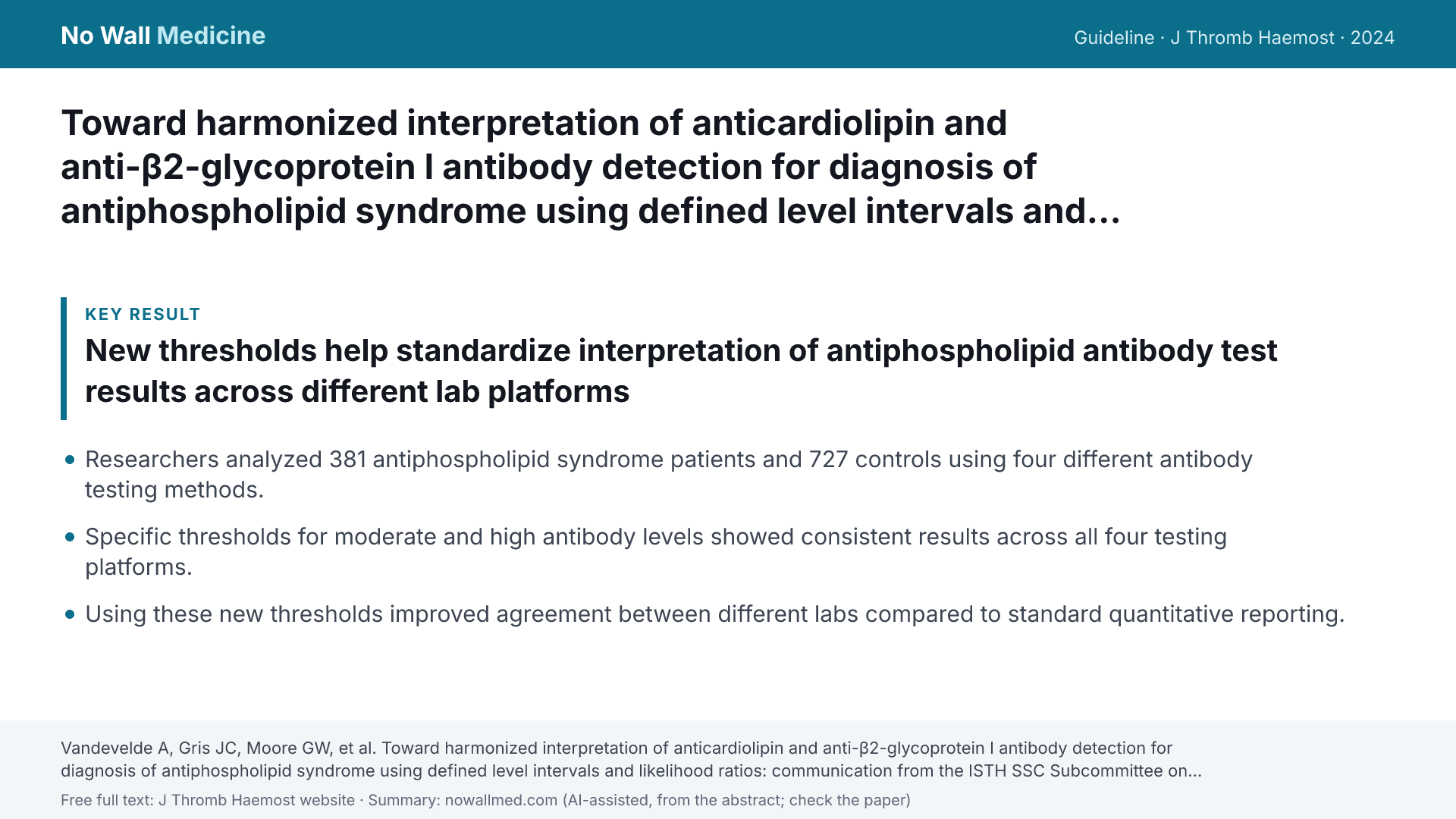
Key result: New thresholds help standardize interpretation of antiphospholipid antibody test results across different lab platforms
Key points
- Researchers analyzed 381 antiphospholipid syndrome patients and 727 controls using four different antibody testing methods.
- Specific thresholds for moderate and high antibody levels showed consistent results across all four testing platforms.
- Using these new thresholds improved agreement between different labs compared to standard quantitative reporting.
Why it matters: Clinicians need a consistent way to interpret varying antibody levels to accurately diagnose antiphospholipid syndrome across different laboratories.
Discussion prompts
- Would these patients look like yours? Who was left out?
- Is the main outcome one that matters to patients?
- Is the difference large enough to change what you do?
Cite: Vandevelde A, Gris JC, Moore GW, et al. Toward harmonized interpretation of anticardiolipin and anti-β2-glycoprotein I antibody detection for diagnosis of antiphospholipid syndrome using defined level intervals and likelihood ratios: communication from the ISTH SSC Subcommittee on Lupus Anticoagulant/Antiphospholipid Antibodies. J Thromb Haemost. 2024;22(8):2345-2362. doi:10.1016/j.jtha.2024.04.016
Free full text: J Thromb Haemost website · Summary and visual abstract: nowallmed.com/a/toward-harmonized-interpretation-of-anticardiolipin-and-anti-2-uvochx/ (AI-assisted from the abstract; check the paper before relying on it).