Glucagon-like peptide-1 receptor agonist use was associated with increased residual gastric contents but not pulmonary aspiration
Association between glucagon-like peptide-1 receptor agonist use and peri-operative pulmonary aspiration: a systematic review and meta-analysis
Systematic review and meta-analysisMixed results
Is glucagon-like peptide-1 receptor agonist use associated with pulmonary aspiration or residual gastric contents?
Who
185414
Fasted patients or volunteers using glucagon-like peptide-1 receptor agonists
Compared
Glucagon-like peptide-1 receptor agonist exposure: 471 cases of pulmonary aspiration
No exposure
Main outcome
Pulmonary aspiration and residual gastric contents
Result: odds ratio 1.04 (95%CI 0.87-1.25)
Bottom line: Glucagon-like peptide-1 receptor agonists increase residual gastric contents risk but not pulmonary aspiration risk.
Limitation: Low certainty of evidence for both pulmonary aspiration and residual gastric contents outcomes.
Anaesthesia · 2025-04-15Download image
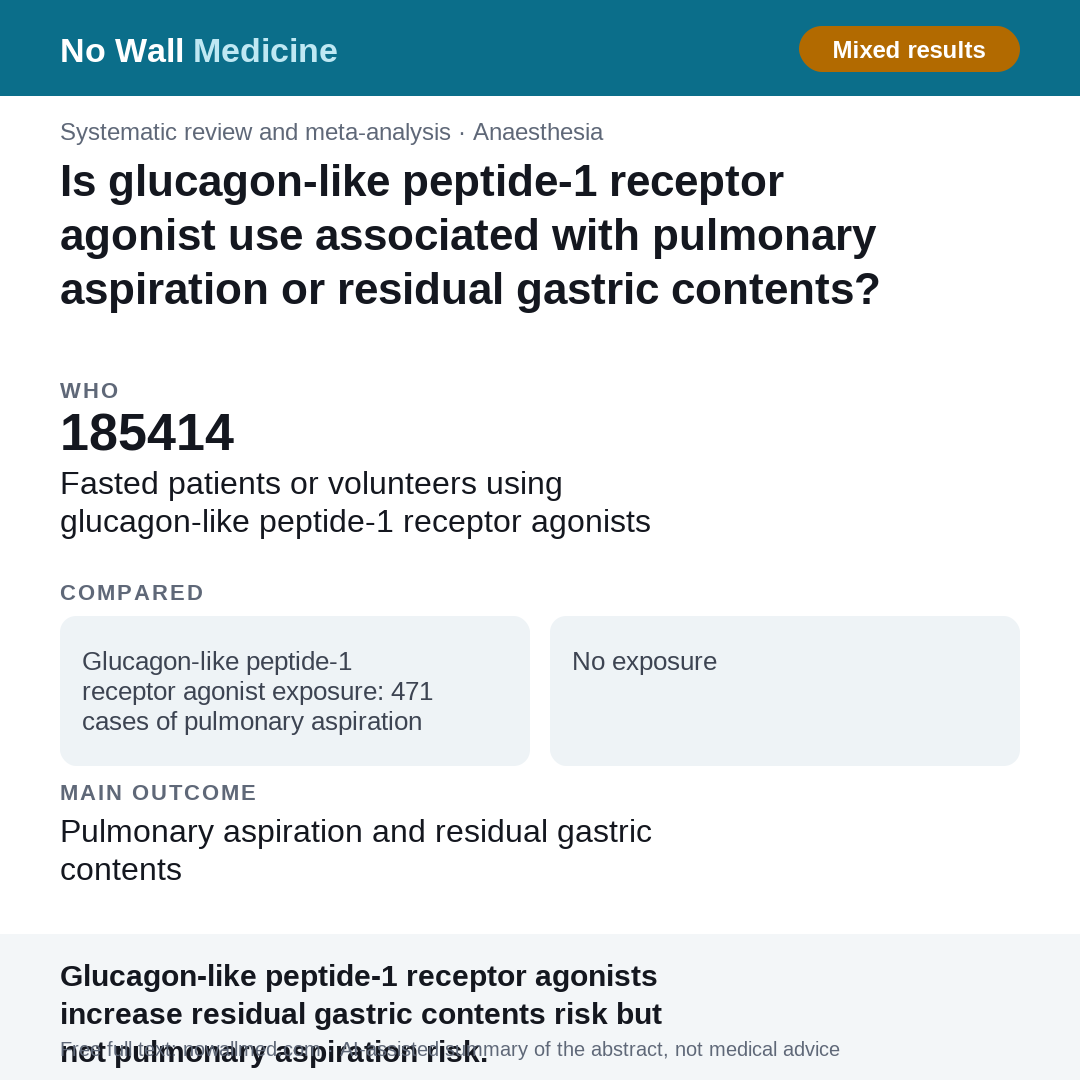
Clinical question: Is glucagon-like peptide-1 receptor agonist use associated with pulmonary aspiration or residual gastric contents?
Why it matters: It is unknown if glucagon-like peptide-1 receptor agonist use is associated with pulmonary aspiration or increased residual gastric contents in fasted patients undergoing anesthesia or sedation.
Key points
- Researchers analyzed 28 observational studies involving 185,414 patients to examine the link between glucagon-like peptide-1 receptor agonist use and risks during anesthesia.
- Glucagon-like peptide-1 receptor agonist exposure was associated with an increased risk of residual gastric contents, which is food or liquid remaining in the stomach, with an odds ratio of 5.96.
- The use of these medications was not associated with pulmonary aspiration, which is the accidental inhalation of stomach contents into the lungs, with an odds ratio of 1.04.
Limitation the authors note: The certainty of evidence for the main outcomes was rated as low or very low.
Headline and key points written with AI from the paper’s abstract, with every number checked against it. Read the paper before relying on them.
Was this summary helpful?
Subject terms
Cite this article
Elkin J, Rele S, Sumithran P, Hii M, Thuraisingam S, Spelman T. Association between glucagon-like peptide-1 receptor agonist use and peri-operative pulmonary aspiration: a systematic review and meta-analysis. Anaesthesia. 2025. doi:10.1111/anae.16601
Spotted a mistake? Suggest a correction
Top studies every Monday
The week’s key trials and guidelines in your specialties, plus any topics you follow. By email, free.
Get the weekly digest