Existing clinical prediction models for pediatric foreign body aspiration show high risk of bias
Clinical Prediction Models for Suspected Pediatric Foreign Body Aspiration: A Systematic Review and Meta-analysis
Meta-analysis of 7 studiesUnclear result
Do models predict pediatric foreign body aspiration?
Who
1577
children with suspected foreign body aspiration
Compared
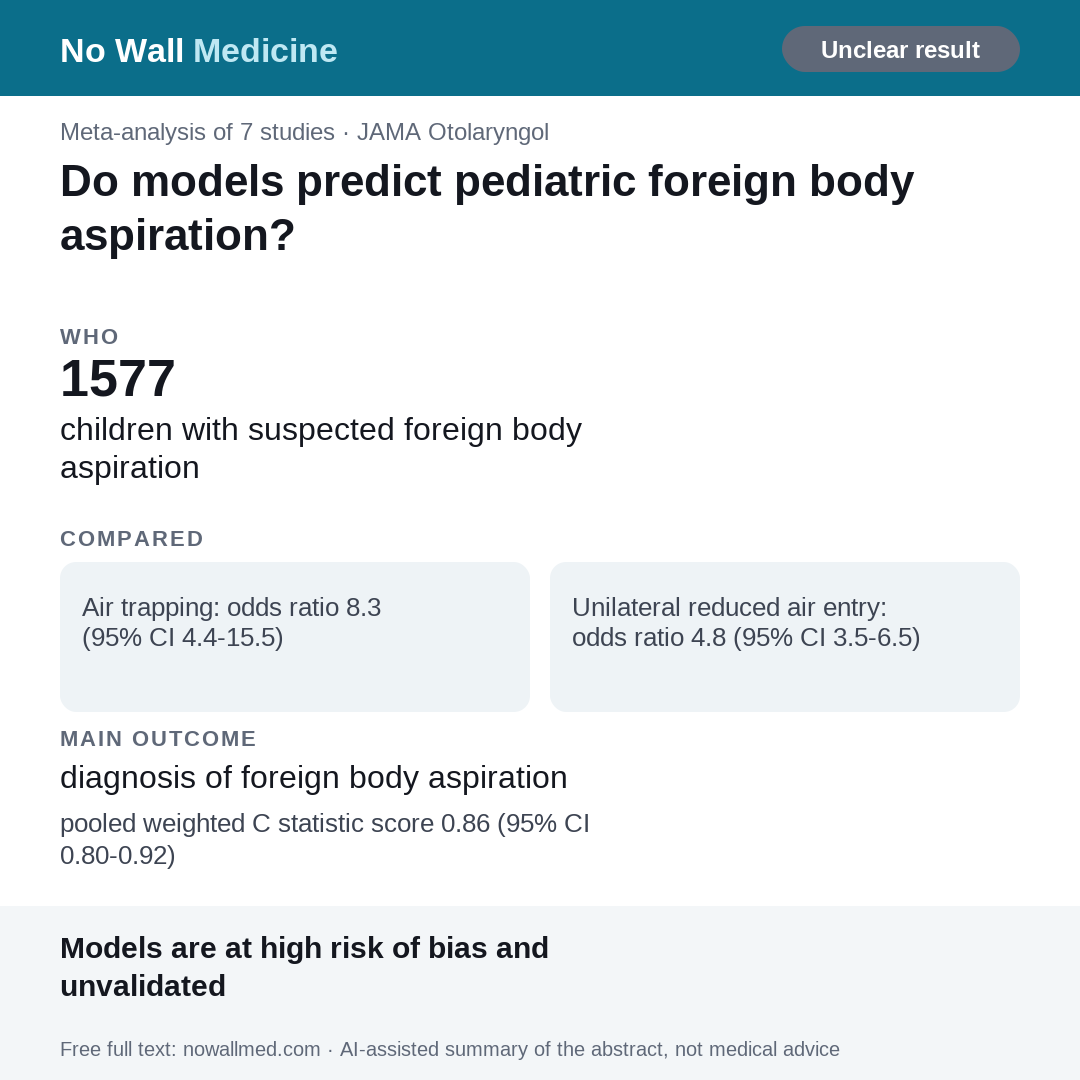
Air trapping: odds ratio 8.3 (95% CI 4.4-15.5)
Unilateral reduced air entry: odds ratio 4.8 (95% CI 3.5-6.5)
Main outcome
diagnosis of foreign body aspiration
Result: pooled weighted C statistic score 0.86 (95% CI 0.80-0.92)
Bottom line: Models are at high risk of bias and unvalidated
Limitation: high risk of bias and lack of validation
JAMA Otolaryngol · 2021-07-16Download image
Clinical question: Do models predict pediatric foreign body aspiration?
Why it matters: There is no consensus regarding the specific indications for bronchoscopy, the standard procedure for identifying foreign objects in a child's airway.
Key points
- Researchers analyzed 7 studies involving 1577 patients to evaluate models used to diagnose foreign body aspiration, which is when an object is inhaled into the airway.
- The pooled discrimination score for the models was 0.86, with individual predictors including suspicious radiography findings (OR, 18.5) and air trapping (OR, 8.3).
- All included studies were found to be at high risk of bias due to model overfitting and a lack of validation.
Limitation the authors note: All studies were deemed to be at high risk of bias, with overfitting of models and lack of validation being the most pertinent concerns.
Headline and key points written with AI from the paper’s abstract, with every number checked against it. Read the paper before relying on them.
Was this summary helpful?
Subject terms
Cite this article
Lee JJW, Philteos J, Levin M, Namavarian A, Propst EJ, Wolter NE. Clinical Prediction Models for Suspected Pediatric Foreign Body Aspiration: A Systematic Review and Meta-analysis. JAMA Otolaryngol. 2021. doi:10.1001/jamaoto.2021.1548
Spotted a mistake? Suggest a correction
Top studies every Monday
The week’s key trials and guidelines in your specialties, plus any topics you follow. By email, free.
Get the weekly digest