Higher hemoglobin levels were associated with lower odds of mild cognitive impairment in older adults
Association between hemoglobin levels and mild cognitive impairment in generally healthy European community-dwelling older adults: a 3-year prospective analysis of the DO-HEALTH trial
Observational analysis of a randomized controlled trialBenefit found
Are baseline hemoglobin levels and anemia associated with mild cognitive impairment?
Who
2150
Generally healthy European community-dwelling adults age 70+ · European community-dwelling sites
Compared
Lowest hemoglobin quintile
2nd hemoglobin quintile: 34% lower odds of MCI
3rd hemoglobin quintile: 39% lower odds of MCI
4th hemoglobin quintile: 44% lower odds of MCI
Main outcome
Mild cognitive impairment over 3 years
Result: OR = 0.66 (95% CI: 0.47, 0.93) for 2nd quintile
Bottom line: Higher baseline hemoglobin levels were associated with reduced odds of mild cognitive impairment over three years.
Limitation: This study does not establish causality.
Am J Clin Nutr · 2025-11-13Download image
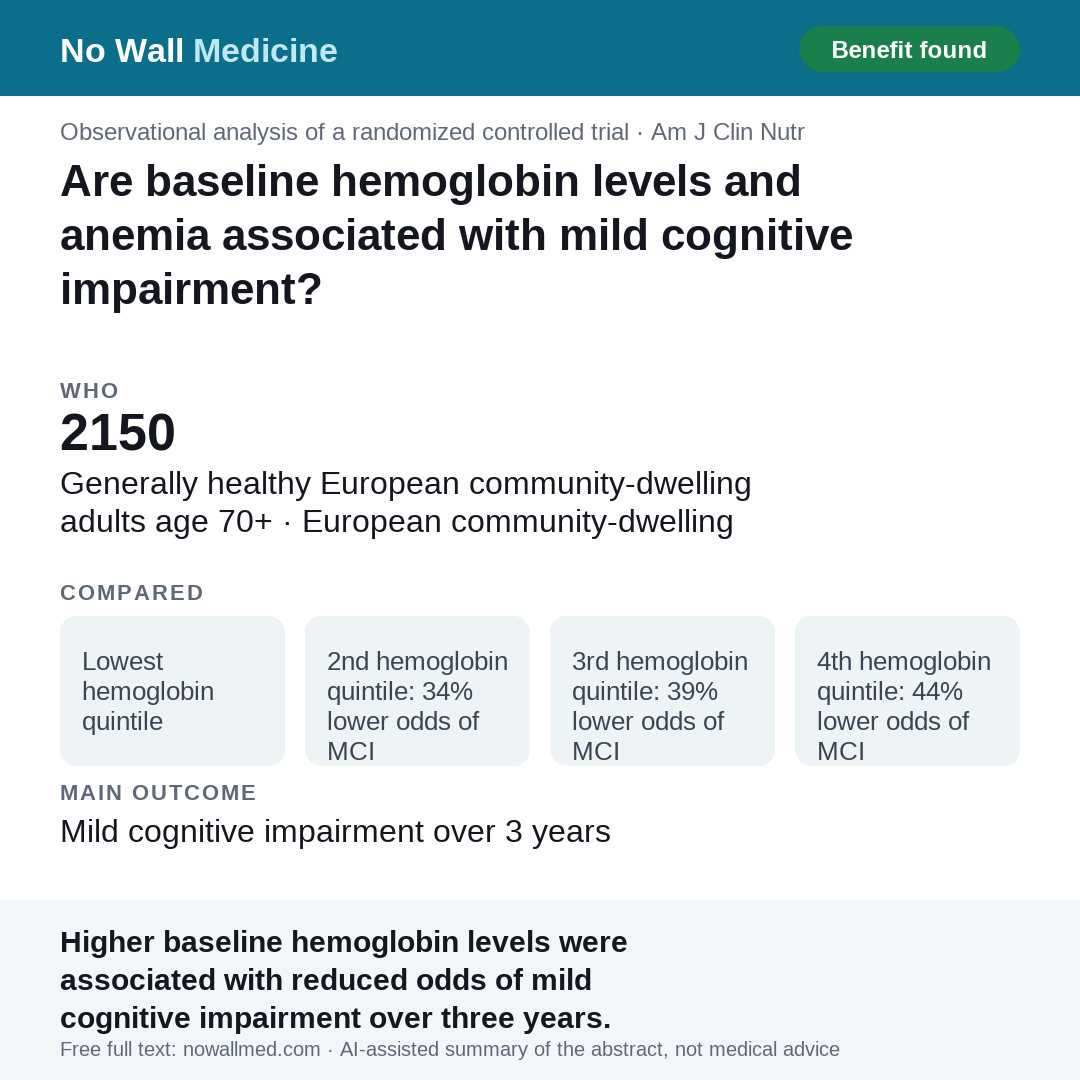
Clinical question: Are baseline hemoglobin levels and anemia associated with mild cognitive impairment?
Why it matters: Data from large longitudinal studies regarding the relationship between anemia and cognitive impairment in generally healthy older adults are limited.
Key points
- Researchers analyzed 2150 community-dwelling European adults aged 70 and older over a 3-year period.
- Compared to the lowest hemoglobin quintile, participants in higher quintiles had 34% to 44% lower odds of mild cognitive impairment.
- Anemia was not associated with the odds of developing mild cognitive impairment over the 3-year follow-up.
Limitation the authors note: This observational analysis of a randomized controlled trial does not establish causality.
Headline and key points written with AI from the paper’s abstract, with every number checked against it. Read the paper before relying on them.
Was this summary helpful?
Subject terms
Cite this article
Wieczorek M, Funk J, Mattle M, Gängler S, Egli A, Kressig RW. Association between hemoglobin levels and mild cognitive impairment in generally healthy European community-dwelling older adults: a 3-year prospective analysis of the DO-HEALTH trial. Am J Clin Nutr. 2025. doi:10.1016/j.ajcnut.2025.11.005
Spotted a mistake? Suggest a correction
Top studies every Monday
The week’s key trials and guidelines in your specialties, plus any topics you follow. By email, free.
Get the weekly digest