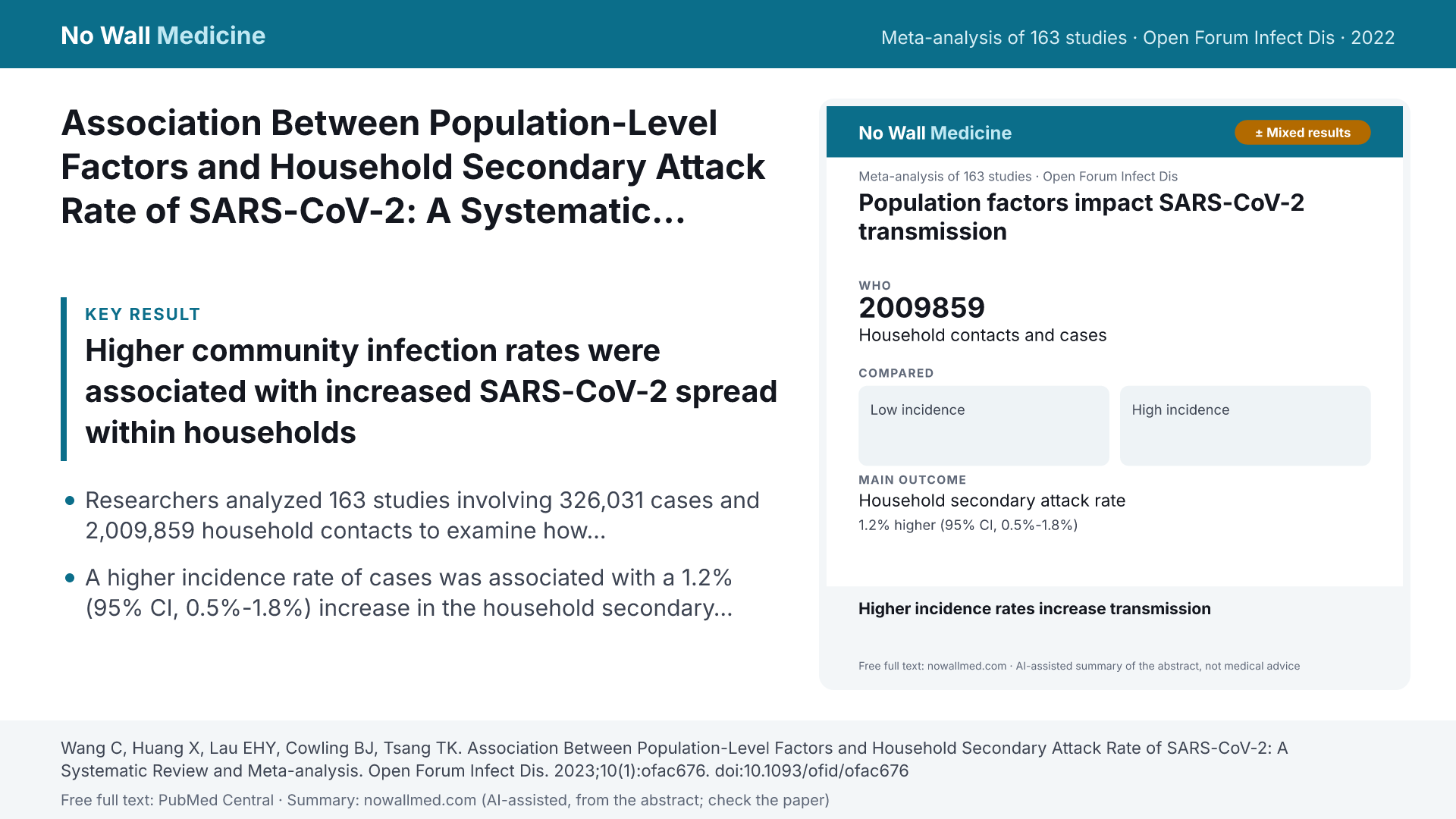
Higher community infection rates were associated with increased SARS-CoV-2 spread within households
Association Between Population-Level Factors and Household Secondary Attack Rate of SARS-CoV-2: A Systematic Review and Meta-analysis
Meta-analysis of 163 studiesMixed results
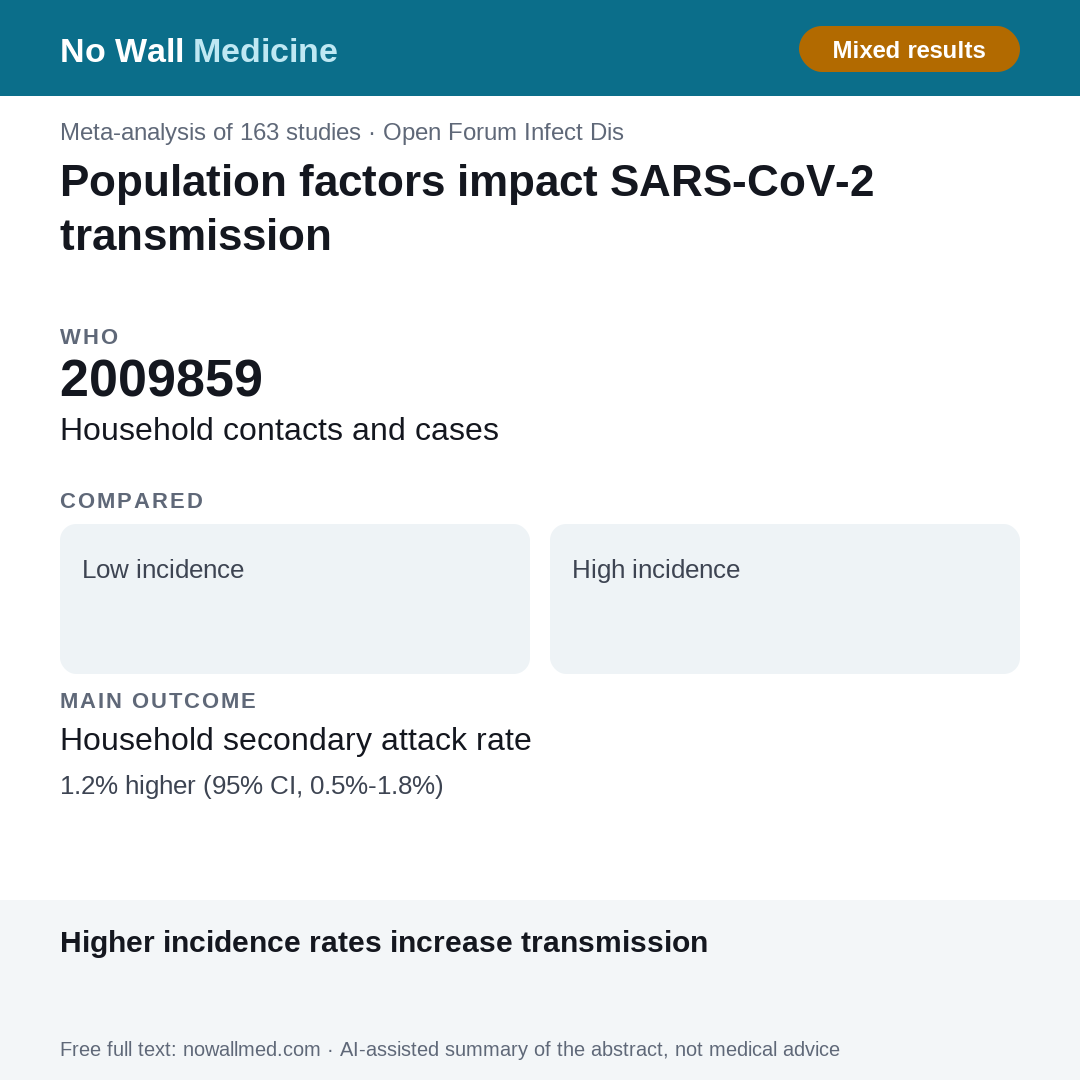
Population factors impact SARS-CoV-2 transmission
Who
2009859
Household contacts and cases
Compared
Low incidence
High incidence
Main outcome
Household secondary attack rate
Result: 1.2% higher (95% CI, 0.5%-1.8%)
Bottom line: Higher incidence rates increase transmission
Open Forum Infect Dis · 2022-12-16Download image
Why it matters: It is unknown how population-level factors, such as community transmission intensity, influence the rate at which SARS-CoV-2 spreads among people living in the same home.
Key points
- Researchers analyzed 163 studies involving 326,031 cases and 2,009,859 household contacts to examine how community transmission affects household spread.
- A higher incidence rate of cases was associated with a 1.2% (95% CI, 0.5%-1.8%) increase in the household secondary attack rate when the incidence rate doubled.
- The correlation between the community incidence rate and the household secondary attack rate was 0.37 (95% CI, 0.24-0.49).
Headline and key points written with AI from the paper’s abstract, with every number checked against it. Read the paper before relying on them.
Was this summary helpful?
Cite this article
Wang C, Huang X, Lau EHY, Cowling BJ, Tsang TK. Association Between Population-Level Factors and Household Secondary Attack Rate of SARS-CoV-2: A Systematic Review and Meta-analysis. Open Forum Infect Dis. 2022. doi:10.1093/ofid/ofac676
Spotted a mistake? Suggest a correction
Top studies every Monday
The week’s key trials and guidelines in your specialties, plus any topics you follow. By email, free.
Get the weekly digest