Association Between Population-Level Factors and Household Secondary Attack Rate of SARS-CoV-2: A Systematic Review and Meta-analysis
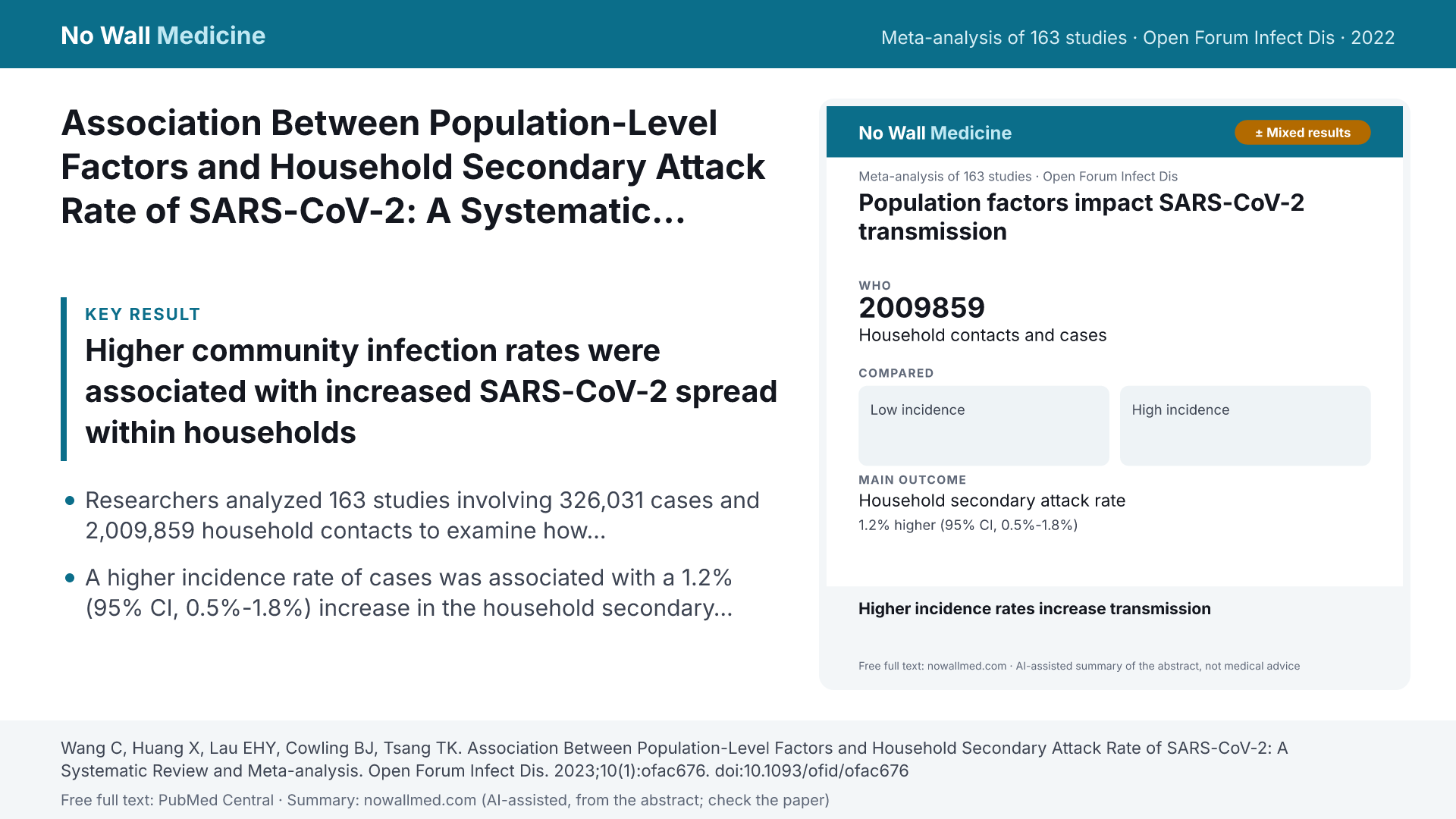
Key result: Higher community infection rates were associated with increased SARS-CoV-2 spread within households
Meta-analysis of 163 studiesMixed results
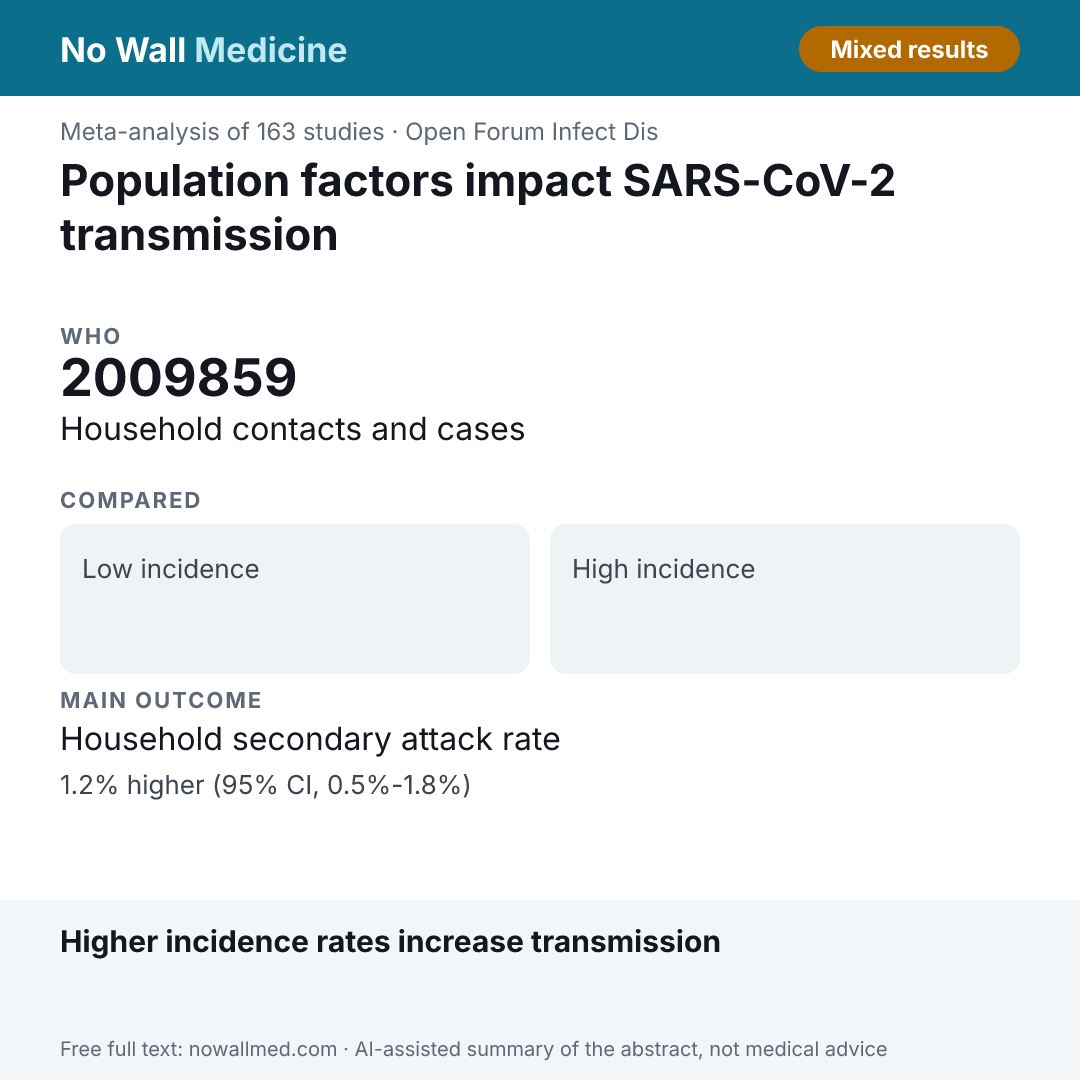
Population factors impact SARS-CoV-2 transmission
Who
2009859
Household contacts and cases
Compared
Low incidence
High incidence
Main outcome
Household secondary attack rate
Result: 1.2% higher (95% CI, 0.5%-1.8%)
Bottom line: Higher incidence rates increase transmission
Open Forum Infect Dis · 2022-12-16 · Save PNG
Key points
- Researchers analyzed 163 studies involving 326,031 cases and 2,009,859 household contacts to examine how community transmission affects household spread.
- A higher incidence rate of cases was associated with a 1.2% (95% CI, 0.5%-1.8%) increase in the household secondary attack rate when the incidence rate doubled.
- The correlation between the community incidence rate and the household secondary attack rate was 0.37 (95% CI, 0.24-0.49).
Discussion prompts
- Would these patients look like yours? Who was left out?
- Is the main outcome one that matters to patients?
- Is the difference large enough to change what you do?
Cite: Wang C, Huang X, Lau EHY, Cowling BJ, Tsang TK. Association Between Population-Level Factors and Household Secondary Attack Rate of SARS-CoV-2: A Systematic Review and Meta-analysis. Open Forum Infect Dis. 2023;10(1):ofac676. doi:10.1093/ofid/ofac676
Free full text: PubMed Central · Summary and visual abstract: nowallmed.com/a/association-between-population-level-factors-and-household-secondary-8nyxkz/ (AI-assisted from the abstract; check the paper before relying on it).