Association between substituting macronutrients and all-cause mortality: a network meta-analysis of prospective observational studies
Network meta-analysis of prospective observational studiesBenefit found
Does substituting macronutrients affect all-cause mortality risk?
Who
1,737,644
Participants from thirty-nine prospective observational studies
Compared
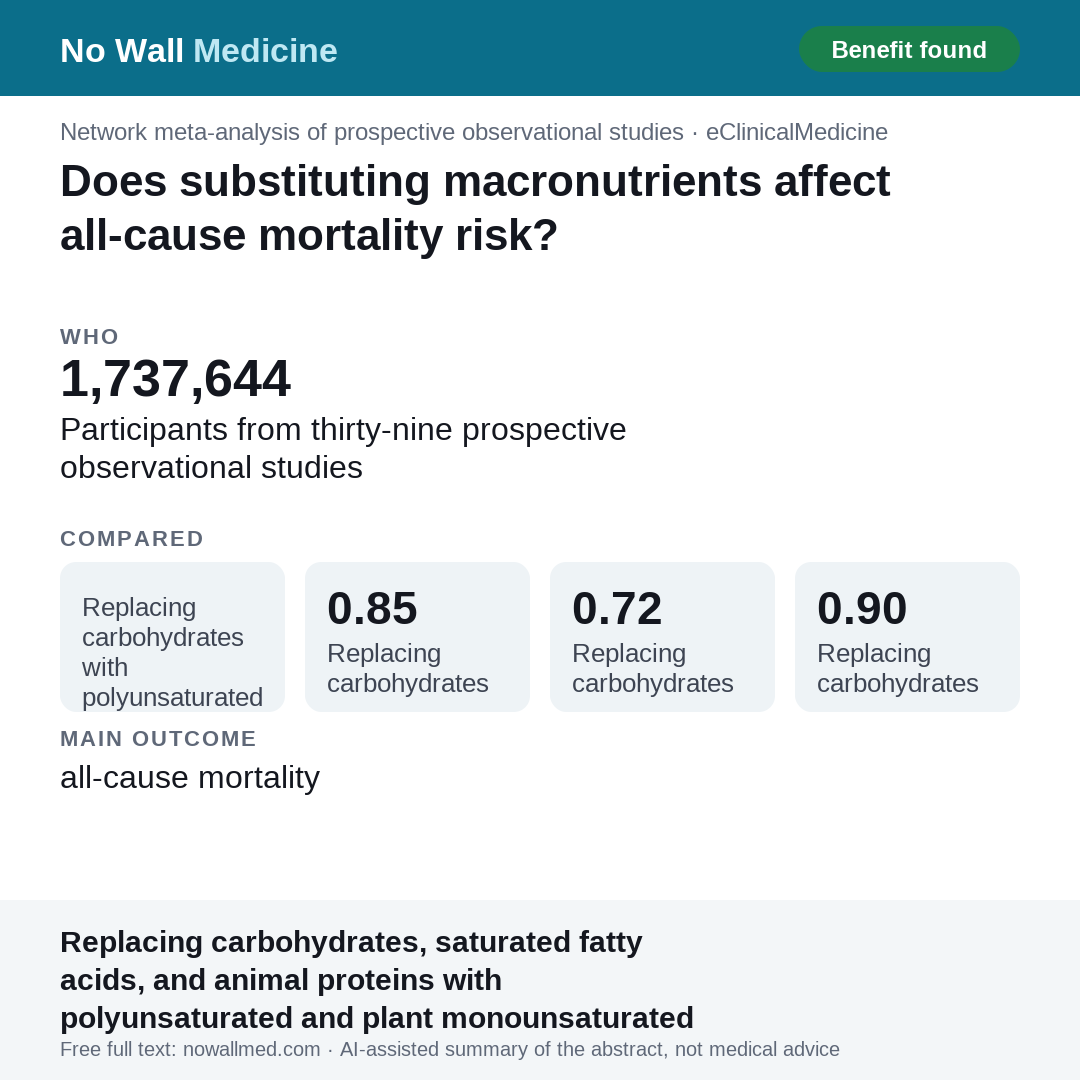
Replacing carbohydrates with polyunsaturated fatty acids: HR 0.90 (95%CI 0.84, 0.95)
0.85Replacing carbohydrates with n-6 polyunsaturated fatty acids (0.77, 0.94)
0.72Replacing carbohydrates with n-3 polyunsaturated fatty acids (0.59, 0.86)
0.90Replacing carbohydrates with plant monounsaturated fatty acids (0.85, 0.95)
Main outcome
all-cause mortality
Bottom line: Replacing carbohydrates, saturated fatty acids, and animal proteins with polyunsaturated and plant monounsaturated fatty acids reduces mortality risk.
Limitation: Moderate certainty of evidence was found for the associations.
eClinicalMedicine · 2024-09-05Download image
Clinical question: Does substituting macronutrients affect all-cause mortality risk?
Abstract
Background
Suboptimal diet quality is a key risk factor for premature death. Assuming relatively stable energy intake among individuals, changes in nutrient intakes occur by exchanging different nutrients. Therefore we aimed to examine the association of isocaloric substitution of dietary (macro)nutrients with all-cause mortality using network meta-analysis (NMA). Methods
For this systematic review and NMA of prospective observational studies MEDLINE, Embase, and Scopus were searched from inception to February 13th, 2024. Eligible studies reported substitution analyses for quantity and/or quality of macronutrients, including carbohydrates, proteins, and fatty acids on all-cause mortality. Random-effects NMA were used in order to evaluate the pooled hazard ratios (HR) and 95% confidence intervals (CI) of substituting each included nutrient with another. We assessed risk of bias with the ROBINS-E tool, and the certainty of evidence (CoE) using the Grading of Recommendations Assessment, Development and Evaluations (GRADE) approach. This study is registered with PROSPERO (CRD42023450706). Findings
Thirty-nine studies with 1,737,644 participants, 395,491 deaths, 297 direct comparisons, and seven nutrient-specific networks were included. Moderate CoE was found for an association with lower mortality risk when replacing 5% of energy intake from carbohydrates with polyunsaturated fatty acids (PUFA; HR: 0.90; 95%CI: 0.84, 0.95), n-6 PUFA (0.85; 0.77, 0.94), n-3 PUFA (0.72; 0.59, 0.86), and plant monounsaturated fatty acids (MUFA; 0.90; 0.85, 0.95), and when replacing 5% of energy from saturated fatty acids (SFA) and trans-fatty acids (TFA), with PUFA, MUFA, and plant-MUFA (HRrange: 0.75 to 0.91). A lower mortality risk was additionally found when 5% of animal-MUFA was replaced with plant-MUFA, and when replacing animal protein, and SFA with plant protein (HRrange: 0.81 to 0.87, moderate CoE). Interpretation
Our results provide practical knowledge for public health professionals and can inform upcoming dietary guidelines. The beneficial association of increasing PUFA (both n-3 and n-6) and (plant-) MUFA intake while reducing carbohydrates, SFA and TFA, along with replacing animal protein and animal-MUFA with plant-based sources of protein and fat (MUFA) on the all-cause mortality risk, underscores the importance of plant-based dietary recommendations. Funding
None.
Cite this article
Wallerer S, Papakonstantinou T, Morze J, Stadelmaier J, Kiesswetter E, Gorenflo L. Association between substituting macronutrients and all-cause mortality: a network meta-analysis of prospective observational studies. eClinicalMedicine. 2024. doi:10.1016/j.eclinm.2024.102807
Spotted a mistake? Suggest a correction
Top studies every Monday
The week’s key trials and guidelines in your specialties, by email. Free.
Get the weekly digest