Trial registration status was not linked to reporting large treatment effects in infertility studies
Association between trial registration and reporting large treatment effects in randomized controlled trials of infertility interventions: a meta-epidemiological study
Meta-epidemiologic studyNo clear difference
Is trial registration status associated with reporting large treatment effects in infertility trials?
Who
1369
Infertility randomized controlled trials published between 2012 and 2023
Compared
Prospectively registered
Retrospectively registered
Unregistered
Main outcome
Reporting of large treatment effects on pregnancy or live birth
Result: adjusted relative risk 0.77 (95% CI 0.49-1.20) for retrospective and 1.07 (95% CI 0.71-1.66) for unregistered
Bottom line: Unregistered or retrospectively registered infertility trials do not show a greater likelihood of reporting large treatment effects.
Fertil Steril · 2026-03-30Download image
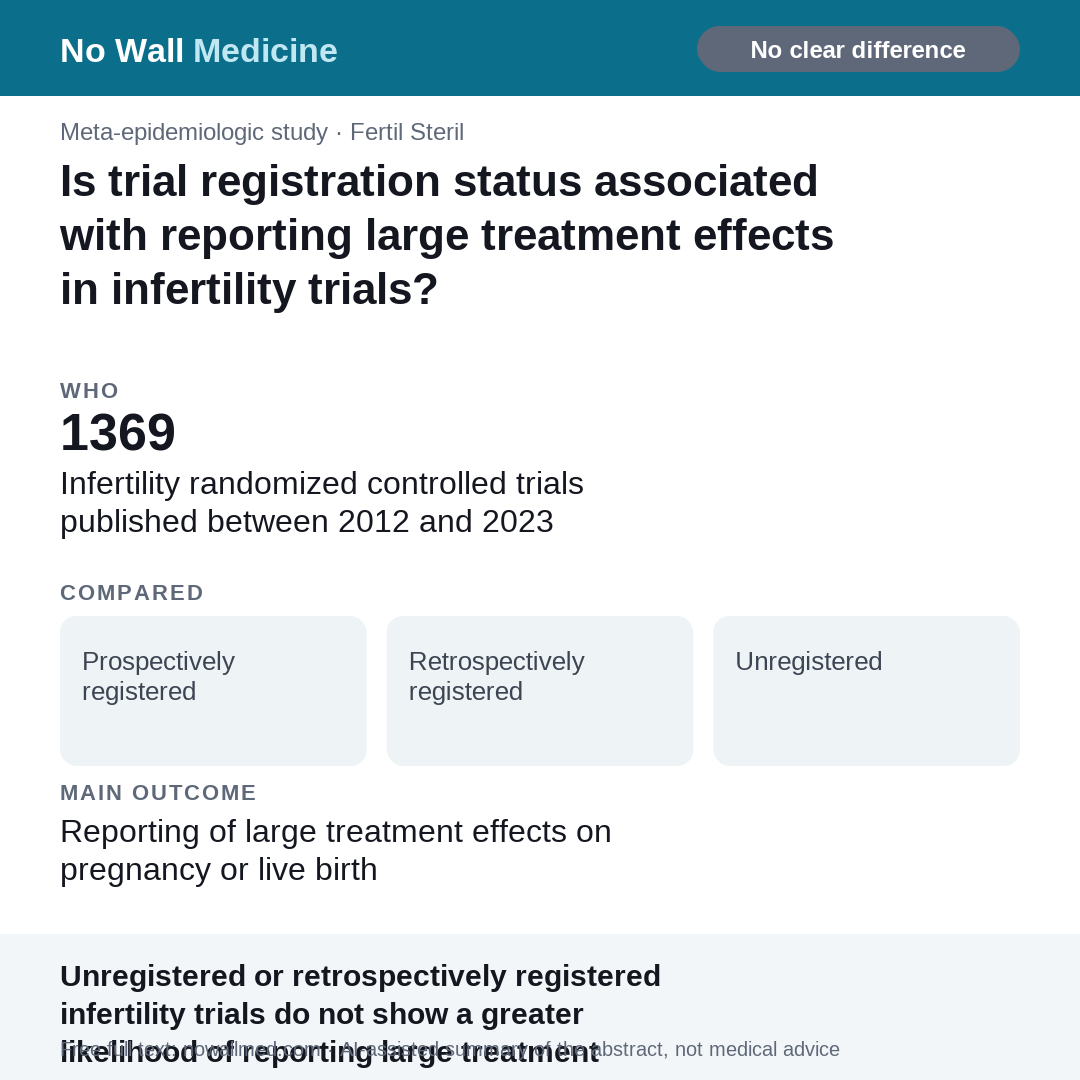
Clinical question: Is trial registration status associated with reporting large treatment effects in infertility trials?
Why it matters: Researchers wanted to know if unregistered or retrospectively registered trials are more likely to report large treatment effects, which could influence systematic reviews.
Key points
- Researchers analyzed 1,369 randomized controlled trials of infertility interventions published between 2012 and 2023.
- There was no statistically significant difference in the likelihood of reporting large treatment effects for retrospectively registered or unregistered trials compared to prospectively registered trials.
- In trials published before 2018, retrospective registration was associated with a significantly lower likelihood of reporting large treatment effects (adjusted relative risk = 0.40; 95% confidence interval: 0.21-0.75).
Headline and key points written with AI from the paper’s abstract, with every number checked against it. Read the paper before relying on them.
Topics
Spotted a mistake? Suggest a correction