Higher urea levels were associated with increased death risk in critically ill patients receiving protein
Association between urea trajectory and protein dose in critically ill adults: a secondary exploratory analysis of the effort protein trial (RE-EFFORT)
Secondary exploratory analysis of a randomized controlled trialHarm found
Does urea trajectory mediate the effect of higher protein doses on 30-day survival?
Who
1277
Mechanically ventilated critically ill adults
Compared
High protein group: median urea 2.1 mmol/L higher by day 6
Control group
Main outcome
30-day survival
Result: hazard ratio 1.34, 95% credible interval 1.21-1.48
Bottom line: Higher protein doses increase urea, and a twofold rise in urea is associated with increased death risk.
Crit Care · 2024-01-16Download image
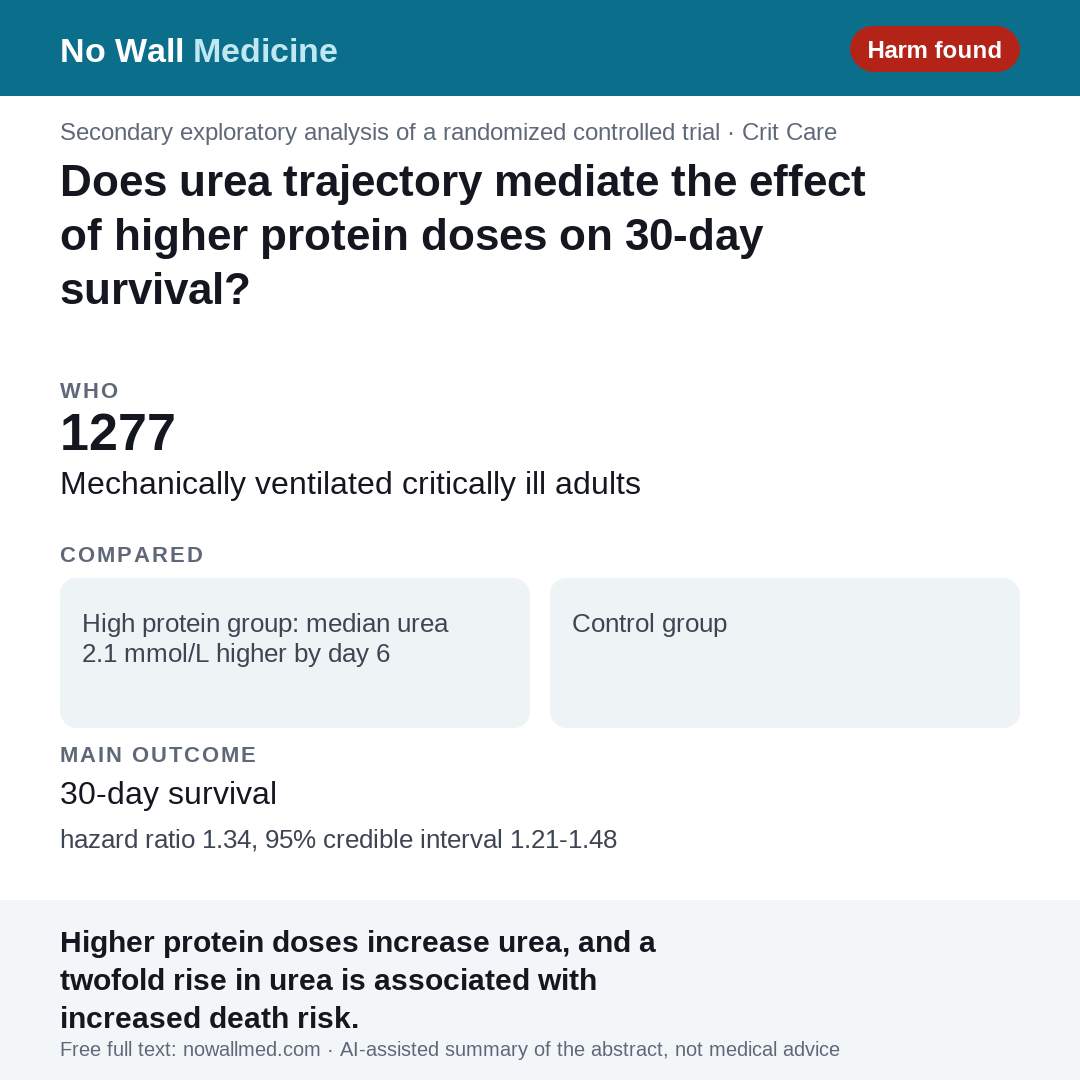
Clinical question: Does urea trajectory mediate the effect of higher protein doses on 30-day survival?
Why it matters: It was unknown if higher urea levels over time could explain potential harmful effects of higher protein doses in critically ill patients.
Key points
- Researchers reanalyzed 1277 patients from a randomized controlled trial to examine the link between urea levels and 30-day survival.
- A twofold rise in urea was associated with an increased risk of death at 30 days with a hazard ratio of 1.34.
- By day 12, the median urea was 3.0 mmol/L higher in the high protein group compared to the control group.
Headline and key points written with AI from the paper’s abstract, with every number checked against it. Read the paper before relying on them.
Was this summary helpful?
Subject terms
Cite this article
Haines RW, Prowle JR, Day A, Bear DE, Heyland DK, Puthucheary Z. Association between urea trajectory and protein dose in critically ill adults: a secondary exploratory analysis of the effort protein trial (RE-EFFORT). Crit Care. 2024. doi:10.1186/s13054-024-04799-1
Spotted a mistake? Suggest a correction
Top studies every Monday
The week’s key trials and guidelines in your specialties, plus any topics you follow. By email, free.
Get the weekly digest