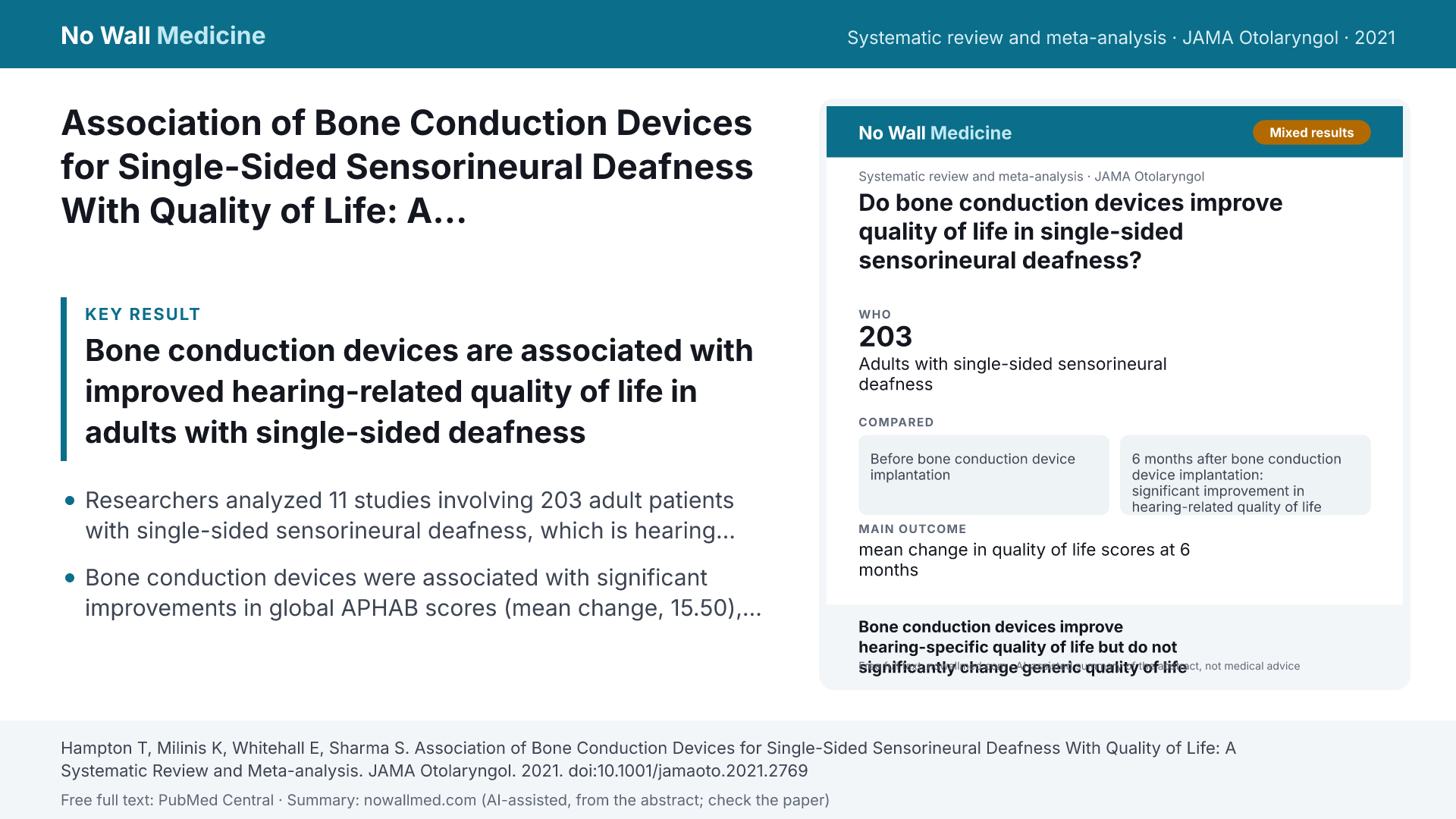
Bone conduction devices are associated with improved hearing-related quality of life in adults with single-sided deafness
Association of Bone Conduction Devices for Single-Sided Sensorineural Deafness With Quality of Life: A Systematic Review and Meta-analysis
ENT (Otolaryngology)Adult and pediatric
Systematic review and meta-analysisMixed results
Do bone conduction devices improve quality of life in single-sided sensorineural deafness?
Who
203
Adults with single-sided sensorineural deafness
Compared
Before bone conduction device implantation
6 months after bone conduction device implantation: significant improvement in hearing-related quality of life
Main outcome
mean change in quality of life scores at 6 months
Result: mean change in global APHAB scores 15.50 (95% CI 12.63-18.36)
Bottom line: Bone conduction devices improve hearing-specific quality of life but do not significantly change generic quality of life in adults.
Limitation: Ten of eleven studies were nonrandomized cohort studies.
JAMA Otolaryngol · 2021-10-15Download image
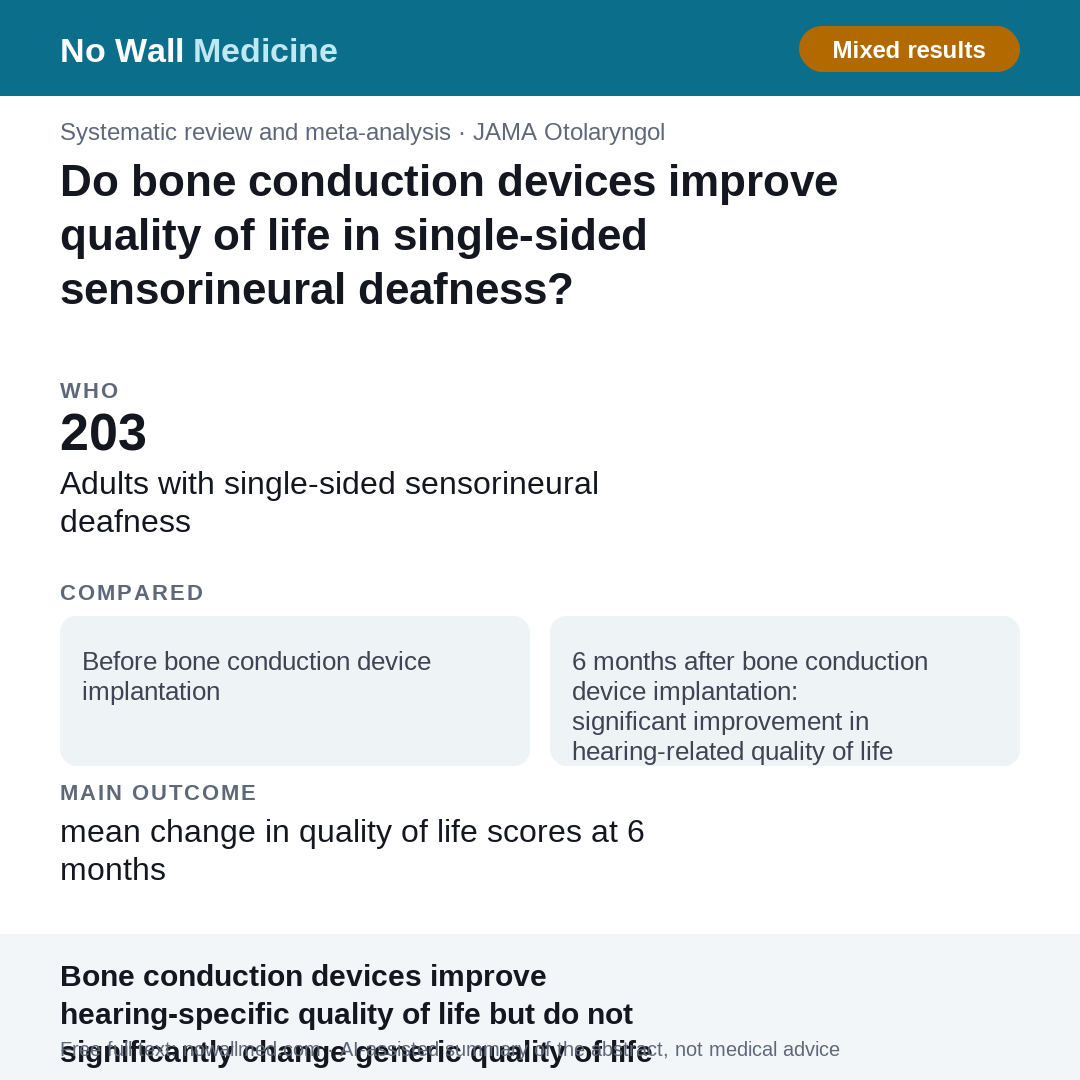
Clinical question: Do bone conduction devices improve quality of life in single-sided sensorineural deafness?
Why it matters: The effects of bone conduction devices on the quality of life for patients with single-sided sensorineural deafness are unclear.
Key points
- Researchers analyzed 11 studies involving 203 adult patients with single-sided sensorineural deafness, which is hearing loss in one ear with a pure tone average greater than 70 dB.
- Bone conduction devices were associated with significant improvements in global APHAB scores (mean change, 15.50), SSQ hearing qualities (mean change, 1.19), speech (mean change, 2.03), and spatial hearing (mean change, 1.51).
- The devices were not associated with a significant change in generic quality of life measured by the HUI-3 scale (mean change, 0.03).
Limitation the authors note: Ten of the 11 included studies were nonrandomized cohort studies.
Headline and key points written with AI from the paper’s abstract, with every number checked against it. Read the paper before relying on them.
Was this summary helpful?
Subject terms
Cite this article
Hampton T, Milinis K, Whitehall E, Sharma S. Association of Bone Conduction Devices for Single-Sided Sensorineural Deafness With Quality of Life: A Systematic Review and Meta-analysis. JAMA Otolaryngol. 2021. doi:10.1001/jamaoto.2021.2769
Spotted a mistake? Suggest a correction