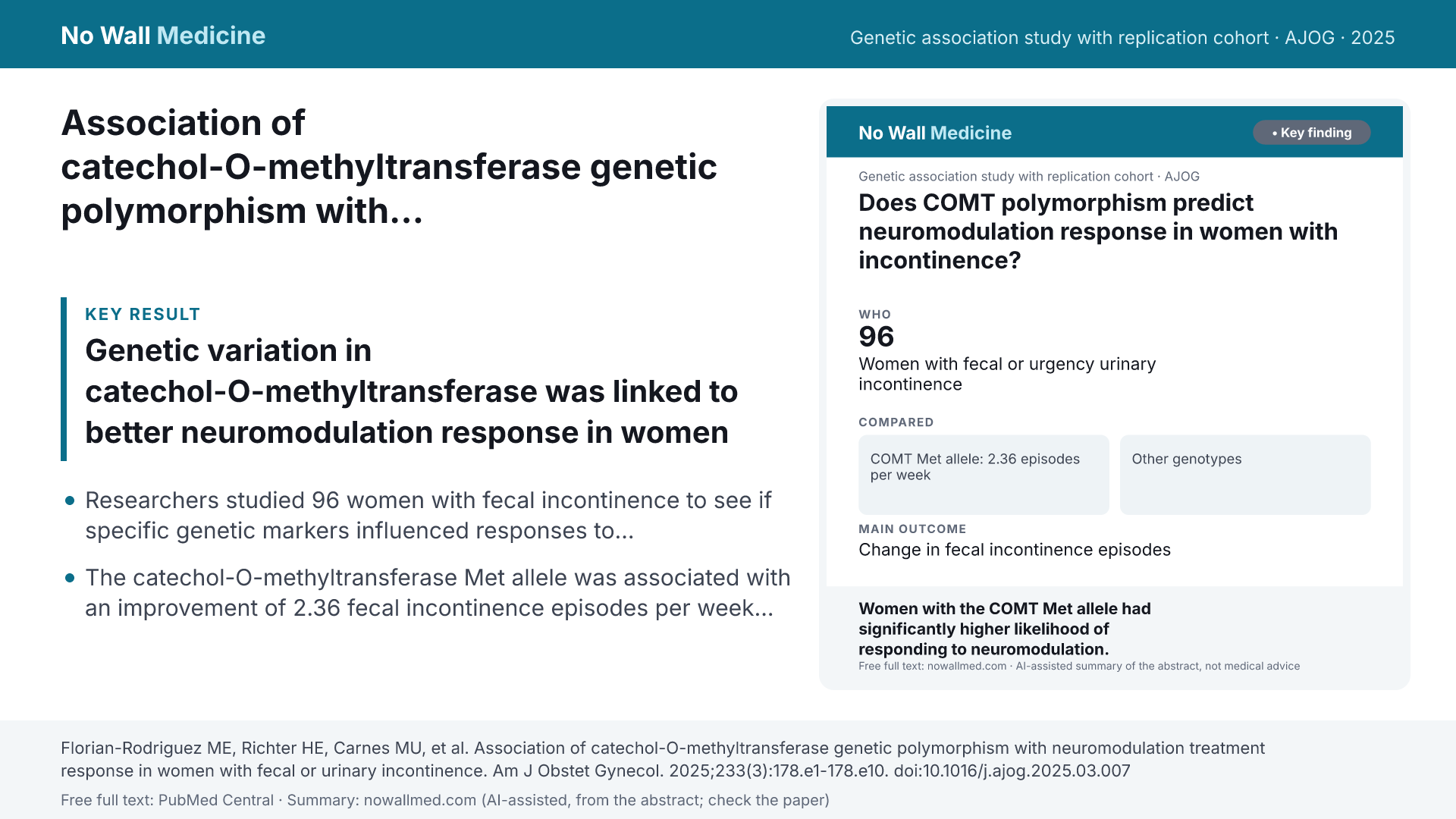
Association of catechol-O-methyltransferase genetic polymorphism with neuromodulation treatment response in women with fecal or urinary incontinence
Key result: Genetic variation in catechol-O-methyltransferase was linked to better neuromodulation response in women
Key points
- Researchers studied 96 women with fecal incontinence to see if specific genetic markers influenced responses to percutaneous tibial nerve stimulation or sham treatment.
- The catechol-O-methyltransferase Met allele was associated with an improvement of 2.36 fecal incontinence episodes per week in the nerve stimulation group.
- In an independent cohort, the Met allele was associated with higher odds of improved bladder function and urinary leak response during sacral neuromodulation.
Discussion prompts
- Would these patients look like yours? Who was left out?
- Is the main outcome one that matters to patients?
- Is the difference large enough to change what you do?
Cite: Florian-Rodriguez ME, Richter HE, Carnes MU, et al. Association of catechol-O-methyltransferase genetic polymorphism with neuromodulation treatment response in women with fecal or urinary incontinence. Am J Obstet Gynecol. 2025;233(3):178.e1-178.e10. doi:10.1016/j.ajog.2025.03.007
Free full text: PubMed Central · Summary and visual abstract: nowallmed.com/a/association-of-catechol-o-methyltransferase-genetic-polymorphism-with-x11wxf/ (AI-assisted from the abstract; check the paper before relying on it).