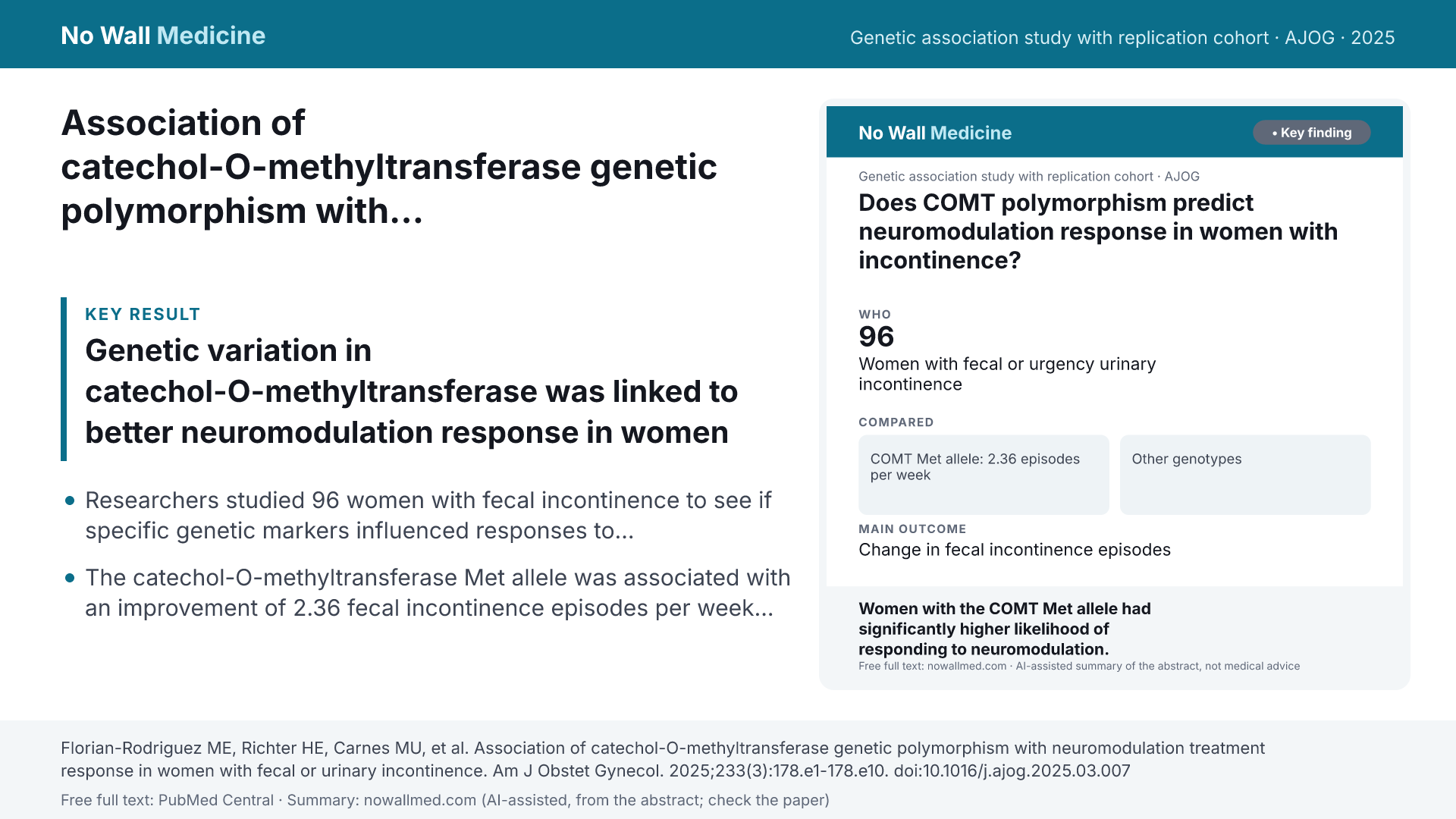
Genetic variation in catechol-O-methyltransferase was linked to better neuromodulation response in women
Association of catechol-O-methyltransferase genetic polymorphism with neuromodulation treatment response in women with fecal or urinary incontinence
Why it matters: Previous studies failed to show clinical differences between nerve stimulation and sham treatment, suggesting a possible placebo effect that may be linked to genetic biomarkers.
Key points
- Researchers studied 96 women with fecal incontinence to see if specific genetic markers influenced responses to percutaneous tibial nerve stimulation or sham treatment.
- The catechol-O-methyltransferase Met allele was associated with an improvement of 2.36 fecal incontinence episodes per week in the nerve stimulation group.
- In an independent cohort, the Met allele was associated with higher odds of improved bladder function and urinary leak response during sacral neuromodulation.
Headline and key points written with AI from the paper’s abstract, with every number checked against it. Read the paper before relying on them.
Was this summary helpful?
Subject terms
Cite this article
Florian-Rodriguez ME, Richter HE, Carnes MU, et al. Association of catechol-O-methyltransferase genetic polymorphism with neuromodulation treatment response in women with fecal or urinary incontinence. AJOG. 2025. doi:10.1016/j.ajog.2025.03.007
Spotted a mistake? Suggest a correction