Greater declines in prostate-specific antigen levels were associated with better outcomes in prostate cancer patients
Association of Declining Prostate-specific Antigen Levels with Clinical Outcomes in Patients with Metastatic Castration-resistant Prostate Cancer Receiving [177Lu]Lu-PSMA-617 in the Phase 3 VISION Trial
Post hoc analysis of a phase 3 randomized trialBenefit found
Does prostate-specific antigen decline predict outcomes in patients receiving 177Lu-PSMA-617?
Who
551
Patients with prostate-specific membrane antigen-positive metastatic castration-resistant prostate cancer
Compared
PSA decline ≥90%: 88% reduced risks of radiographic disease progression or death
PSA decline ≥50-<90%: 72% reduced risks of radiographic disease progression or death
PSA decline ≥0-<50%: 61% reduced risks of radiographic disease progression or death
Increased PSA levels
Main outcome
Radiographic progression-free survival and overall survival
Bottom line: Greater prostate-specific antigen decline is associated with improved clinical and patient-reported outcomes in patients receiving 177Lu-PSMA-617.
Limitation: This was a post hoc analysis of the phase 3 VISION trial.
Eur Urol · 2024-09-05Download image
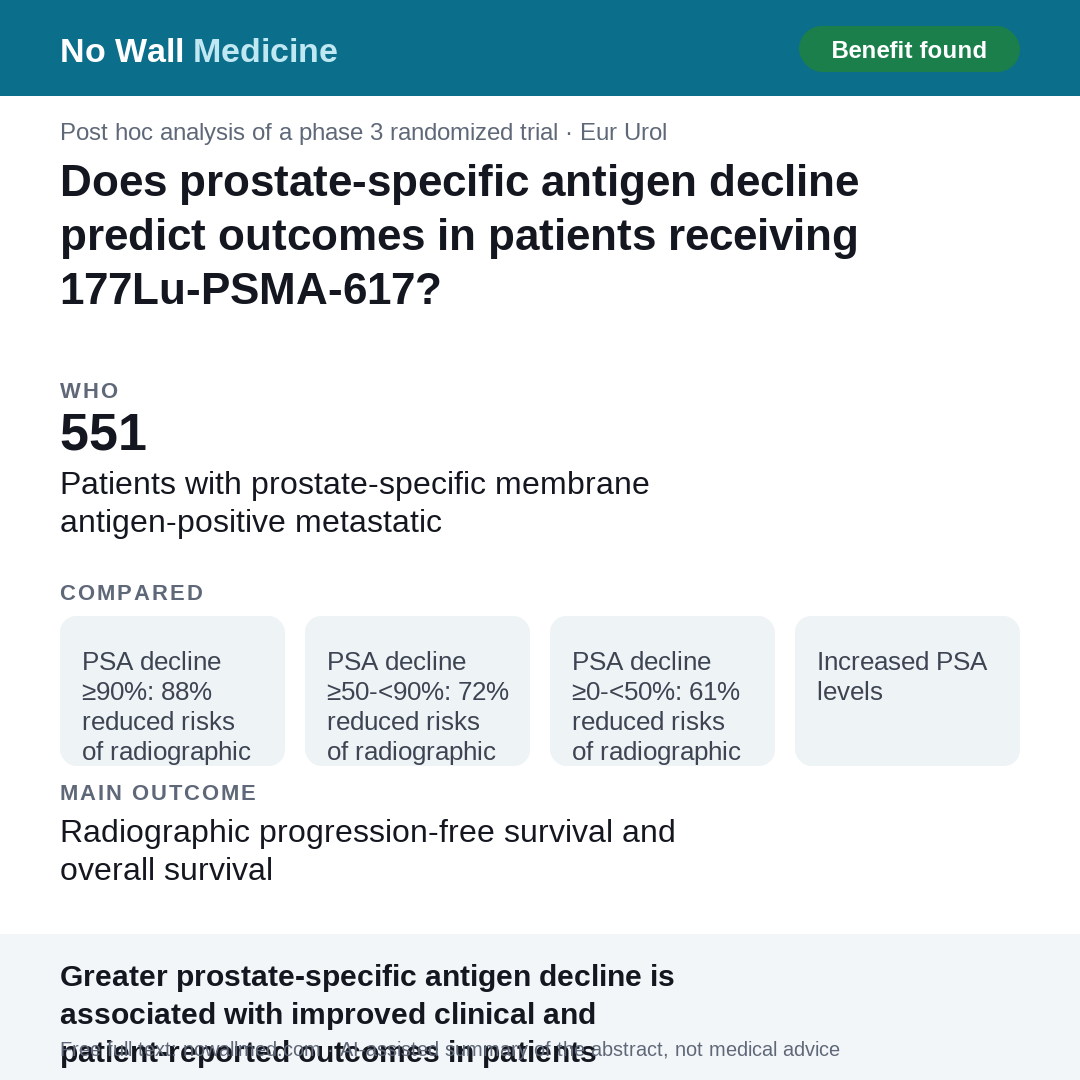
Clinical question: Does prostate-specific antigen decline predict outcomes in patients receiving 177Lu-PSMA-617?
Why it matters: The prognostic value of declining prostate-specific antigen levels in patients receiving prostate-specific membrane antigen-targeted radioligand therapy is under investigation.
Key points
- Researchers analyzed 551 patients with metastatic castration-resistant prostate cancer receiving radioligand therapy plus standard care.
- Patients with prostate-specific antigen declines of 90% or more had 88% reduced risks of radiographic disease progression or death and 87% reduced risks of death.
- Larger declines in prostate-specific antigen levels were associated with more frequent radiographic responses and longer times before health-related quality of life or pain scores worsened.
Headline and key points written with AI from the paper’s abstract, with every number checked against it. Read the paper before relying on them.
Topics
Cite this article
Armstrong AJ, Sartor O, de Bono J, Chi K, Fizazi K, Krause BJ. Association of Declining Prostate-specific Antigen Levels with Clinical Outcomes in Patients with Metastatic Castration-resistant Prostate Cancer Receiving [177Lu]Lu-PSMA-617 in the Phase 3 VISION Trial. Eur Urol. 2024. doi:10.1016/j.eururo.2024.08.021
Spotted a mistake? Suggest a correction
Top studies every Monday
The week’s key trials and guidelines in your specialties, by email. Free.
Get the weekly digest