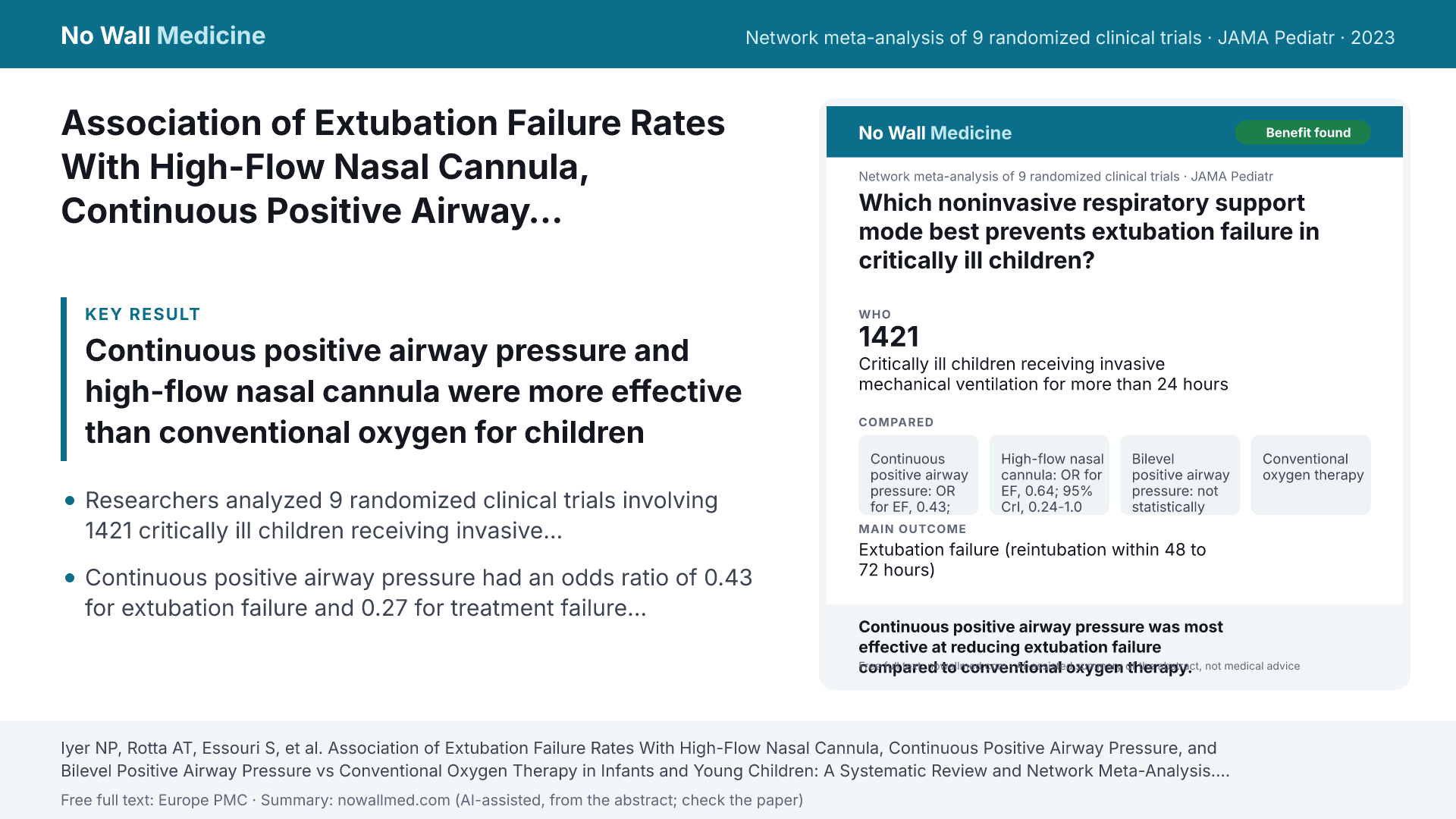
Continuous positive airway pressure and high-flow nasal cannula were more effective than conventional oxygen for children
Association of Extubation Failure Rates With High-Flow Nasal Cannula, Continuous Positive Airway Pressure, and Bilevel Positive Airway Pressure vs Conventional Oxygen Therapy in Infants and Young Children: A Systematic Review and Network Meta-Analysis
Network meta-analysis of 9 randomized clinical trialsBenefit found
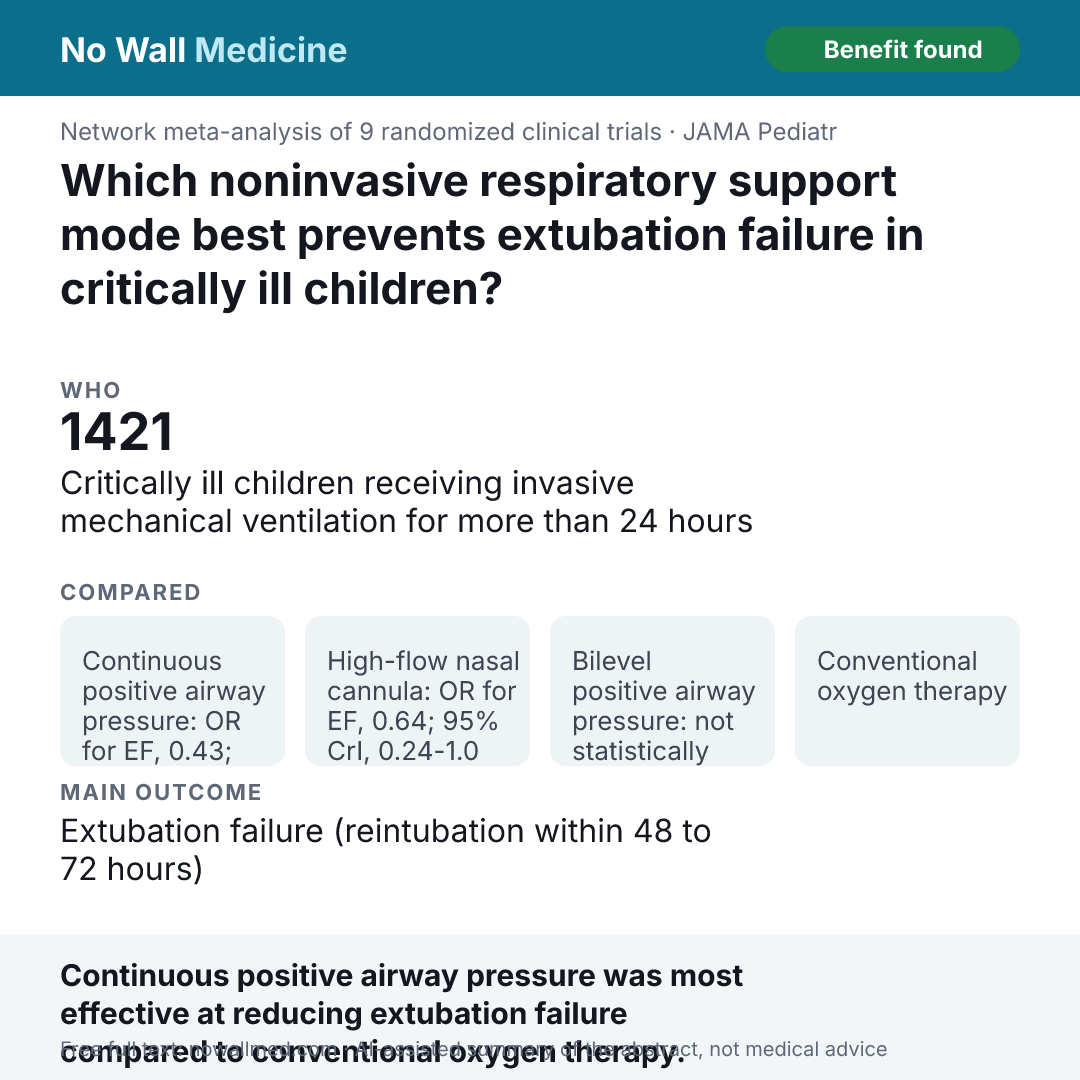
Which noninvasive respiratory support mode best prevents extubation failure in critically ill children?
Who
1421
Critically ill children receiving invasive mechanical ventilation for more than 24 hours
Compared
Continuous positive airway pressure: OR for EF, 0.43; 95% CrI, 0.17-1.0
High-flow nasal cannula: OR for EF, 0.64; 95% CrI, 0.24-1.0
Bilevel positive airway pressure: not statistically significant
Conventional oxygen therapy
Main outcome
Extubation failure (reintubation within 48 to 72 hours)
Result: CPAP: OR for EF, 0.43; 95% CrI, 0.17-1.0
Bottom line: Continuous positive airway pressure was most effective at reducing extubation failure compared to conventional oxygen therapy.
JAMA Pediatr · 2023-06-05
Headline and visual abstract written with AI from the paper’s abstract, with every number checked against it. Read the paper before relying on them.
Was this summary helpful?
Abstract
Importance
Extubation failure (EF) has been associated with worse outcomes in critically ill children. The relative efficacy of different modes of noninvasive respiratory support (NRS) to prevent EF is unknown.Objective
To study the reported relative efficacy of different modes of NRS (high-flow nasal cannula [HFNC], continuous positive airway pressure [CPAP], and bilevel positive airway pressure [BiPAP]) compared to conventional oxygen therapy (COT).Data sources
MEDLINE, Embase, and CINAHL Complete through May 2022.Study selection
Randomized clinical trials that enrolled critically ill children receiving invasive mechanical ventilation for more than 24 hours and compared the efficacy of different modes of postextubation NRS.Data extraction and synthesis
Random-effects models were fit using a bayesian network meta-analysis framework. Between-group comparisons were estimated using odds ratios (ORs) or mean differences with 95% credible intervals (CrIs). Treatment rankings were assessed by rank probabilities and the surface under the cumulative rank curve (SUCRA).Main outcomes and measures
The primary outcome was EF (reintubation within 48 to 72 hours). Secondary outcomes were treatment failure (TF, reintubation plus NRS escalation or crossover to another NRS mode), pediatric intensive care unit (PICU) mortality, PICU and hospital length of stay, abdominal distension, and nasal injury.Results
A total of 11 615 citations were screened, and 9 randomized clinical trials with a total of 1421 participants were included. Both CPAP and HFNC were found to be more effective than COT in reducing EF and TF (CPAP: OR for EF, 0.43; 95% CrI, 0.17-1.0 and OR for TF 0.27, 95% CrI 0.11-0.57 and HFNC: OR for EF, 0.64; 95% CrI, 0.24-1.0 and OR for TF, 0.34; 95% CrI, 0.16- 0.65). CPAP had the highest likelihood of being the best intervention for both EF (SUCRA, 0.83) and TF (SUCRA, 0.91). Although not statistically significant, BiPAP was likely to be better than COT for preventing both EF and TF. Compared to COT, CPAP and BiPAP were reported as showing a modest increase (approximately 3%) in nasal injury and abdominal distension.Conclusions and relevance
The studies included in this systematic review and network meta-analysis found that compared with COT, EF and TF rates were lower with modest increases in abdominal distension and nasal injury. Of the modes evaluated, CPAP was associated with the lowest rates of EF and TF.
Abstract reproduced under the article’s CC BY licence.
Subject terms
Cite this article
Iyer NP, Rotta AT, Essouri S, et al. Association of Extubation Failure Rates With High-Flow Nasal Cannula, Continuous Positive Airway Pressure, and Bilevel Positive Airway Pressure vs Conventional Oxygen Therapy in Infants and Young Children: A Systematic Review and Network Meta-Analysis. JAMA Pediatr. 2023;177(8):774-781. doi:10.1001/jamapediatrics.2023.1478
Spotted a mistake? Suggest a correction