Seven glucagon-like peptide 1 medications show different levels of weight loss and side effect risks
Association of Glucagon-like Peptide 1 Analogs and Agonists Administered for Obesity with Weight Loss and Adverse Events: A Systematic Review and Network Meta-analysis
Systematic review and network meta-analysisBenefit found
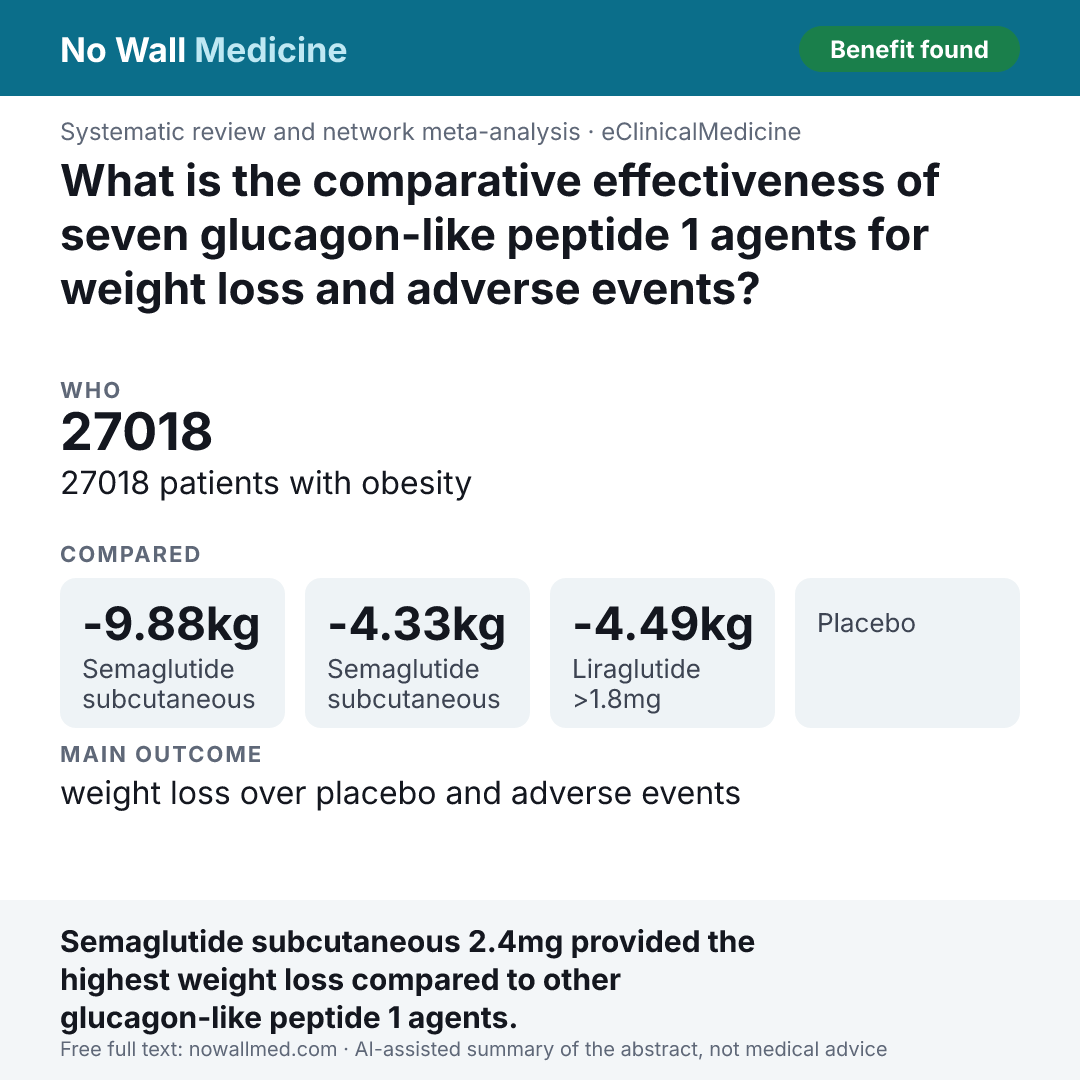
What is the comparative effectiveness of seven glucagon-like peptide 1 agents for weight loss and adverse events?
Who
27018
27018 patients with obesity
Compared
-9.88kgSemaglutide subcutaneous 2.4mg (95% CI -13.17 to -6.59)
-4.33kgSemaglutide subcutaneous <2.4mg (95% CI -5.71 to -3.00)
-4.49kgLiraglutide >1.8mg (95% CI -5.26 to -3.72)
Placebo
Main outcome
weight loss over placebo and adverse events
Bottom line: Semaglutide subcutaneous 2.4mg provided the highest weight loss compared to other glucagon-like peptide 1 agents.
Limitation: Risk of bias was high or unclear for random sequence generation, allocation concealment, and incomplete outcome data.
eClinicalMedicine · 2021-11-27 · Save PNG
Clinical question: What is the comparative effectiveness of seven glucagon-like peptide 1 agents for weight loss and adverse events?
Key points
- Researchers analyzed 64 randomized clinical trials involving 27018 patients with a median age of 55.1 years to compare seven glucagon-like peptide 1 agents.
- Semaglutide subcutaneous 2.4mg showed the largest weight loss compared to placebo at -9.88kg, while taspoglutide and liraglutide >1.8mg had the highest rankings for discontinuation due to adverse events.
- The analysis included various doses of liraglutide, exenatide, and semaglutide to determine how weight loss and side effects varied across different medications.
Limitation the authors note: Risk of bias was high or unclear for random sequence generation (29.7%), allocation concealment (26.6%), and incomplete outcome data (26.6%).
Headline and key points written with AI from the paper’s abstract, with every number checked against it. Read the paper before relying on them.
Was this summary helpful?
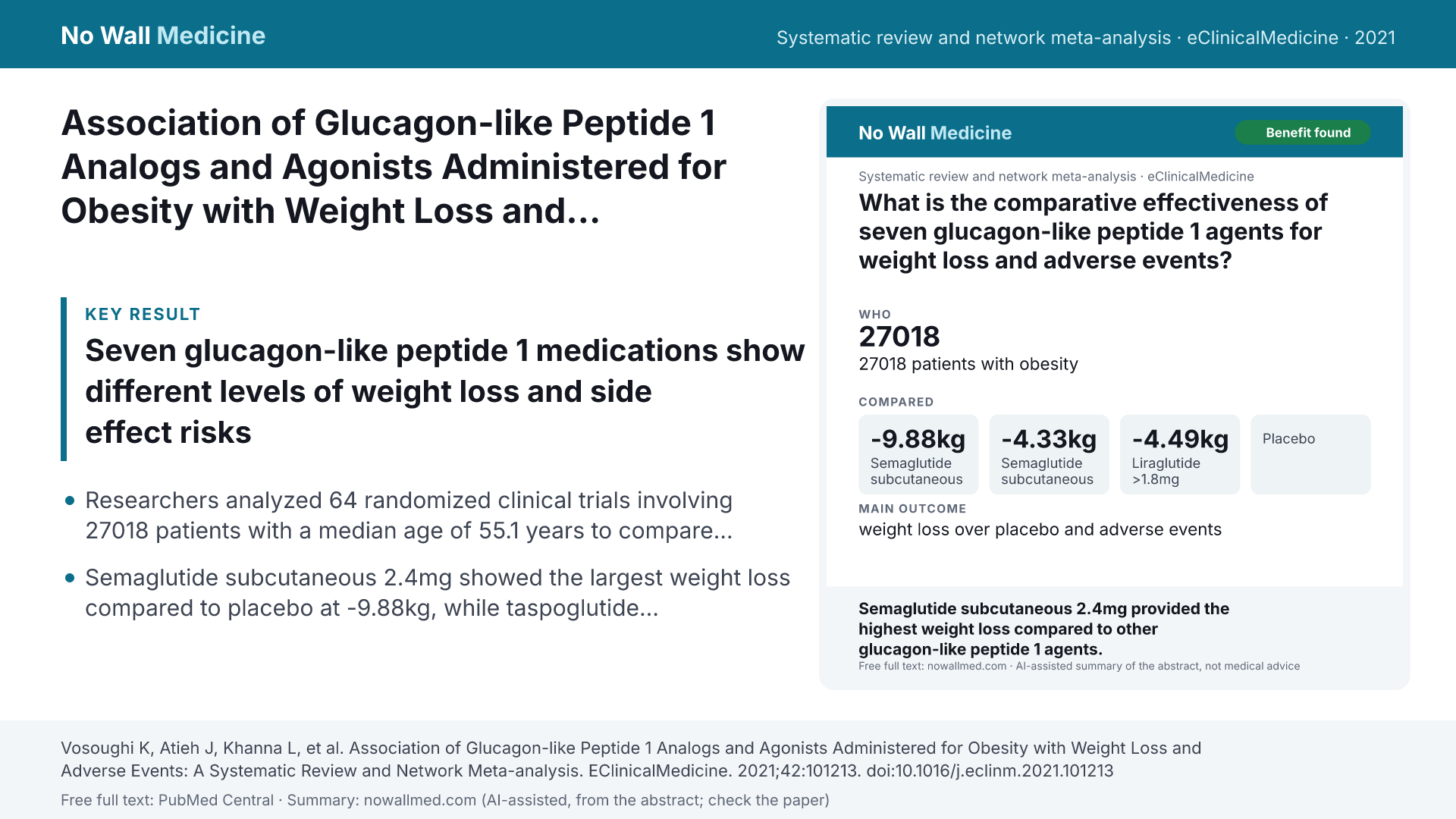
Headline, design, result, key points, caveat and citation as plain text.
Cite this article
Vosoughi K, Atieh J, Khanna L, et al. Association of Glucagon-like Peptide 1 Analogs and Agonists Administered for Obesity with Weight Loss and Adverse Events: A Systematic Review and Network Meta-analysis. EClinicalMedicine. 2021;42:101213. doi:10.1016/j.eclinm.2021.101213
Spotted a mistake? Suggest a correction