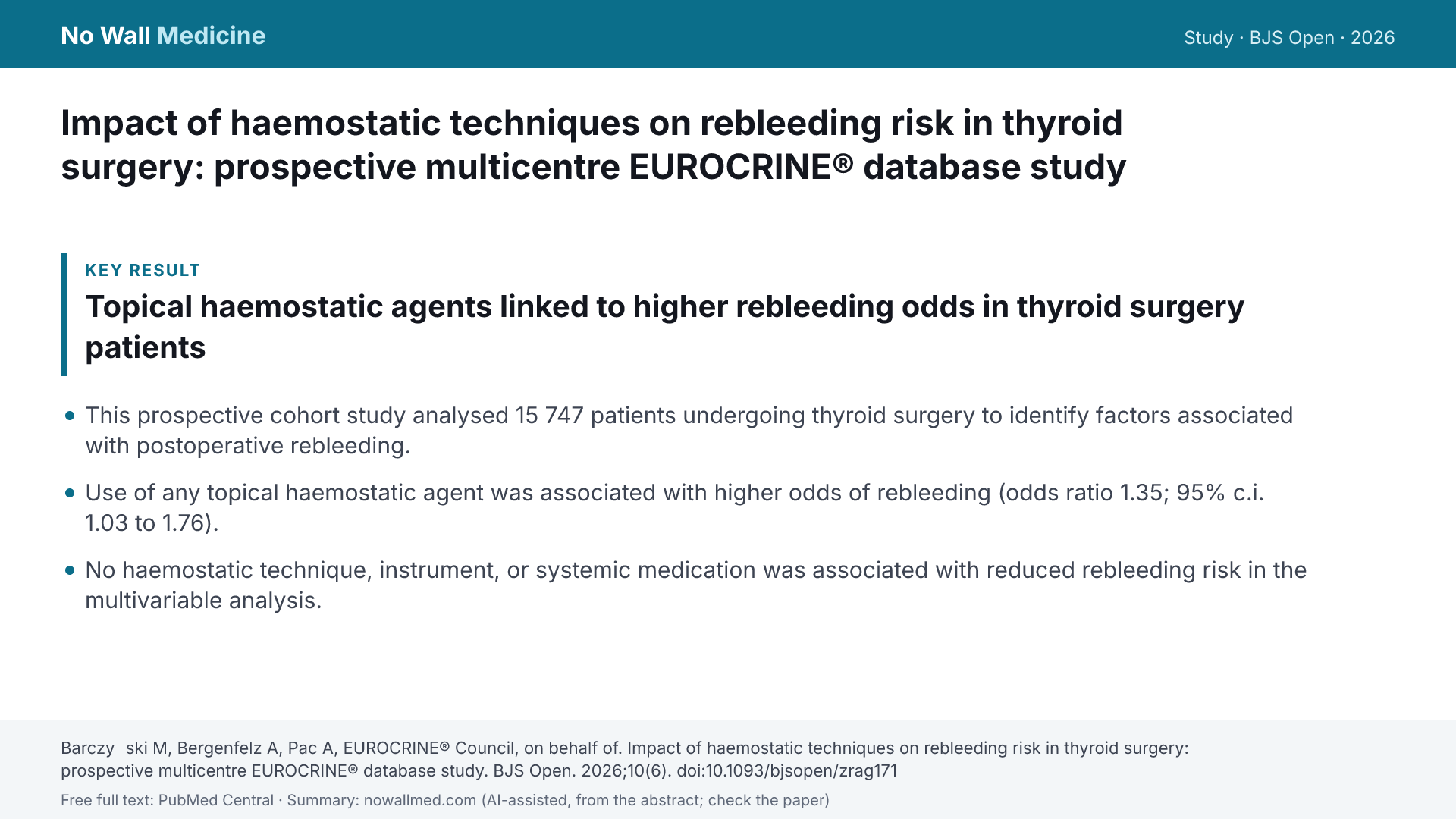
Topical haemostatic agents linked to higher rebleeding odds in thyroid surgery patients
Impact of haemostatic techniques on rebleeding risk in thyroid surgery: prospective multicentre EUROCRINE® database study
Why it matters: Applies to patients undergoing thyroid surgery; suggests rebleeding risk is driven by patient and procedural factors rather than adjunctive haemostatic measures.
Key points
- This prospective cohort study analysed 15 747 patients undergoing thyroid surgery to identify factors associated with postoperative rebleeding.
- Use of any topical haemostatic agent was associated with higher odds of rebleeding (odds ratio 1.35; 95% c.i. 1.03 to 1.76).
- No haemostatic technique, instrument, or systemic medication was associated with reduced rebleeding risk in the multivariable analysis.
Study type: Observational study: it can show a link, but not prove that one thing causes another.
Headline and key points written with AI from the paper’s abstract, with every number checked against it. Read the paper before relying on them.
Was this summary helpful?
Subject terms
Headline, design, result, key points, caveat and citation as plain text.
Cite this article
Barczyński M, Bergenfelz A, Pac A, EUROCRINE® Council, on behalf of. Impact of haemostatic techniques on rebleeding risk in thyroid surgery: prospective multicentre EUROCRINE® database study. BJS Open. 2026;10(6). doi:10.1093/bjsopen/zrag171
Spotted a mistake? Suggest a correction