Impact of haemostatic techniques on rebleeding risk in thyroid surgery: prospective multicentre EUROCRINE® database study
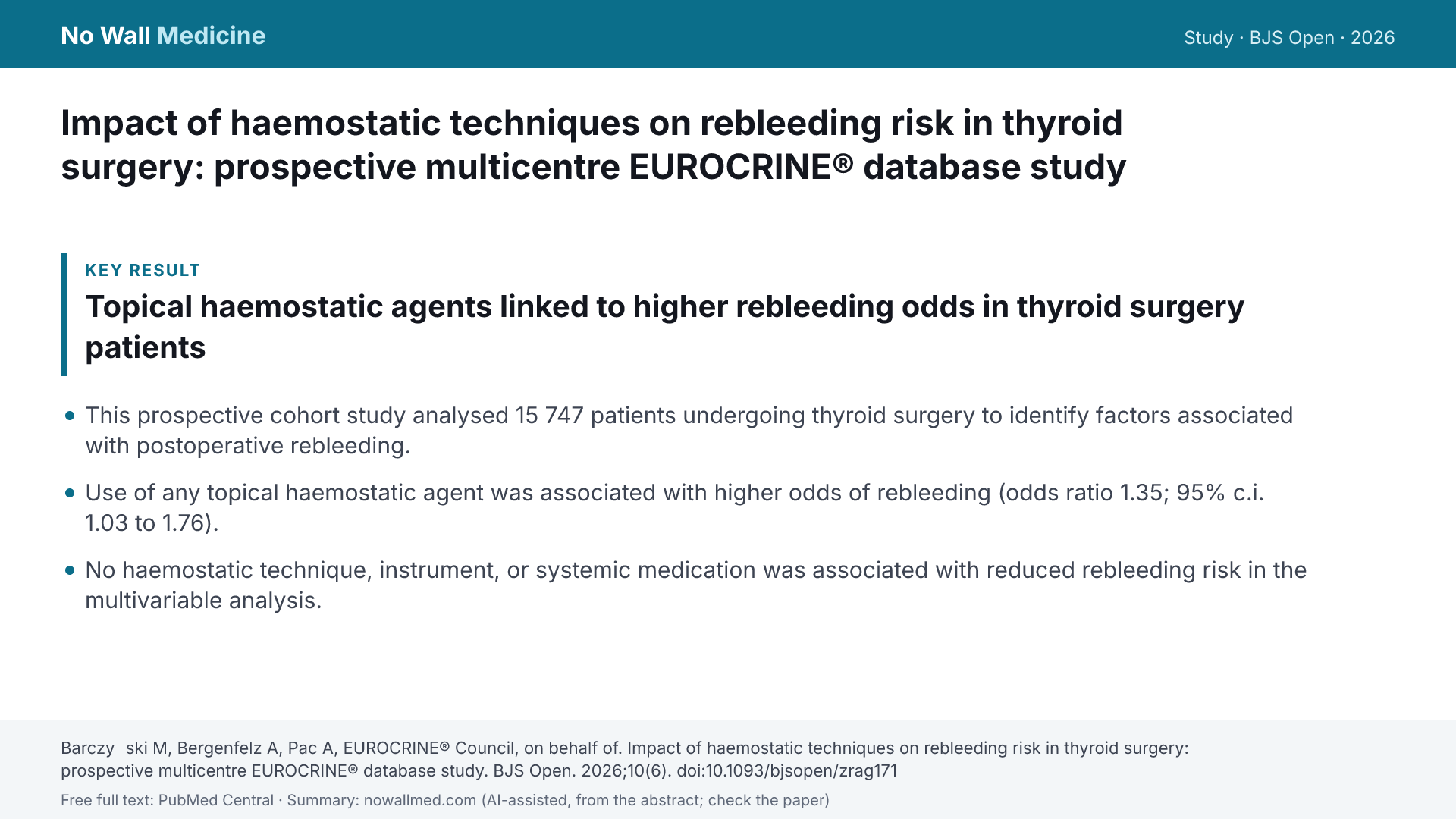
Key result: Topical haemostatic agents linked to higher rebleeding odds in thyroid surgery patients
Key points
- This prospective cohort study analysed 15 747 patients undergoing thyroid surgery to identify factors associated with postoperative rebleeding.
- Use of any topical haemostatic agent was associated with higher odds of rebleeding (odds ratio 1.35; 95% c.i. 1.03 to 1.76).
- No haemostatic technique, instrument, or systemic medication was associated with reduced rebleeding risk in the multivariable analysis.
Why it matters: Applies to patients undergoing thyroid surgery; suggests rebleeding risk is driven by patient and procedural factors rather than adjunctive haemostatic measures.
Discussion prompts
- Would these patients look like yours? Who was left out?
- Is the main outcome one that matters to patients?
- Is the difference large enough to change what you do?
Cite: Barczyński M, Bergenfelz A, Pac A, EUROCRINE® Council, on behalf of. Impact of haemostatic techniques on rebleeding risk in thyroid surgery: prospective multicentre EUROCRINE® database study. BJS Open. 2026;10(6). doi:10.1093/bjsopen/zrag171
Free full text: PubMed Central · Summary and visual abstract: nowallmed.com/a/impact-of-haemostatic-techniques-on-rebleeding-risk-in-thyroid-1c2zs81/ (AI-assisted from the abstract; check the paper before relying on it).