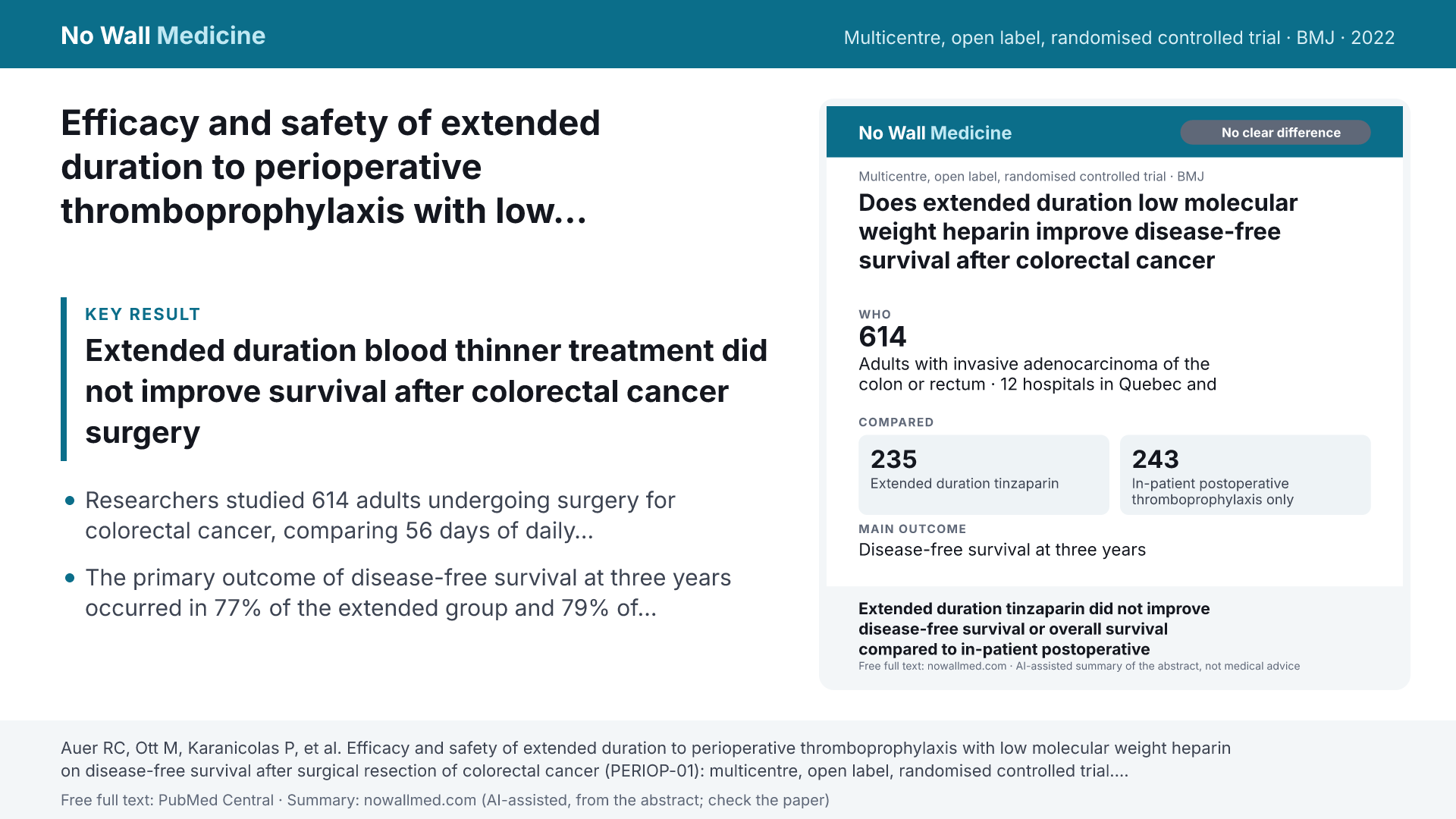
Extended duration blood thinner treatment did not improve survival after colorectal cancer surgery
Efficacy and safety of extended duration to perioperative thromboprophylaxis with low molecular weight heparin on disease-free survival after surgical resection of colorectal cancer (PERIOP-01): multicentre, open label, randomised controlled trial
Multicentre, open label, randomised controlled trialNo clear difference
Does extended duration low molecular weight heparin improve disease-free survival after colorectal cancer resection?
Who
614
Adults with invasive adenocarcinoma of the colon or rectum · 12 hospitals in Quebec and Ontario, Canada
Compared
235Extended duration tinzaparin (77%)
243In-patient postoperative thromboprophylaxis only (79%)
Main outcome
Disease-free survival at three years
Result: hazard ratio 1.1 (95% confidence interval 0.90 to 1.33)
Bottom line: Extended duration tinzaparin did not improve disease-free survival or overall survival compared to in-patient postoperative thromboprophylaxis alone.
BMJ · 2022-09-13 · Save PNG
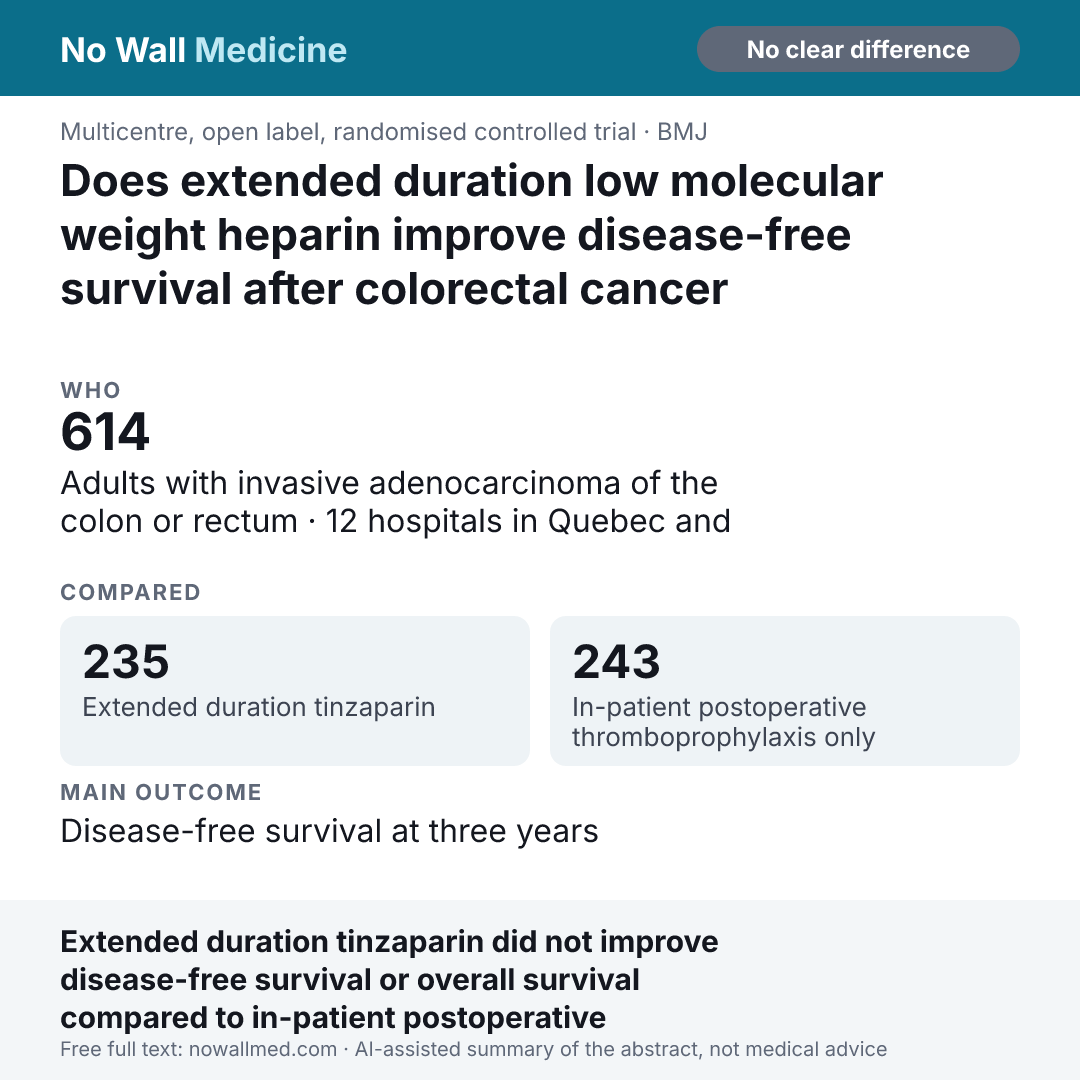
Clinical question: Does extended duration low molecular weight heparin improve disease-free survival after colorectal cancer resection?
Key points
- Researchers studied 614 adults undergoing surgery for colorectal cancer, comparing 56 days of daily subcutaneous tinzaparin to standard in-hospital blood thinner treatment.
- The primary outcome of disease-free survival at three years occurred in 77% of the extended group and 79% of the in-hospital group (P=0.4).
- No significant difference was found for five-year overall survival, postoperative venous thromboembolism, or major bleeding complications between the two groups.
Headline and key points written with AI from the paper’s abstract, with every number checked against it. Read the paper before relying on them.
Was this summary helpful?
Abstract
Objective
To determine the efficacy and safety of extended duration perioperative thromboprophylaxis by low molecular weight heparin when assessing disease-free survival in patients undergoing resection for colorectal cancer. Design
Multicentre, open label, randomised controlled trial. Settings
12 hospitals in Quebec and Ontario, Canada, between 25 October 2011 and 31 December 2020. Participants
614 adults (age ≥18 years) were eligible with pathologically confirmed invasive adenocarcinoma of the colon or rectum, no evidence of metastatic disease, a haemoglobin concentration of ≥8 g/dL, and were scheduled to undergo surgical resection. Interventions
Random assignment to extended duration thromboprophylaxis using daily subcutaneous tinzaparin at 4500 IU, beginning at decision to operate and continuing for 56 days postoperatively, compared with in-patient postoperative thromboprophylaxis only. Main outcome measures
Primary outcome was disease-free survival at three years, defined as survival without locoregional recurrence, distant metastases, second primary (same cancer), second primary (other cancer), or death. Secondary outcomes included venous thromboembolism, postoperative major bleeding complications, and five year overall survival. Analyses were done in the intention-to-treat population. Results
The trial stopped recruitment prematurely after the interim analysis for futility. The primary outcome occurred in 235 (77%) of 307 patients in the extended duration group and in 243 (79%) of 307 patients in the in-hospital thromboprophylaxis group (hazard ratio 1.1, 95% confidence interval 0.90 to 1.33; P=0.4). Postoperative venous thromboembolism occurred in five patients (2%) in the extended duration group and in four patients (1%) in the in-hospital thromboprophylaxis group (P=0.8). Major surgery related bleeding in the first postoperative week was reported in one person (<1%) in the extended duration and in six people (2%) in the in-hospital thromboprophylaxis group (P=0.1). No difference was noted for overall survival at five years in 272 (89%) patients in the extended duration group and 280 (91%) patients in the in-hospital thromboprophylaxis group (hazard ratio 1.12; 95% confidence interval 0.72 to 1.76; P=0.1). Conclusions
Extended duration to perioperative anticoagulation with tinzaparin did not improve disease-free survival or overall survival in patients with colorectal cancer undergoing surgical resection compared with in-patient postoperative thromboprophylaxis alone. The incidences of venous thromboembolism and postoperative major bleeding were low and similar between groups. Trial registration
ClinicalTrials.gov NCT01455831.
Abstract reproduced under the article’s CC BY NC licence.
Subject terms
Headline, design, result, key points, caveat and citation as plain text.
Cite this article
Auer RC, Ott M, Karanicolas P, et al. Efficacy and safety of extended duration to perioperative thromboprophylaxis with low molecular weight heparin on disease-free survival after surgical resection of colorectal cancer (PERIOP-01): multicentre, open label, randomised controlled trial. BMJ. 2022;378:e071375. doi:10.1136/bmj-2022-071375
Spotted a mistake? Suggest a correction