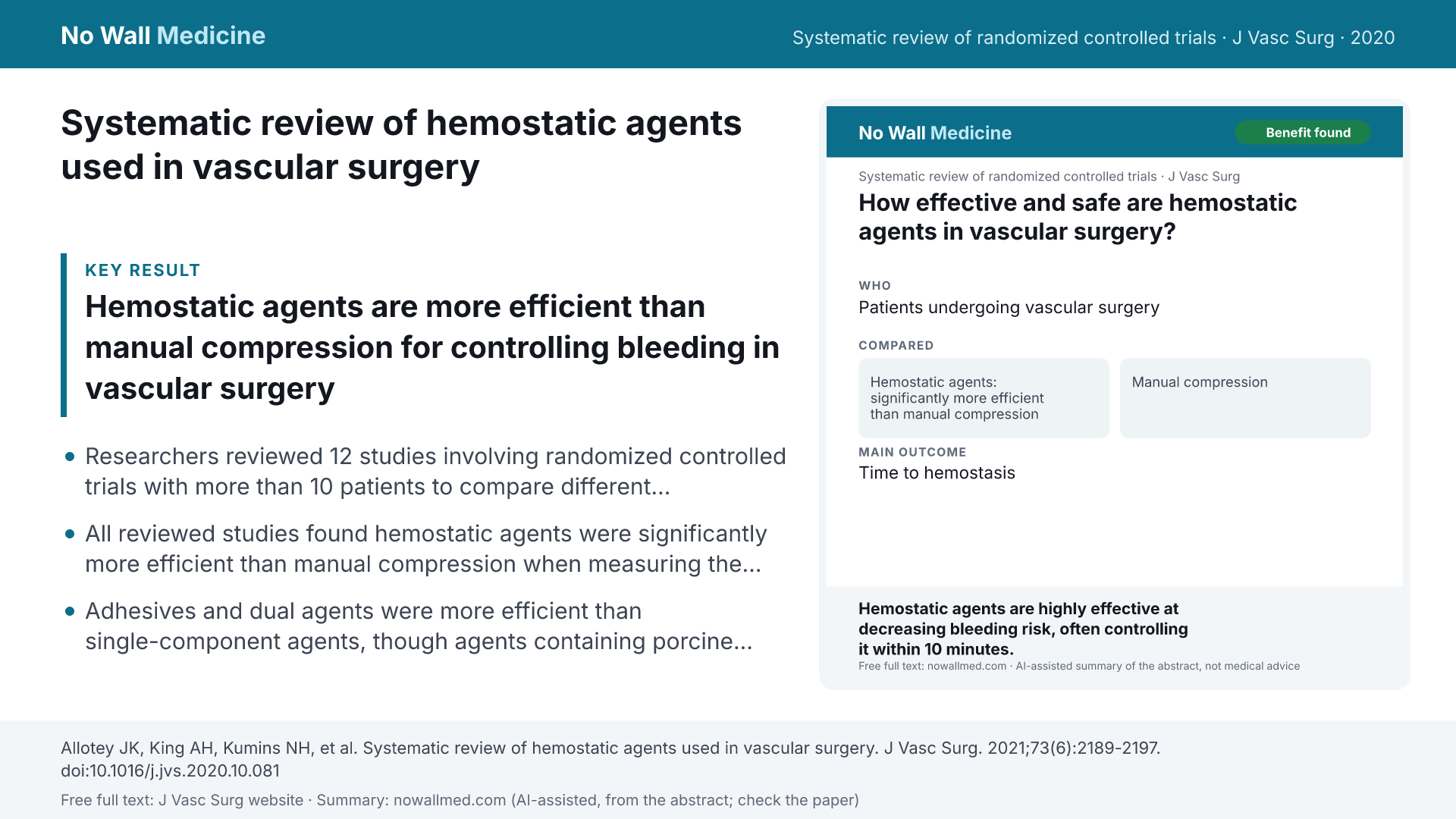
Hemostatic agents are more efficient than manual compression for controlling bleeding in vascular surgery
Systematic review of hemostatic agents used in vascular surgery
Systematic review of randomized controlled trialsBenefit found
How effective and safe are hemostatic agents in vascular surgery?
Who
Patients undergoing vascular surgery
Compared
Hemostatic agents: significantly more efficient than manual compression
Manual compression
Main outcome
Time to hemostasis
Bottom line: Hemostatic agents are highly effective at decreasing bleeding risk, often controlling it within 10 minutes.
Limitation: A relative lack of comparative research studies.
J Vasc Surg · 2020-11-27 · Save PNG
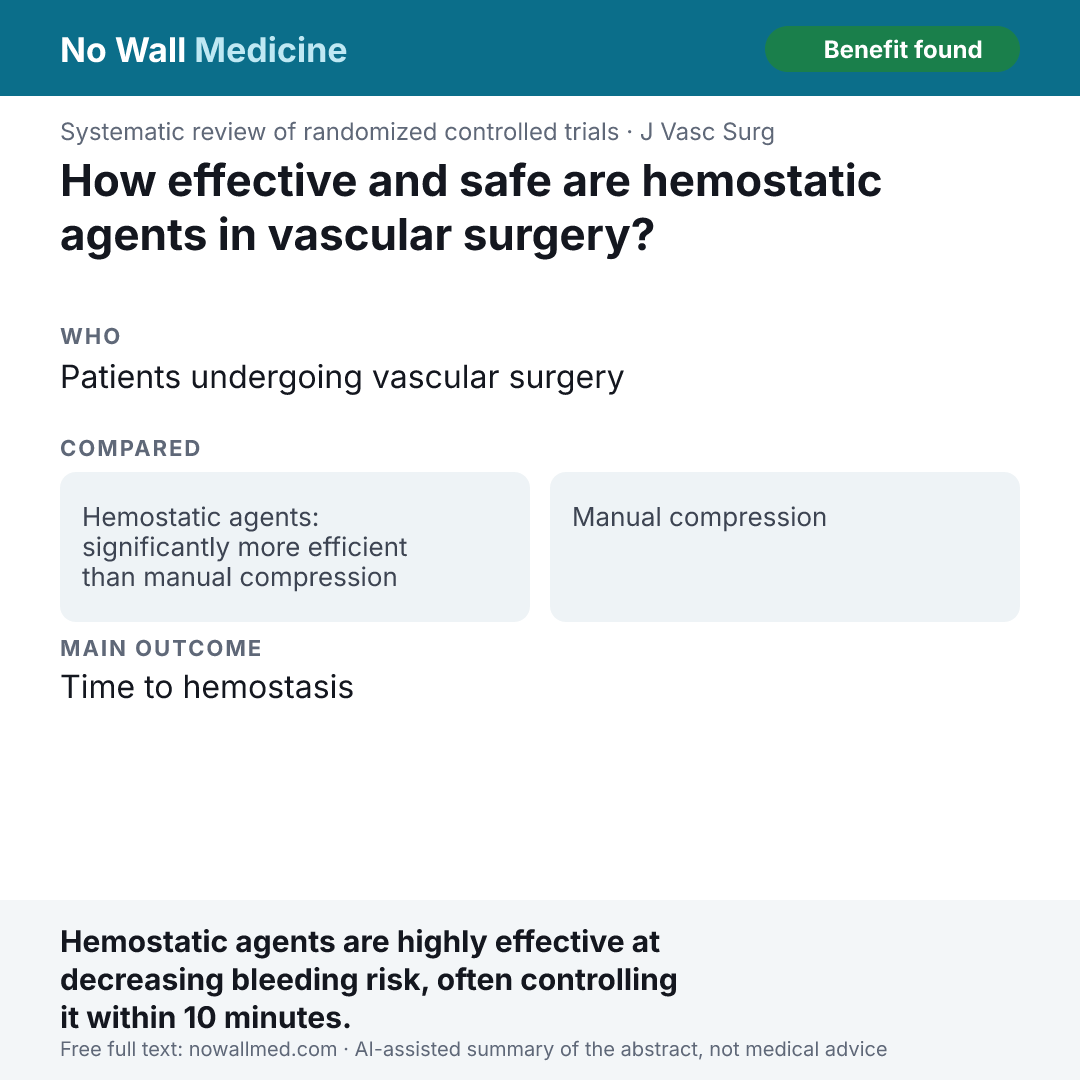
Clinical question: How effective and safe are hemostatic agents in vascular surgery?
Why it matters: A lack of comparative research studies has left vascular surgeons choosing bleeding control products based on personal experience.
Key points
- Researchers reviewed 12 studies involving randomized controlled trials with more than 10 patients to compare different bleeding control products.
- All reviewed studies found hemostatic agents were significantly more efficient than manual compression when measuring the time to stop bleeding.
- Adhesives and dual agents were more efficient than single-component agents, though agents containing porcine or bovine parts were linked to rare anaphylactic reactions.
Headline and key points written with AI from the paper’s abstract, with every number checked against it. Read the paper before relying on them.
Was this summary helpful?
Subject terms
Headline, design, result, key points, caveat and citation as plain text.
Cite this article
Allotey JK, King AH, Kumins NH, et al. Systematic review of hemostatic agents used in vascular surgery. J Vasc Surg. 2021;73(6):2189-2197. doi:10.1016/j.jvs.2020.10.081
Spotted a mistake? Suggest a correction