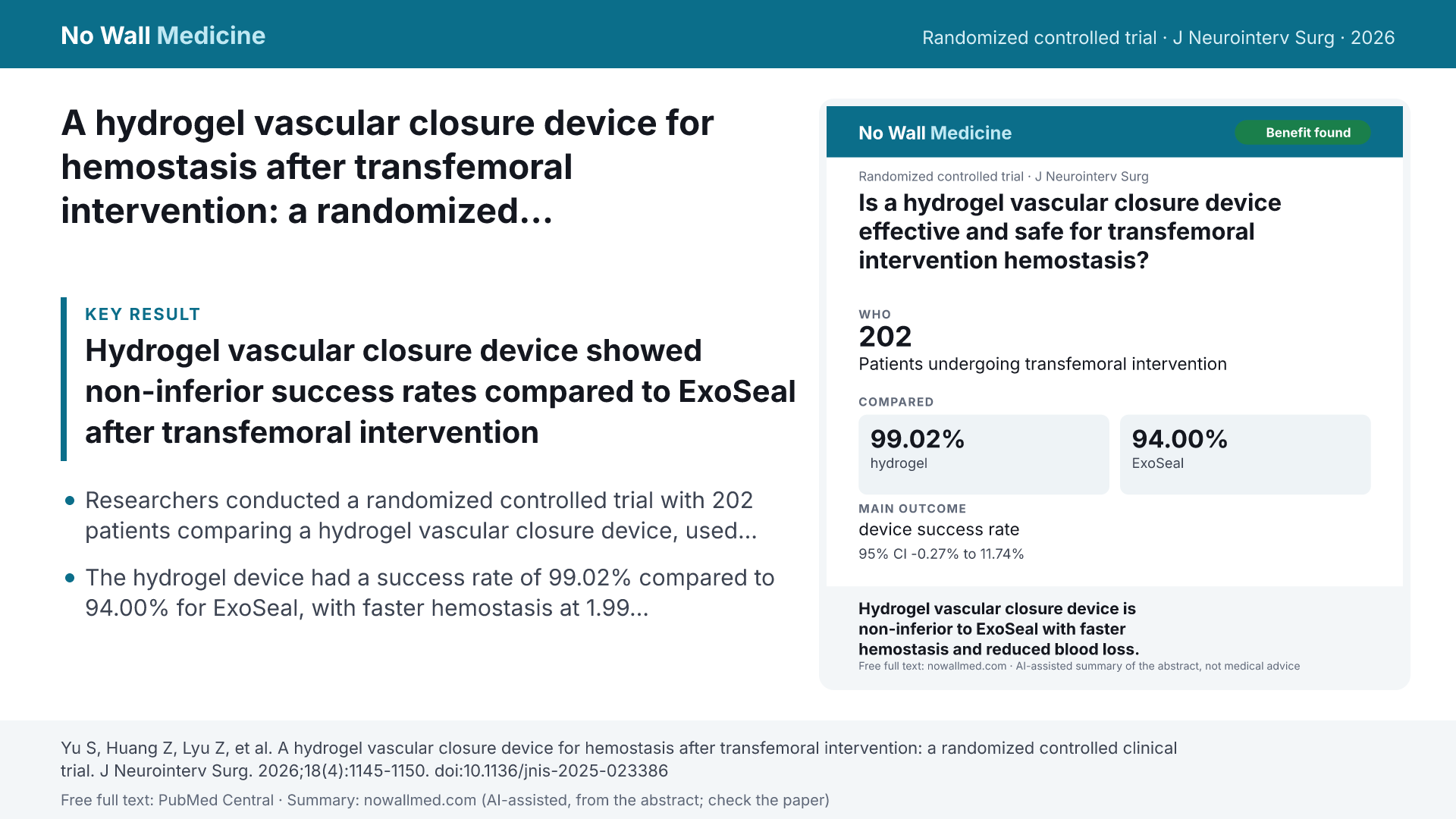
Hydrogel vascular closure device showed non-inferior success rates compared to ExoSeal after transfemoral intervention
A hydrogel vascular closure device for hemostasis after transfemoral intervention: a randomized controlled clinical trial
Randomized controlled trialBenefit found
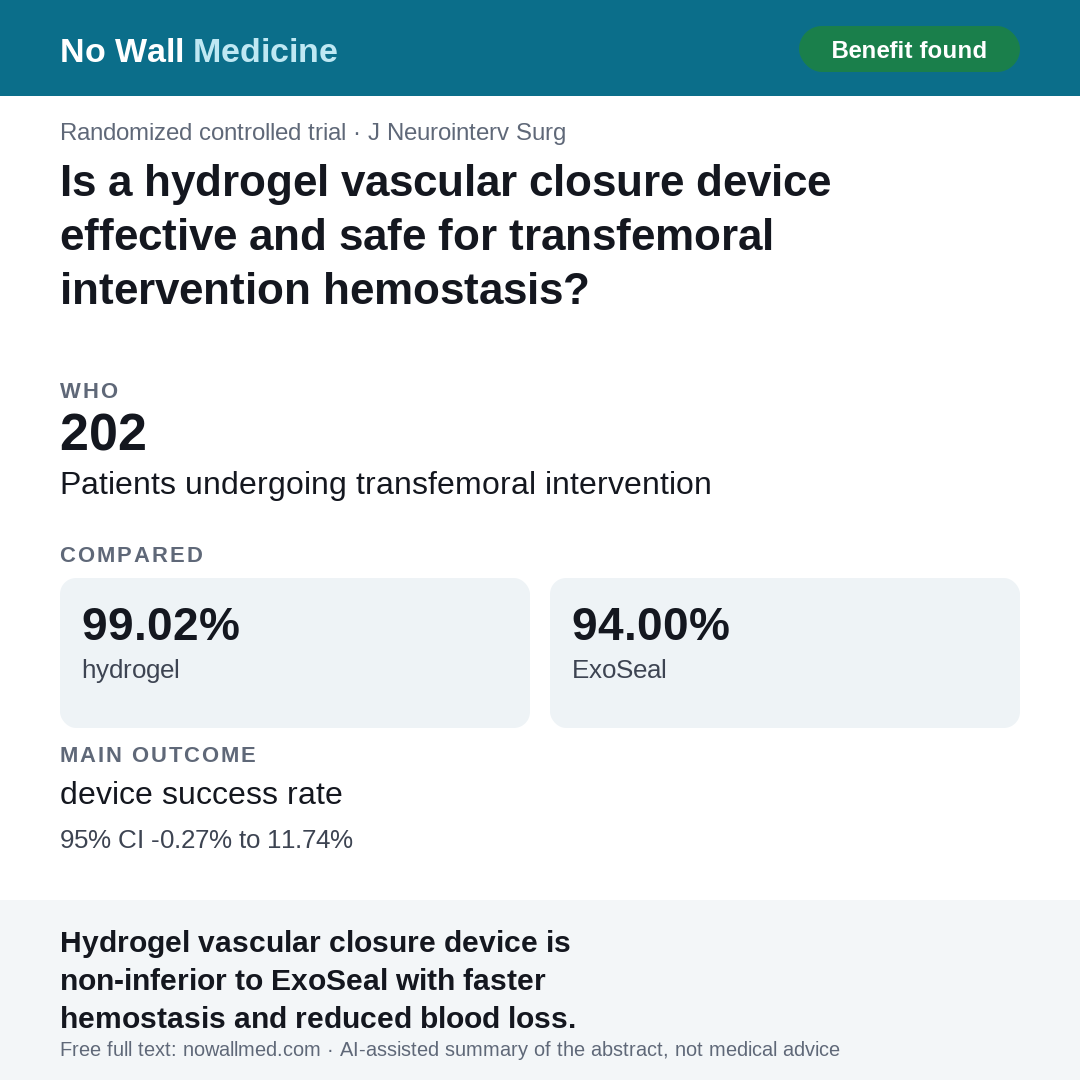
Is a hydrogel vascular closure device effective and safe for transfemoral intervention hemostasis?
Who
202
Patients undergoing transfemoral intervention
Compared
99.02%hydrogel
94.00%ExoSeal
Main outcome
device success rate
Result: 95% CI -0.27% to 11.74%
Bottom line: Hydrogel vascular closure device is non-inferior to ExoSeal with faster hemostasis and reduced blood loss.
J Neurointerv Surg · 2026-03-13Download image
Clinical question: Is a hydrogel vascular closure device effective and safe for transfemoral intervention hemostasis?
Why it matters: The efficacy and safety of a hydrogel vascular closure device for stopping bleeding after transfemoral interventions needed validation.
Key points
- Researchers conducted a randomized controlled trial with 202 patients comparing a hydrogel vascular closure device, used to stop bleeding, to the ExoSeal device.
- The hydrogel device had a success rate of 99.02% compared to 94.00% for ExoSeal, with faster hemostasis at 1.99 minutes versus 3.14 minutes.
- Blood loss was 0.83 mL in the hydrogel group compared to 8.93 mL in the ExoSeal group, and no major access site complications occurred in either group.
Headline and key points written with AI from the paper’s abstract, with every number checked against it. Read the paper before relying on them.
Was this summary helpful?
Abstract
Background
In this randomized controlled trial we aim to validate the efficacy and safety of a hydrogel vascular closure device (VCD) for hemostasis after transfemoral intervention. Methods
Between January and August 2023, 212 patients were enrolled, including 202 in a non-inferiority randomized controlled trial (1:1 hydrogel vs ExoSeal; prespecified margin -10%) and 10 in a hydrogel-only observational arm (8 F). The primary endpoint was device success rate and secondary endpoints including hemostasis time and procedural blood loss. Results
Among 102 hydrogel and 100 ExoSeal recipients, hydrogel had non-inferior success rates (99.02% vs 94.00%; 95% CI -0.27% to 11.74%). Hydrogel achieved significantly faster hemostasis (1.99 vs 3.14 min, P<0.001) and reduced blood loss (0.83 mL vs 8.93 mL, P<0.001). No major access site complications were observed in either group. No secondary complications occurred in patients in the experimental group and secondary complications occurred in one patient in the control group (P=0.497). The supplementary cohort of 10 patients supported the efficacy and safety of hydrogel VCD. Conclusions
Hydrogel VCD shows non-inferior efficacy to ExoSeal for transfemoral cerebrovascular interventions, with superior hemostatic speed and reduced blood loss while maintaining comparable safety. Trial registration number
ChiCTR2300068029 (https://www.chictr.org.cn/showproj.html?proj=178962).
Abstract reproduced under the article’s CC BY NC licence.
Subject terms
Cite this article
Yu S, Huang Z, Lyu Z, Li M, Ye B, Zeng G. A hydrogel vascular closure device for hemostasis after transfemoral intervention: a randomized controlled clinical trial. J Neurointerv Surg. 2026. doi:10.1136/jnis-2025-023386
Spotted a mistake? Suggest a correction