Measurable residual disease negativity is associated with better survival in patients with acute myeloid leukemia
Association of hematologic response and assay sensitivity on the prognostic impact of measurable residual disease in acute myeloid leukemia: a systematic review and meta-analysis
Systematic review and meta-analysis of 48 studiesBenefit found
Does measurable residual disease impact survival in acute myeloid leukemia?
Who
Patients with acute myeloid leukemia
Compared
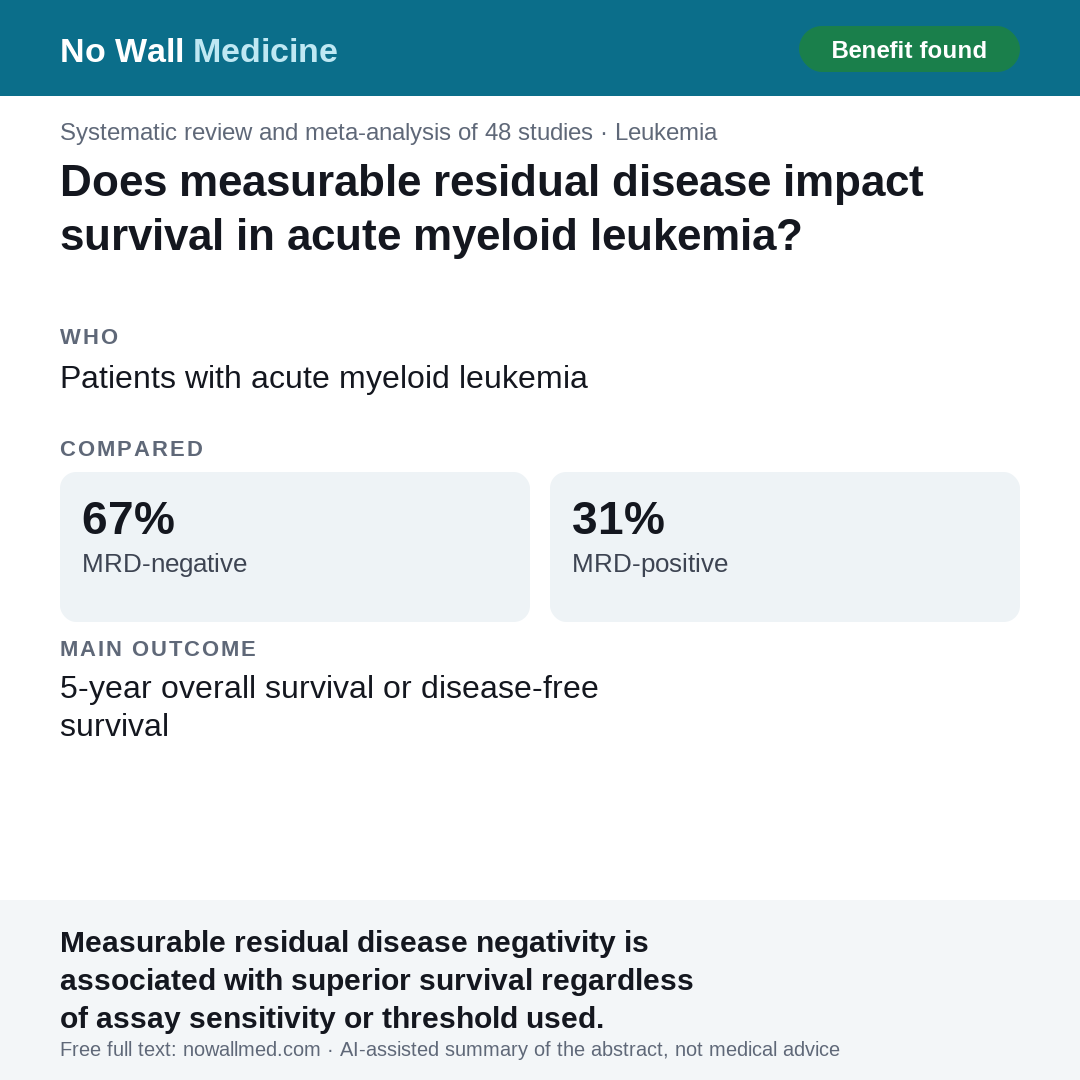
67%MRD-negative (95% Bayesian credible interval, 53-77%)
31%MRD-positive (95% credible interval, 18-44%)
Main outcome
5-year overall survival or disease-free survival
Bottom line: Measurable residual disease negativity is associated with superior survival regardless of assay sensitivity or threshold used.
Leukemia · 2022-10-19Download image
Clinical question: Does measurable residual disease impact survival in acute myeloid leukemia?
Why it matters: It was unknown how the impact of measurable residual disease on survival changes based on different testing sensitivities, thresholds, or the patient's hematologic response.
Key points
- Researchers analyzed 48 studies to examine how measurable residual disease, or the presence of remaining cancer cells, relates to survival in acute myeloid leukemia patients.
- In patients in complete remission, the estimated 5-year overall survival was 67% for those who were measurable residual disease negative and 31% for those who were positive.
- Achieving a negative measurable residual disease status was associated with better disease-free survival and overall survival regardless of the testing sensitivity or the specific threshold used.
Headline and key points written with AI from the paper’s abstract, with every number checked against it. Read the paper before relying on them.
Was this summary helpful?
Subject terms
Cite this article
Short NJ, Fu C, Berry DA, Walter RB, Freeman SD, Hourigan CS. Association of hematologic response and assay sensitivity on the prognostic impact of measurable residual disease in acute myeloid leukemia: a systematic review and meta-analysis. Leukemia. 2022. doi:10.1038/s41375-022-01692-0
Spotted a mistake? Suggest a correction
Top studies every Monday
The week’s key trials and guidelines in your specialties, plus any topics you follow. By email, free.
Get the weekly digest