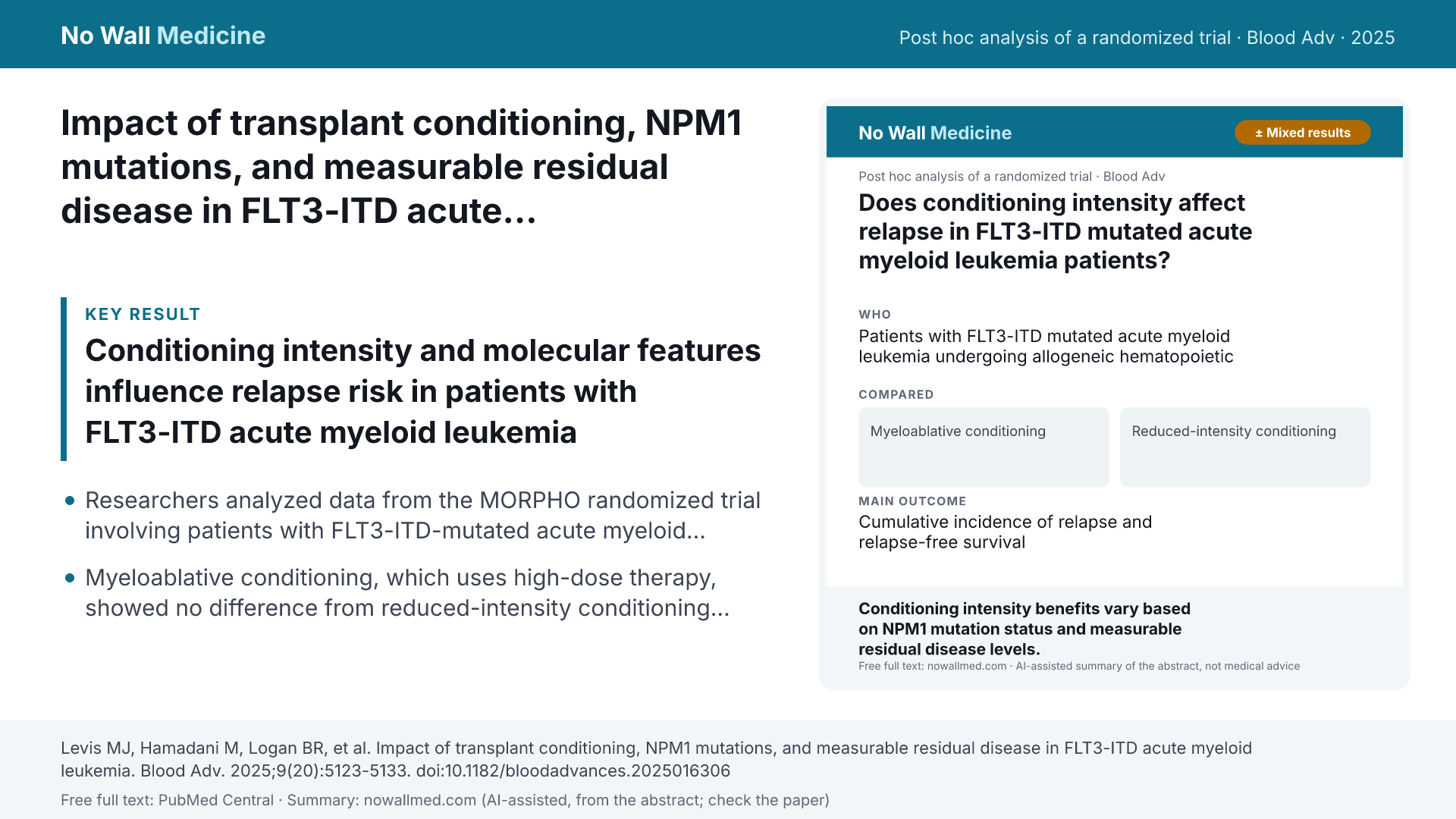
Conditioning intensity and molecular features influence relapse risk in patients with FLT3-ITD acute myeloid leukemia
Impact of transplant conditioning, NPM1 mutations, and measurable residual disease in FLT3-ITD acute myeloid leukemia
Post hoc analysis of a randomized trialMixed results
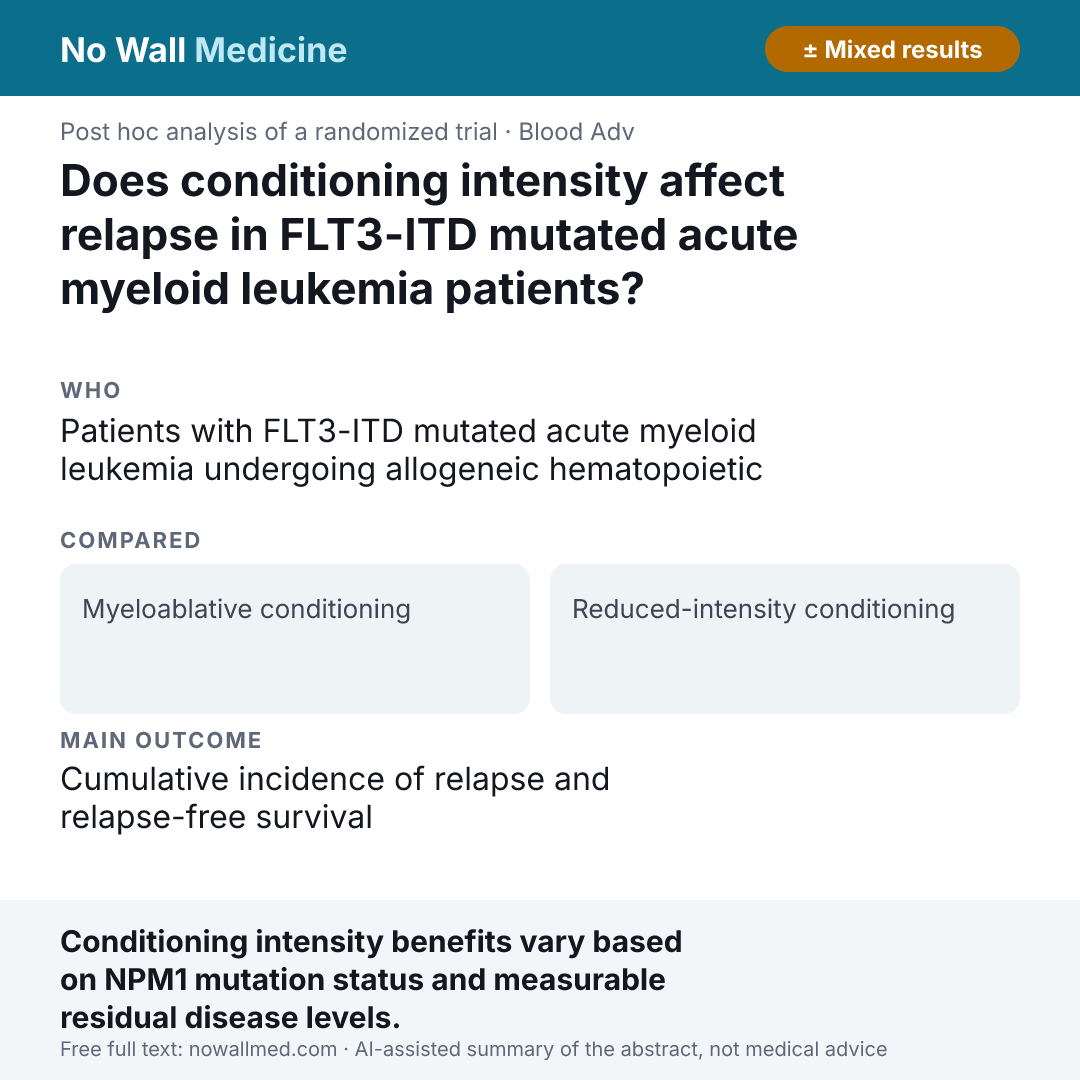
Does conditioning intensity affect relapse in FLT3-ITD mutated acute myeloid leukemia patients?
Who
Patients with FLT3-ITD mutated acute myeloid leukemia undergoing allogeneic hematopoietic cell transplantation · Blood and Marrow Transplant Clinical Trials Network 1506
Compared
Myeloablative conditioning
Reduced-intensity conditioning
Main outcome
Cumulative incidence of relapse and relapse-free survival
Bottom line: Conditioning intensity benefits vary based on NPM1 mutation status and measurable residual disease levels.
Blood Adv · 2025-07-01 · Save PNG
Same trial (NCT02997202)
Papers we list that report this registered trial, oldest first. Read a secondary analysis alongside the main results.
- Related analysis
Gilteritinib maintenance improved relapse-free survival in AML patients with detectable MRD J Clin Oncol 2024-03 - Main results No clear difference
Gilteritinib showed no difference in quality of life compared to placebo after transplant Blood Adv 2024-08 - Secondary analysis Mixed results
Gilteritinib maintenance therapy was associated with better relapse-free survival in patients with detectable residual disease Blood 2025-01 - Secondary analysis Mixed results
This paper Blood Adv 2025-07 - Secondary analysis Mixed results
Regional practice differences influence the benefit of gilteritinib after stem cell transplant in leukemia patients Blood Adv 2026-07
Clinical question: Does conditioning intensity affect relapse in FLT3-ITD mutated acute myeloid leukemia patients?
Key points
- Researchers analyzed data from the MORPHO randomized trial involving patients with FLT3-ITD-mutated acute myeloid leukemia undergoing allogeneic hematopoietic cell transplantation.
- Myeloablative conditioning, which uses high-dose therapy, showed no difference from reduced-intensity conditioning in eradicating or reducing measurable residual disease before transplantation.
- For patients with NPM1 mutations, post-transplant gilteritinib was as effective with reduced-intensity conditioning as it was with myeloablative conditioning at preventing relapse.
Headline and key points written with AI from the paper’s abstract, with every number checked against it. Read the paper before relying on them.
Was this summary helpful?
Abstract
We conducted a post hoc analysis of data from Blood and Marrow Transplant Clinical Trials Network 1506 (MORPHO), a randomized trial of gilteritinib vs placebo as posttransplantation maintenance for patients with FLT3-ITD-mutated acute myeloid leukemia (AML) undergoing allogeneic hematopoietic cell transplantation (HCT), focusing the interactions between conditioning regimen intensity, measurable residual disease (MRD), and NPM1 comutation status reported from diagnosis. Comparing FLT3-ITD MRD before and after conditioning, there was no difference between myeloablative conditioning (MAC) and reduced-intensity conditioning (RIC) in eradication or reduction of FLT3-ITD MRD. For participants who were FLT3-ITD MRD negative before HCT, there was no difference in the cumulative incidence of relapse during follow-up between those receiving MAC vs RIC. NPM1 comutation was associated with the largest magnitude of relapse-free survival benefit from post-HCT gilteritinib, and in these participants, post-HCT gilteritinib in the setting of RIC appeared to be as effective as MAC at preventing relapse. MAC appeared superior to RIC in preventing relapse only in participants who were NPM1 wild type at diagnosis and FLT3-ITD MRD positive before HCT. Our findings suggest that only a subset of patients with FLT3-ITD AML undergoing HCT may benefit from MAC and that, similar to AML therapy before HCT, the intensity of the HCT regimen should be adapted according to the molecular features of the disease. This trial was registered at www.clinicaltrials.gov as #NCT02997202.
Abstract reproduced under the article’s CC BY NC ND licence.
Subject terms
Headline, design, result, key points, caveat and citation as plain text.
Cite this article
Levis MJ, Hamadani M, Logan BR, et al. Impact of transplant conditioning, NPM1 mutations, and measurable residual disease in FLT3-ITD acute myeloid leukemia. Blood Adv. 2025;9(20):5123-5133. doi:10.1182/bloodadvances.2025016306
Spotted a mistake? Suggest a correction