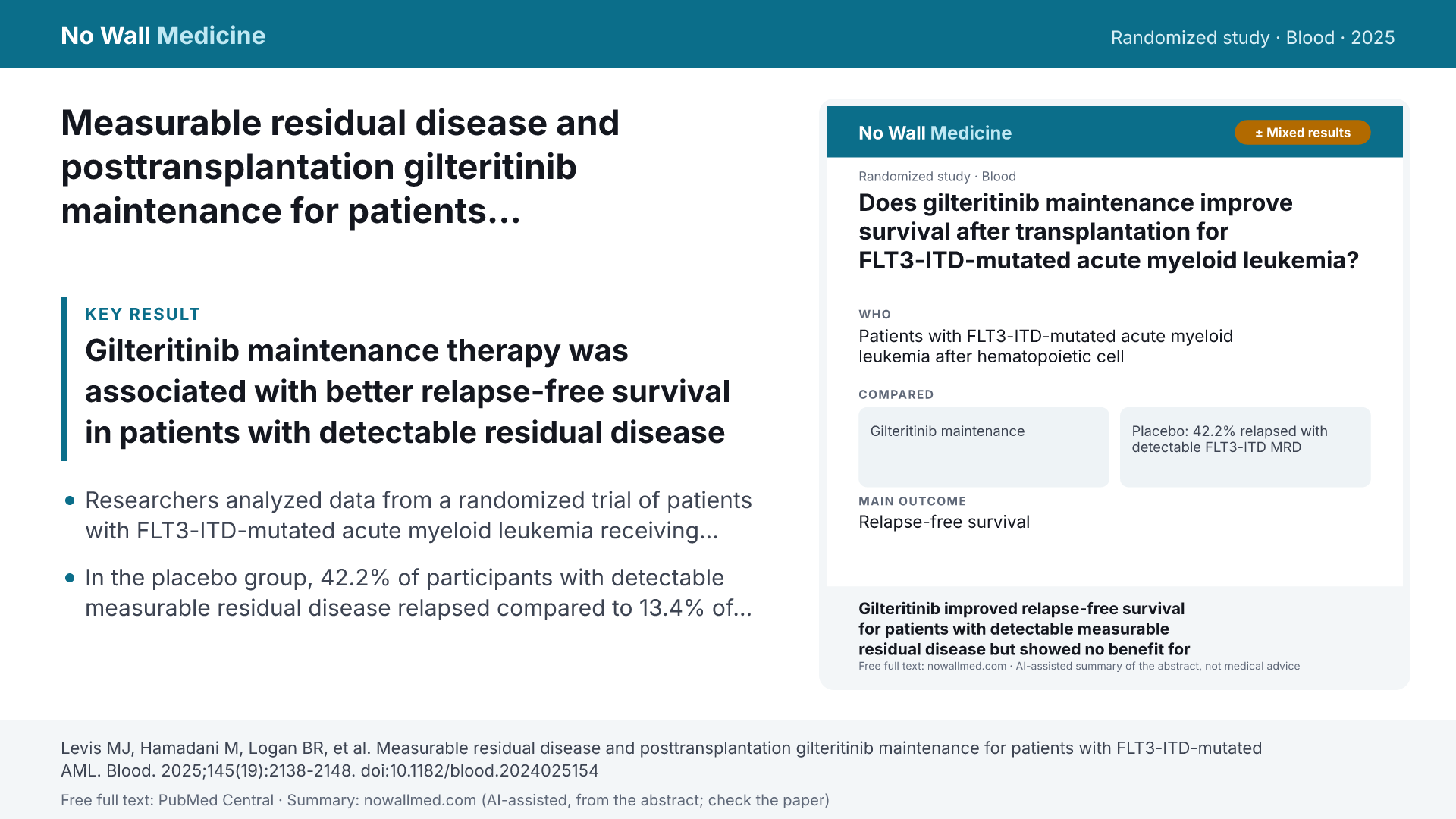
Gilteritinib maintenance therapy was associated with better relapse-free survival in patients with detectable residual disease
Measurable residual disease and posttransplantation gilteritinib maintenance for patients with FLT3-ITD-mutated AML
Randomized studyMixed results
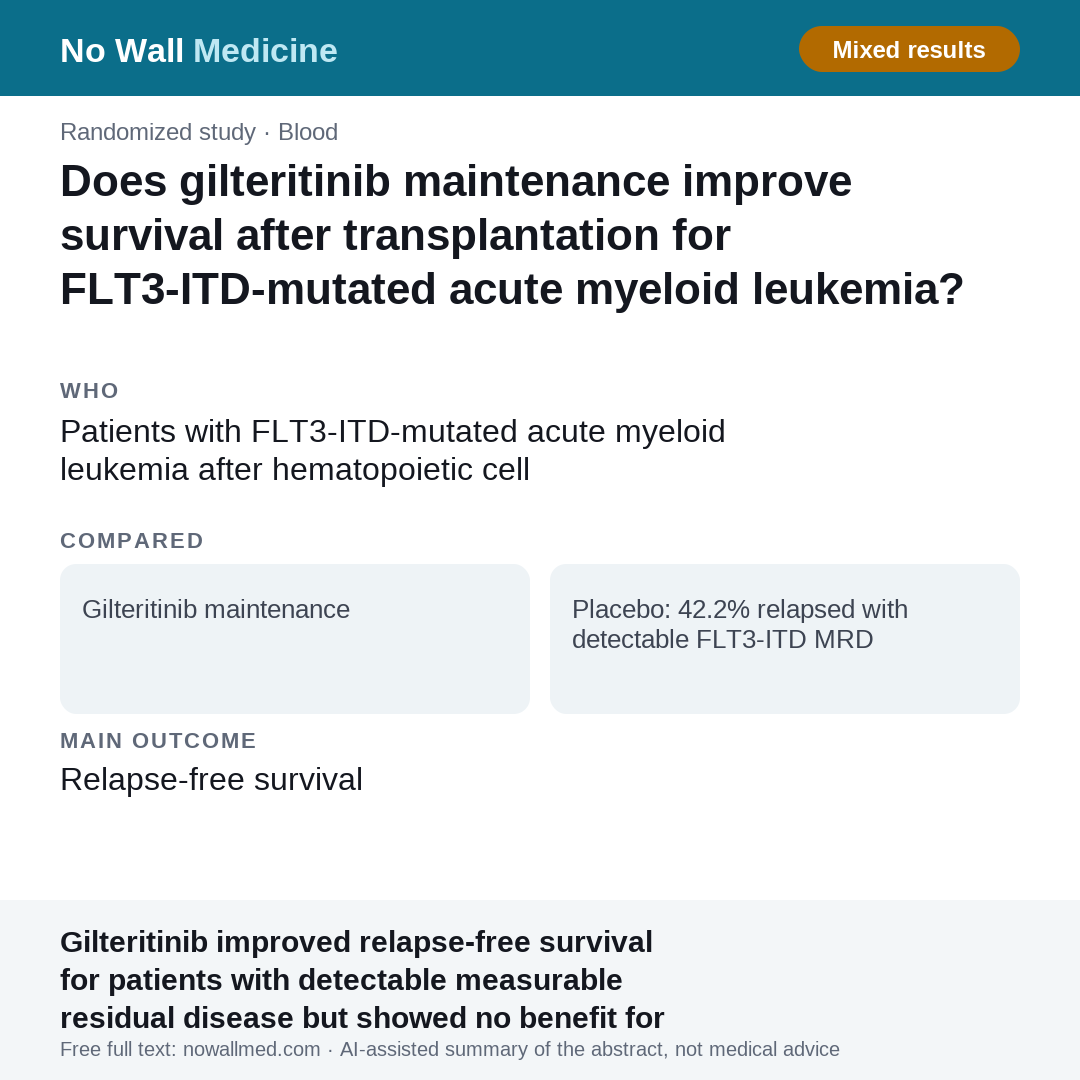
Does gilteritinib maintenance improve survival after transplantation for FLT3-ITD-mutated acute myeloid leukemia?
Who
Patients with FLT3-ITD-mutated acute myeloid leukemia after hematopoietic cell transplantation · Blood and Marrow Transplant Clinical Trials Network
Compared
Gilteritinib maintenance
Placebo: 42.2% relapsed with detectable FLT3-ITD MRD
Main outcome
Relapse-free survival
Bottom line: Gilteritinib improved relapse-free survival for patients with detectable measurable residual disease but showed no benefit for those without.
Blood · 2025-01-08Download image
Clinical question: Does gilteritinib maintenance improve survival after transplantation for FLT3-ITD-mutated acute myeloid leukemia?
Why it matters: It was unknown how the presence or level of measurable residual disease affects survival and the effectiveness of gilteritinib maintenance therapy after transplantation.
Key points
- Researchers analyzed data from a randomized trial of patients with FLT3-ITD-mutated acute myeloid leukemia receiving either gilteritinib or a placebo after hematopoietic cell transplantation.
- In the placebo group, 42.2% of participants with detectable measurable residual disease relapsed compared to 13.4% of those without detectable disease.
- Participants with multiple FLT3-ITD clones detected as measurable residual disease, occurring in 14.8% of participants, were associated with worse survival regardless of treatment.
Headline and key points written with AI from the paper’s abstract, with every number checked against it. Read the paper before relying on them.
Was this summary helpful?
Abstract
BMT CTN (Blood and Marrow Transplant Clinical Trials Network) 1506 ("MORPHO") was a randomized study of gilteritinib compared with placebo as maintenance therapy after hematopoietic cell transplantation (HCT) for patients with FLT3-ITD-mutated acute myeloid leukemia (AML). A key secondary end point was to determine the impact on survival of before and/or after HCT measurable residual disease (MRD), as determined using a highly sensitive assay for FLT3-ITD mutations. Generally, gilteritinib maintenance therapy was associated with improved relapse-free survival (RFS) for participants with detectable peri-HCT MRD, whereas no benefit was evident for those lacking detectable MRD. We conducted a post hoc analysis of the data and found that the level of MRD detected with this approach correlated remarkably with RFS and relapse risk, and that MRD detectable at any level negatively affected RFS. In the placebo arm, 42.2% of participants with detectable FLT3-ITD MRD relapsed compared with 13.4% of those without detectable MRD. We found that 14.8% of participants had multiple FLT3-ITD clones detected as MRD and had worse survival irrespective of treatment arm. Finally, we examined the kinetics of FLT3-ITD clonal relapse or eradication and found that participants on the placebo arm with detectable MRD relapsed rapidly after HCT, often within a few weeks. MRD-positive participants on the gilteritinib arm relapsed either with FLT3 wild-type clones (assessed by capillary electrophoresis), after cessation of gilteritinib with persistent MRD, or on progression of multiclonal disease. These data demonstrate the potential of FLT3-ITD MRD to guide therapy with gilteritinib for this subtype of AML. This trial was registered at www.clinicaltrials.gov as #NCT02997202.
Abstract reproduced under the article’s CC BY NC ND licence.
Subject terms
Cite this article
Levis MJ, Hamadani M, Logan BR, Jones RJ, Singh AK, Litzow MR. Measurable residual disease and posttransplantation gilteritinib maintenance for patients with FLT3-ITD-mutated AML. Blood. 2025. doi:10.1182/blood.2024025154
Spotted a mistake? Suggest a correction