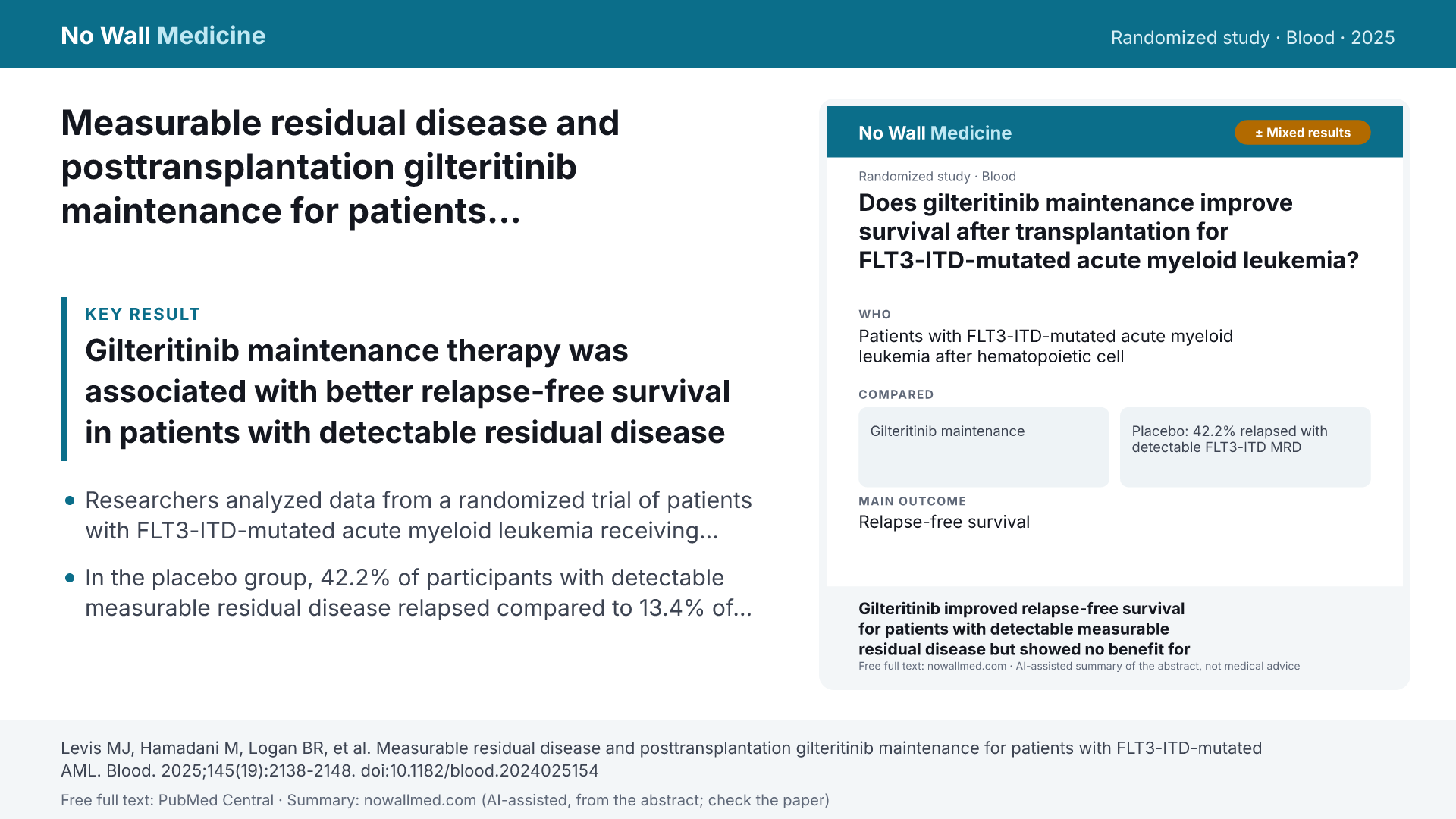
Measurable residual disease and posttransplantation gilteritinib maintenance for patients with FLT3-ITD-mutated AML
Key result: Gilteritinib maintenance therapy was associated with better relapse-free survival in patients with detectable residual disease
Secondary analysis of a trialMixed results
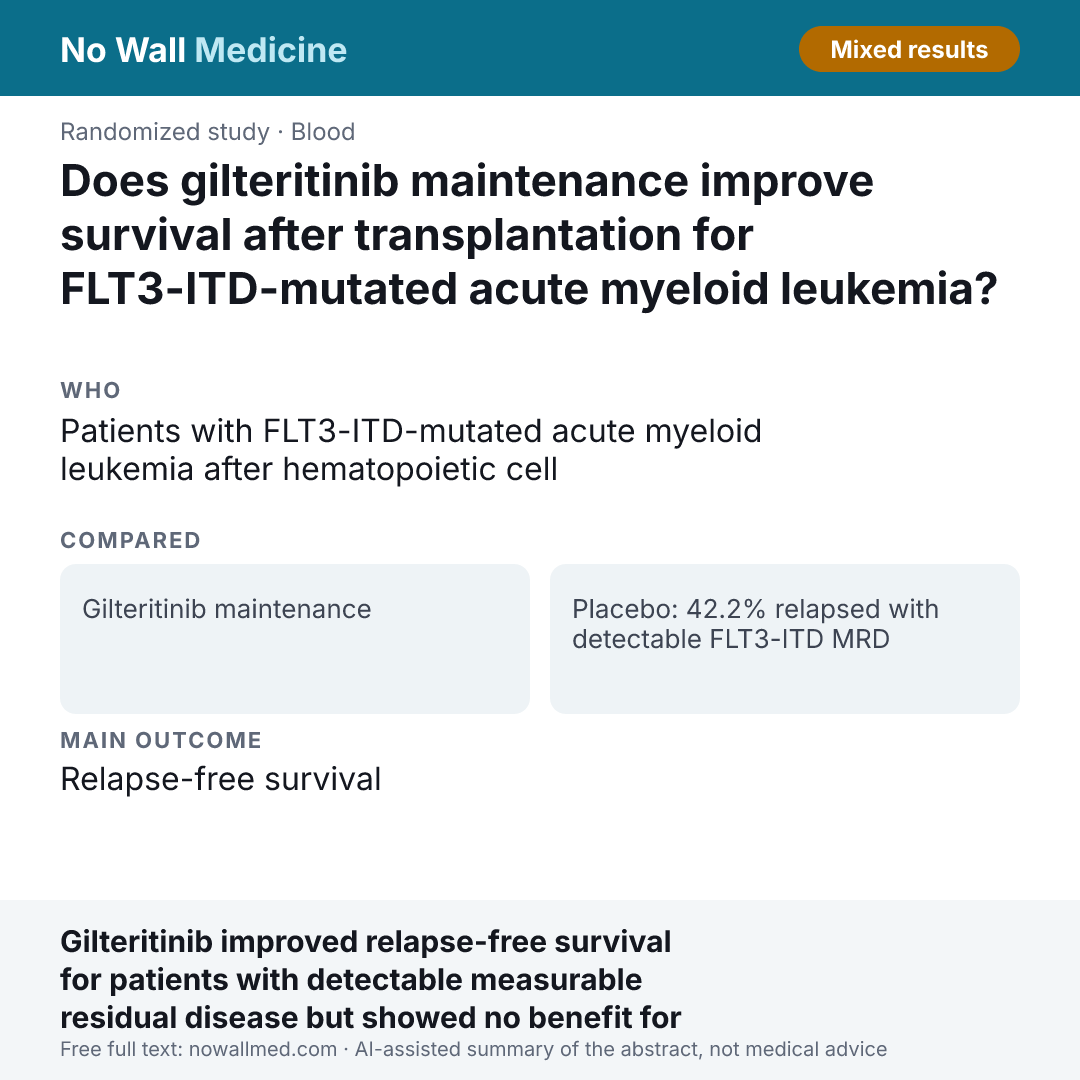
Does gilteritinib maintenance improve survival after transplantation for FLT3-ITD-mutated acute myeloid leukemia?
Who
Patients with FLT3-ITD-mutated acute myeloid leukemia after hematopoietic cell transplantation · Blood and Marrow Transplant Clinical Trials Network
Compared
Gilteritinib maintenance
Placebo: 42.2% relapsed with detectable FLT3-ITD MRD
Main outcome
Relapse-free survival
Bottom line: Gilteritinib improved relapse-free survival for patients with detectable measurable residual disease but showed no benefit for those without.
Blood · 2025-01-08 · Save PNG
Key points
- Researchers analyzed data from a randomized trial of patients with FLT3-ITD-mutated acute myeloid leukemia receiving either gilteritinib or a placebo after hematopoietic cell transplantation.
- In the placebo group, 42.2% of participants with detectable measurable residual disease relapsed compared to 13.4% of those without detectable disease.
- Participants with multiple FLT3-ITD clones detected as measurable residual disease, occurring in 14.8% of participants, were associated with worse survival regardless of treatment.
Discussion prompts
- Would these patients look like yours? Who was left out?
- Is the main outcome one that matters to patients?
- Is the difference large enough to change what you do?
Cite: Levis MJ, Hamadani M, Logan BR, et al. Measurable residual disease and posttransplantation gilteritinib maintenance for patients with FLT3-ITD-mutated AML. Blood. 2025;145(19):2138-2148. doi:10.1182/blood.2024025154
Free full text: PubMed Central · Summary and visual abstract: nowallmed.com/a/measurable-residual-disease-and-posttransplantation-gilteritinib-1q0c8ko/ (AI-assisted from the abstract; check the paper before relying on it).