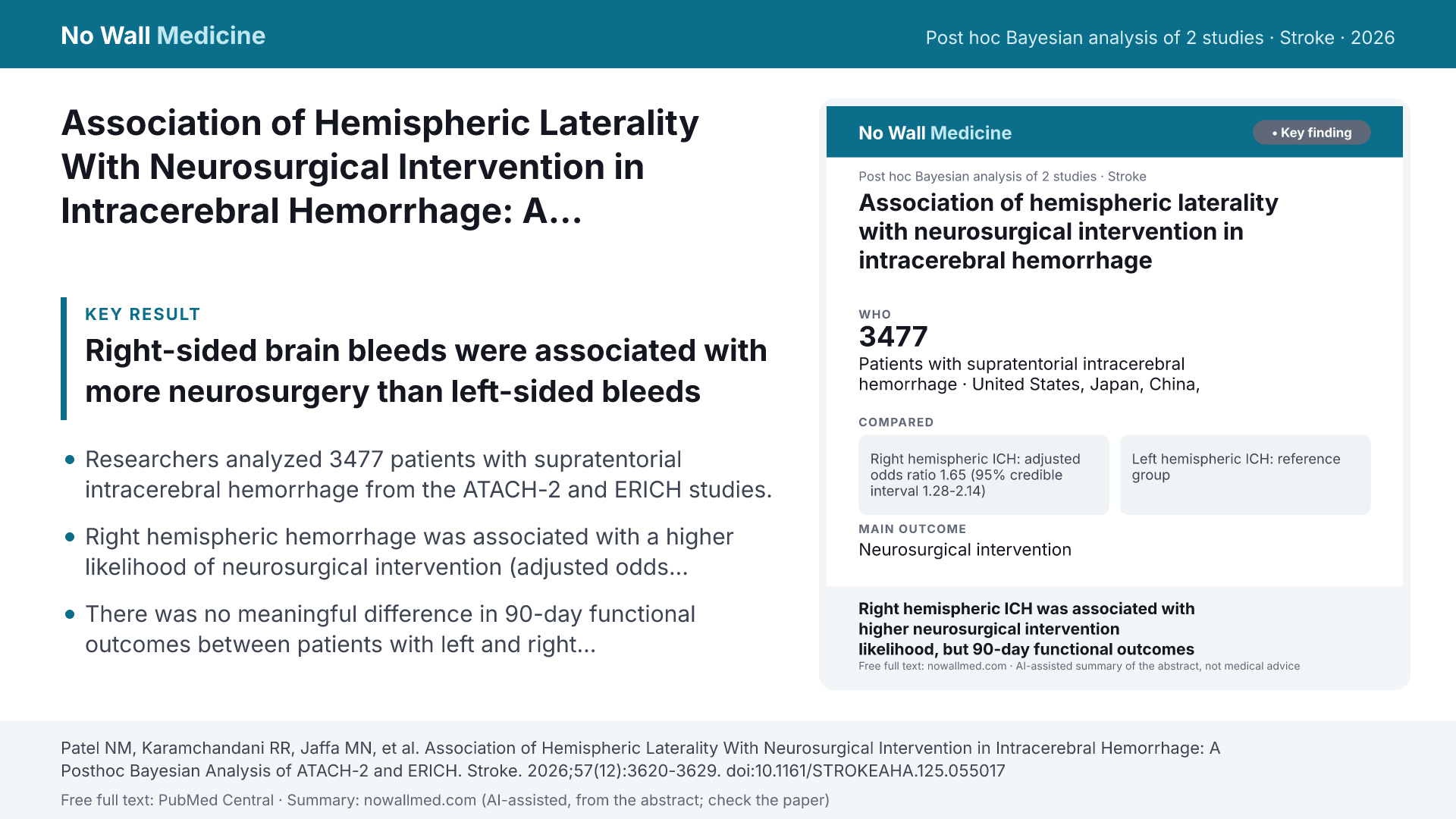
Right-sided brain bleeds were associated with more neurosurgery than left-sided bleeds
Association of Hemispheric Laterality With Neurosurgical Intervention in Intracerebral Hemorrhage: A Posthoc Bayesian Analysis of ATACH-2 and ERICH
Same trial (NCT01176565, NCT01202864)
Papers we list that report this registered trial, oldest first. Read a secondary analysis alongside the main results.
- Secondary analysis Benefit found
Blood pressure reduction of 55 to 85 mm Hg was associated with better outcomes in brain hemorrhage Neurology 2025-02 - Pooled analysis
Blood pressure patterns over 24 hours relate to outcomes after acute brain bleeding Neurology 2026-03 - Secondary analysis
This paper Stroke 2026-10
Key points
- Researchers analyzed 3477 patients with supratentorial intracerebral hemorrhage from the ATACH-2 and ERICH studies.
- Right hemispheric hemorrhage was associated with a higher likelihood of neurosurgical intervention (adjusted odds ratio, 1.65) and external ventricular drain placement (adjusted odds ratio, 1.22) compared to left-sided hemorrhage.
- There was no meaningful difference in 90-day functional outcomes between patients with left and right hemispheric hemorrhage.
Limitation the authors note: The authors stated that residual confounding from unmeasured anatomic severity and family preferences cannot be excluded.
Headline and key points written with AI from the paper’s abstract, with every number checked against it. Read the paper before relying on them.
Was this summary helpful?
Subject terms
Headline, design, result, key points, caveat and citation as plain text.
Cite this article
Patel NM, Karamchandani RR, Jaffa MN, et al. Association of Hemispheric Laterality With Neurosurgical Intervention in Intracerebral Hemorrhage: A Posthoc Bayesian Analysis of ATACH-2 and ERICH. Stroke. 2026;57(12):3620-3629. doi:10.1161/STROKEAHA.125.055017
Spotted a mistake? Suggest a correction