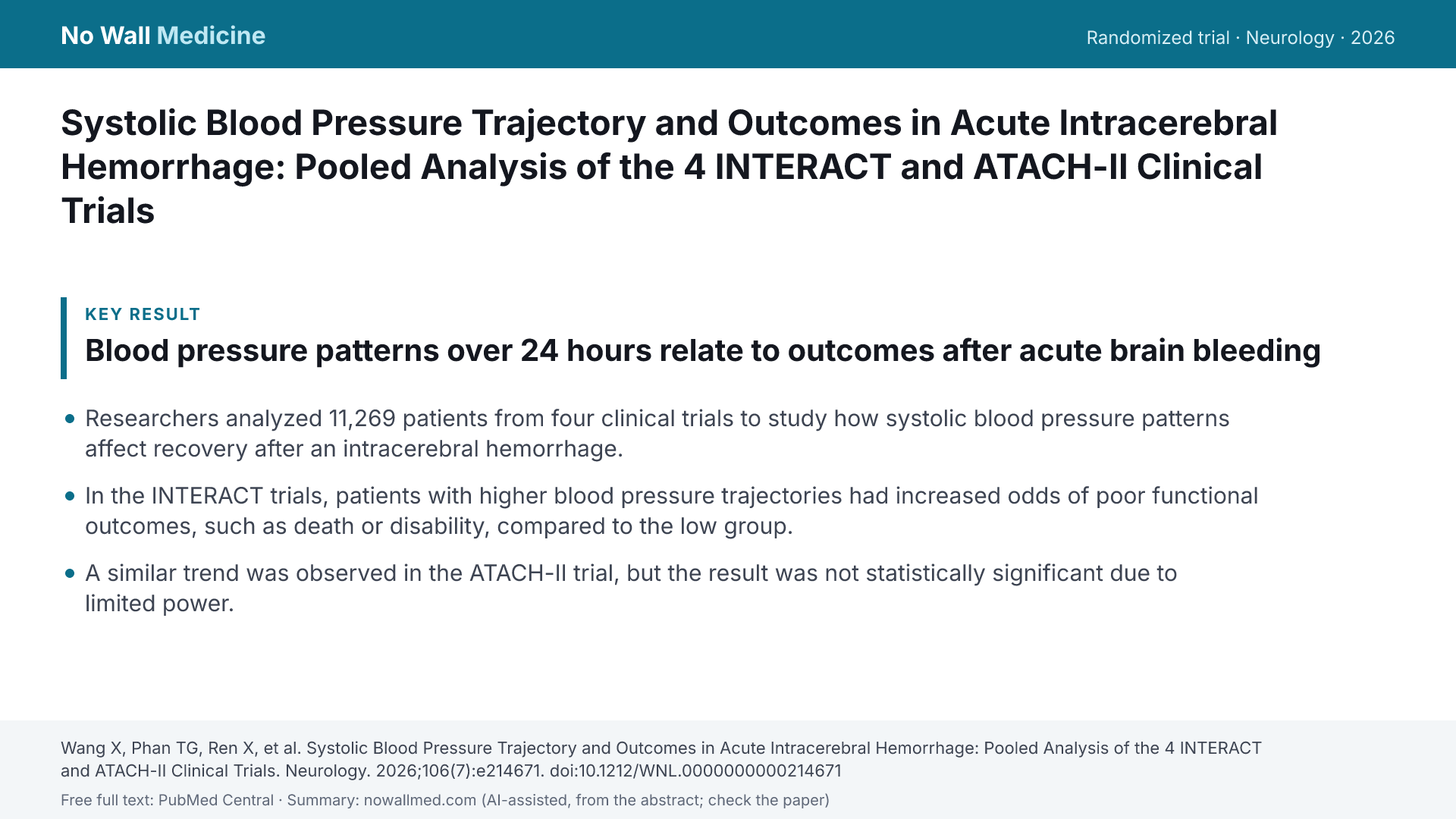
Blood pressure patterns over 24 hours relate to outcomes after acute brain bleeding
Systolic Blood Pressure Trajectory and Outcomes in Acute Intracerebral Hemorrhage: Pooled Analysis of the 4 INTERACT and ATACH-II Clinical Trials
Same trial (NCT00226096, NCT00716079)
Papers we list that report this registered trial, oldest first. Read a secondary analysis alongside the main results.
- Secondary analysis Harm found
Low kidney function was associated with higher death or disability risks during intensive blood pressure control Neurology 2021-07 - Related analysis
Rapidly dropping blood pressure was associated with higher death or disability risks after brain hemorrhage Stroke 2022-04 - Main results Benefit found
Care bundle for blood pressure and glucose management was associated with better functional recovery after brain hemorrhage Lancet 2023-05 - Secondary analysis Benefit found
Blood pressure reduction of 55 to 85 mm Hg was associated with better outcomes in brain hemorrhage Neurology 2025-02 - Pooled analysis
This paper Neurology 2026-03 - Secondary analysis Benefit found
Early blood pressure control linked to better outcomes after brain bleed surgery Stroke 2026-03 - Secondary analysis No clear difference
Frailty is associated with worse outcomes after brain bleeding but does not change treatment effectiveness Lancet Healthy Longev 2026-08 - Secondary analysis
Right-sided brain bleeds were associated with more neurosurgery than left-sided bleeds Stroke 2026-10
Key points
- Researchers analyzed 11,269 patients from four clinical trials to study how systolic blood pressure patterns affect recovery after an intracerebral hemorrhage.
- In the INTERACT trials, patients with higher blood pressure trajectories had increased odds of poor functional outcomes, such as death or disability, compared to the low group.
- A similar trend was observed in the ATACH-II trial, but the result was not statistically significant due to limited power.
Limitation the authors note: The ATACH-II trial had limited power to show a statistically significant trend.
Headline and key points written with AI from the paper’s abstract, with every number checked against it. Read the paper before relying on them.
Was this summary helpful?
Subject terms
Headline, design, result, key points, caveat and citation as plain text.
Cite this article
Wang X, Phan TG, Ren X, et al. Systolic Blood Pressure Trajectory and Outcomes in Acute Intracerebral Hemorrhage: Pooled Analysis of the 4 INTERACT and ATACH-II Clinical Trials. Neurology. 2026;106(7):e214671. doi:10.1212/WNL.0000000000214671
Spotted a mistake? Suggest a correction