Association of NEDA-4 With No Long-term Disability Progression in Multiple Sclerosis and Comparison With NEDA-3: A Systematic Review and Meta-analysis
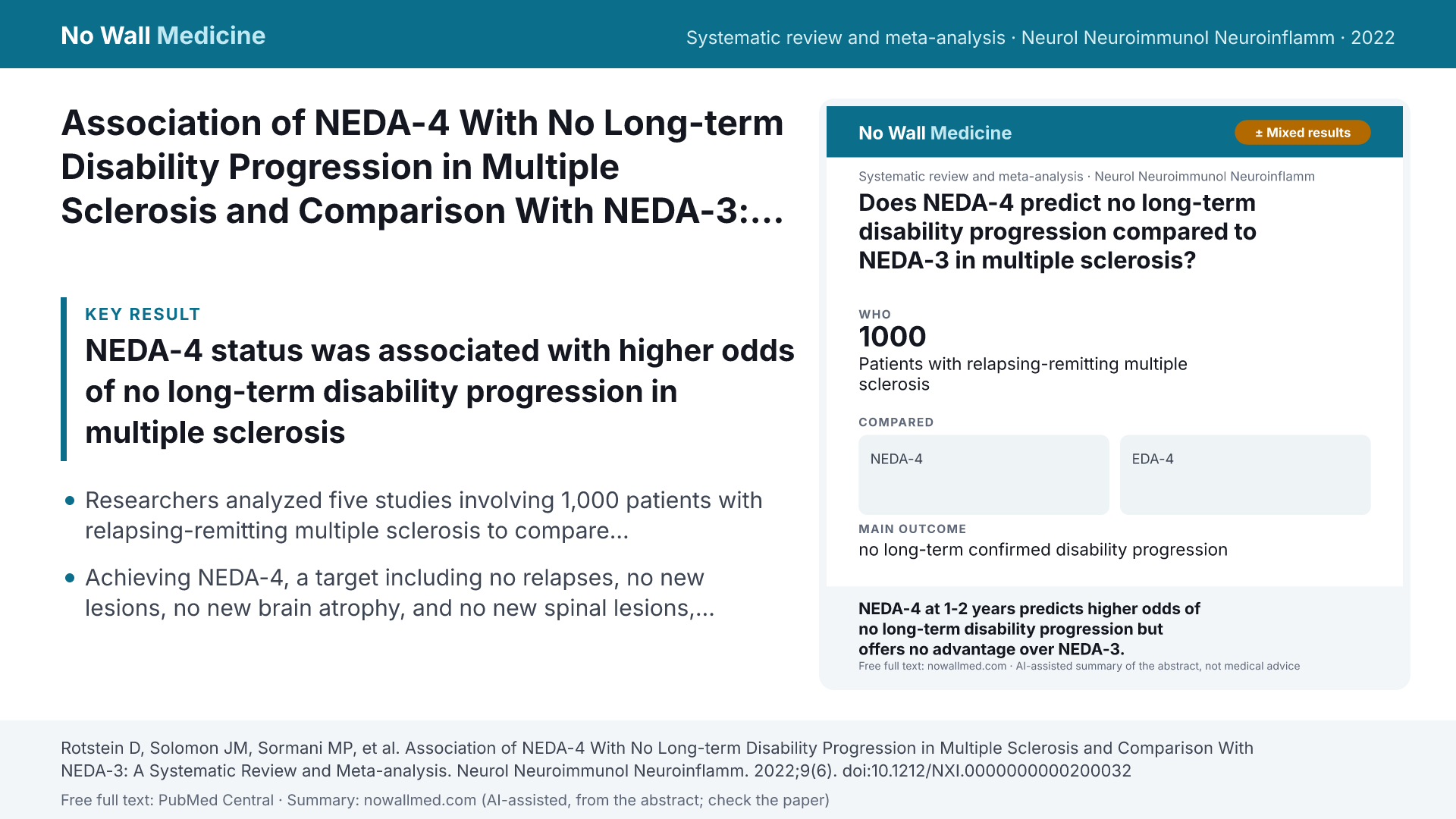
Key result: NEDA-4 status was associated with higher odds of no long-term disability progression in multiple sclerosis
Systematic review and meta-analysisMixed results
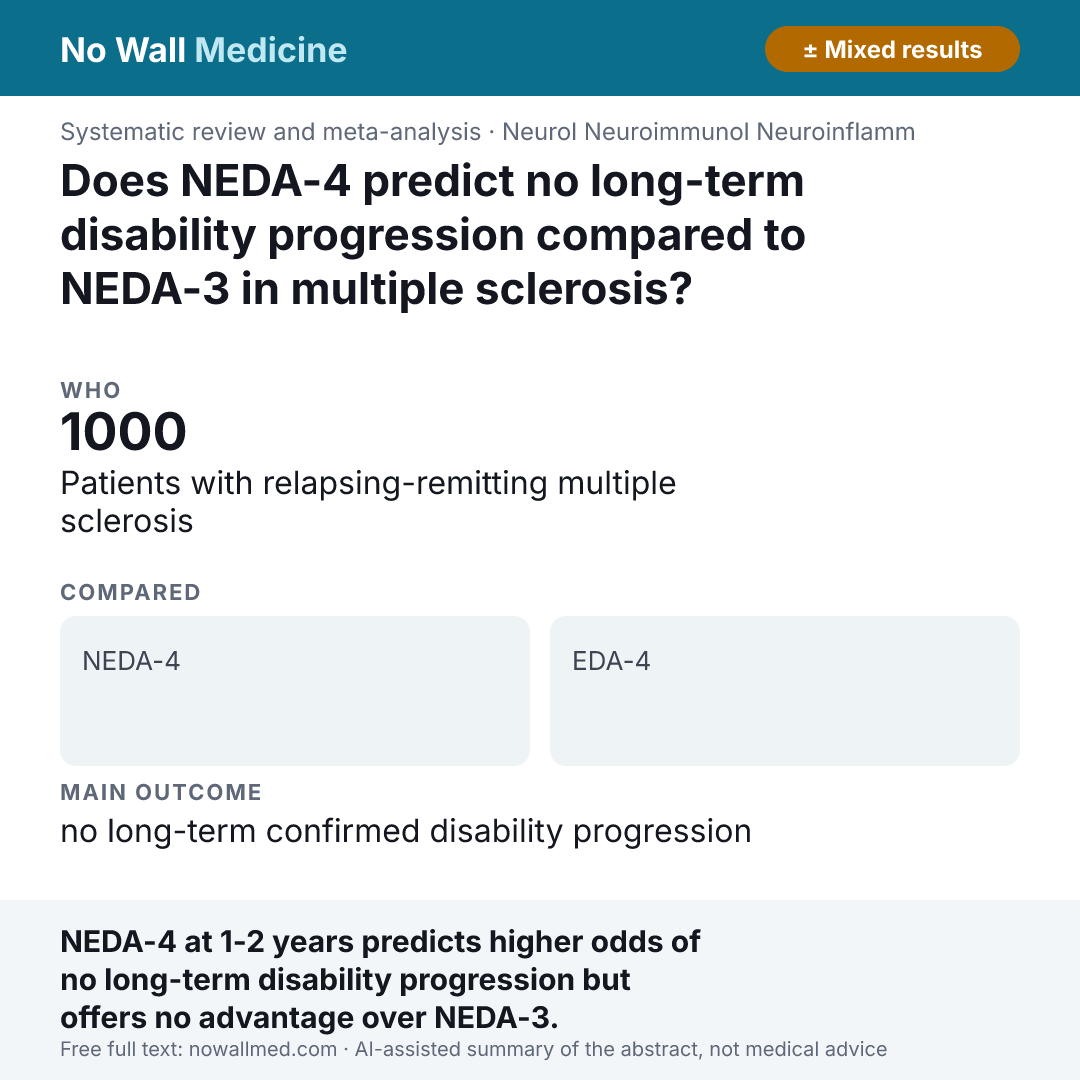
Does NEDA-4 predict no long-term disability progression compared to NEDA-3 in multiple sclerosis?
Who
1000
Patients with relapsing-remitting multiple sclerosis
Compared
NEDA-4
EDA-4
Main outcome
no long-term confirmed disability progression
Result: odds ratio 2.14 (95% confidence interval: 1.36-3.37)
Bottom line: NEDA-4 at 1-2 years predicts higher odds of no long-term disability progression but offers no advantage over NEDA-3.
Neurol Neuroimmunol Neuroinflamm · 2022-10-12 · Save PNG
Key points
- Researchers analyzed five studies involving 1,000 patients with relapsing-remitting multiple sclerosis to compare different treatment target metrics.
- Achieving NEDA-4, a target including no relapses, no new lesions, no new brain atrophy, and no new spinal lesions, was associated with an odds ratio of 2.14 for no long-term disability progression.
- The study found no significant difference between the performance of NEDA-4 and NEDA-3 in predicting no long-term disability progression.
Discussion prompts
- Would these patients look like yours? Who was left out?
- Is the main outcome one that matters to patients?
- Is the difference large enough to change what you do?
Cite: Rotstein D, Solomon JM, Sormani MP, et al. Association of NEDA-4 With No Long-term Disability Progression in Multiple Sclerosis and Comparison With NEDA-3: A Systematic Review and Meta-analysis. Neurol Neuroimmunol Neuroinflamm. 2022;9(6). doi:10.1212/NXI.0000000000200032
Free full text: PubMed Central · Summary and visual abstract: nowallmed.com/a/association-of-neda-4-with-no-long-term-disability-progression-in-149opt5/ (AI-assisted from the abstract; check the paper before relying on it).