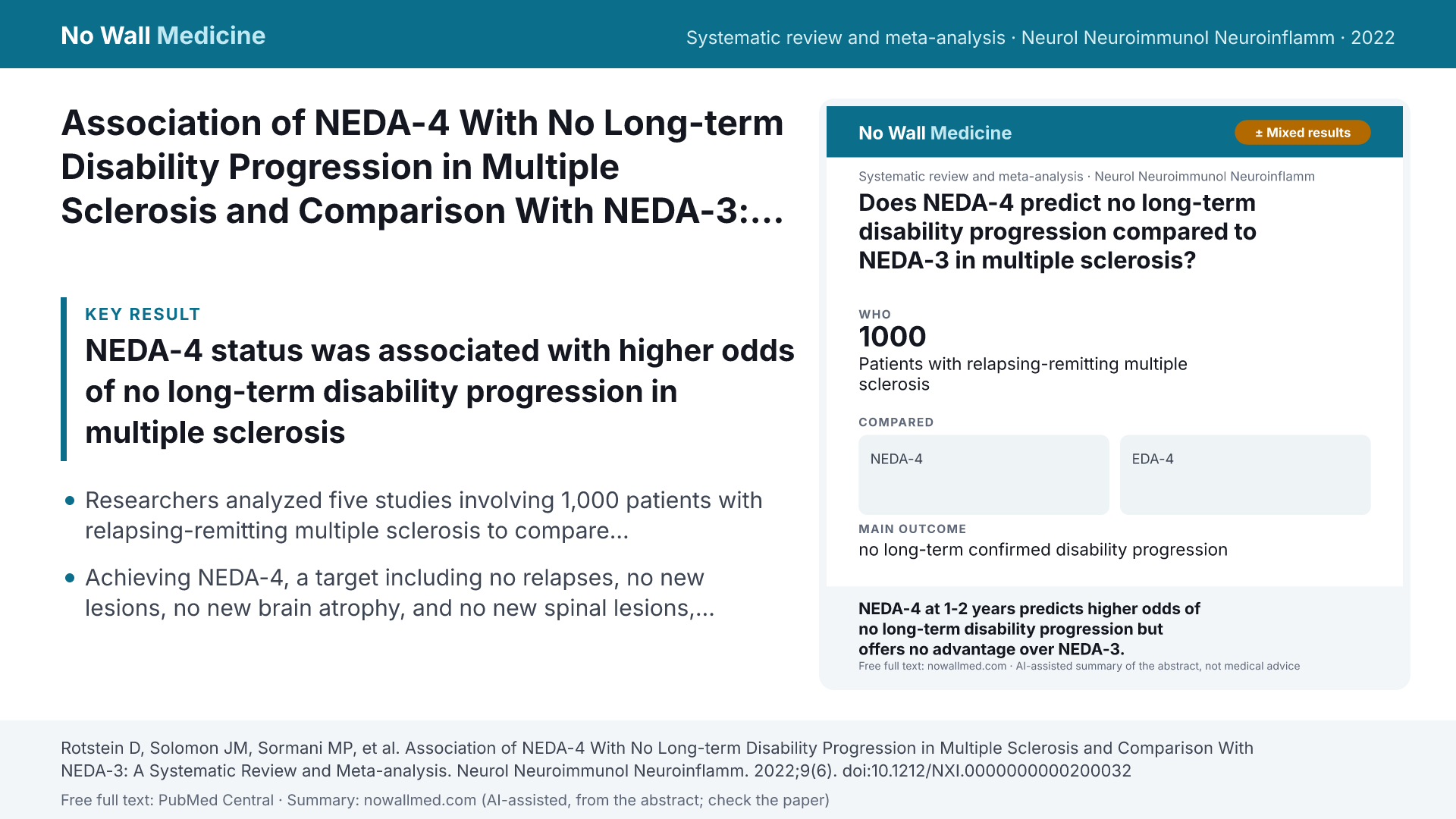
NEDA-4 status was associated with higher odds of no long-term disability progression in multiple sclerosis
Association of NEDA-4 With No Long-term Disability Progression in Multiple Sclerosis and Comparison With NEDA-3: A Systematic Review and Meta-analysis
Systematic review and meta-analysisMixed results
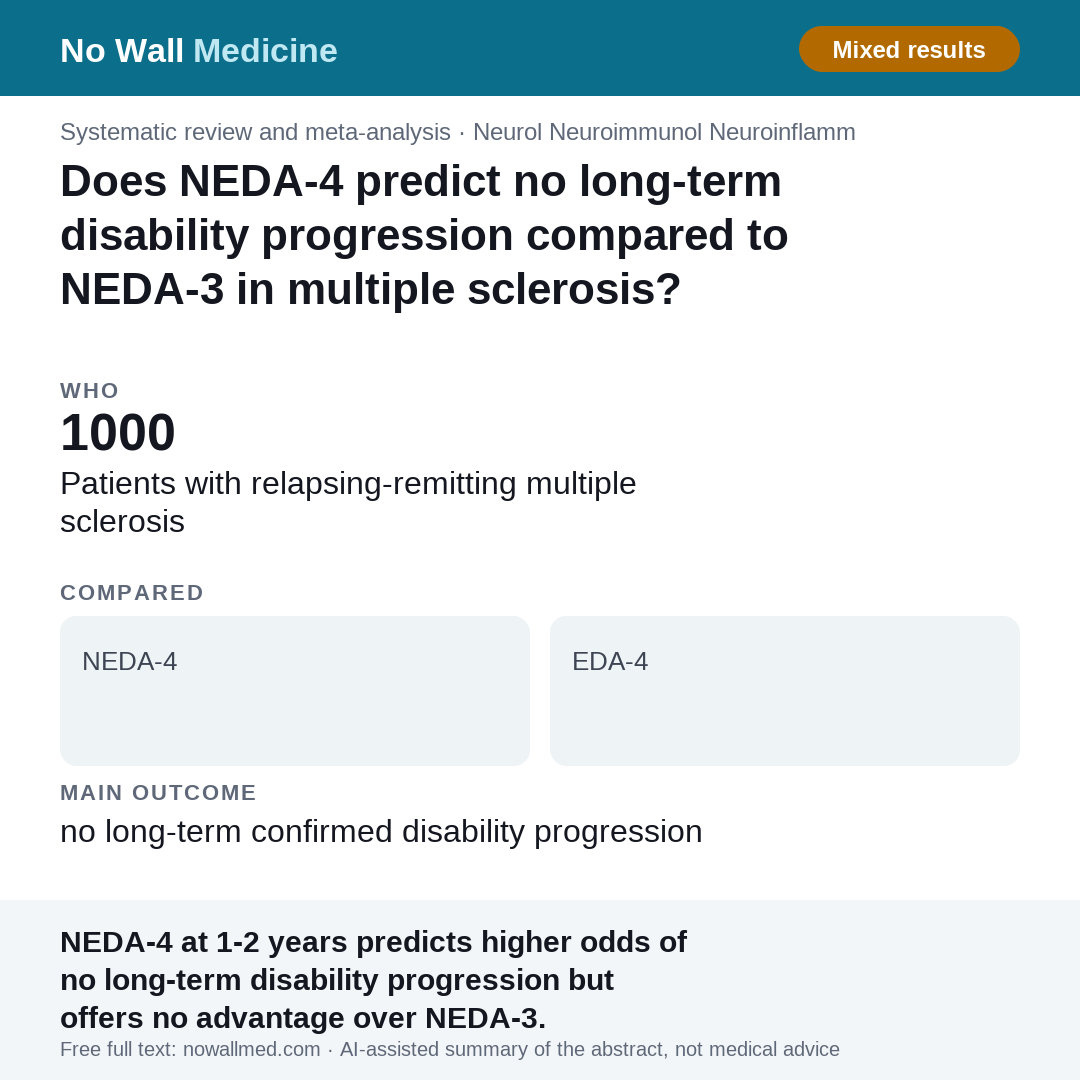
Does NEDA-4 predict no long-term disability progression compared to NEDA-3 in multiple sclerosis?
Who
1000
Patients with relapsing-remitting multiple sclerosis
Compared
NEDA-4
EDA-4
Main outcome
no long-term confirmed disability progression
Result: odds ratio 2.14 (95% confidence interval: 1.36-3.37)
Bottom line: NEDA-4 at 1-2 years predicts higher odds of no long-term disability progression but offers no advantage over NEDA-3.
Neurol Neuroimmunol Neuroinflamm · 2022-10-12Download image
Clinical question: Does NEDA-4 predict no long-term disability progression compared to NEDA-3 in multiple sclerosis?
Why it matters: It is uncertain how well NEDA-4 targets discriminate long-term outcomes in multiple sclerosis compared to the NEDA-3 target.
Key points
- Researchers analyzed five studies involving 1,000 patients with relapsing-remitting multiple sclerosis to compare different treatment target metrics.
- Achieving NEDA-4, a target including no relapses, no new lesions, no new brain atrophy, and no new spinal lesions, was associated with an odds ratio of 2.14 for no long-term disability progression.
- The study found no significant difference between the performance of NEDA-4 and NEDA-3 in predicting no long-term disability progression.
Headline and key points written with AI from the paper’s abstract, with every number checked against it. Read the paper before relying on them.
Was this summary helpful?
Subject terms
Cite this article
Rotstein D, Solomon JM, Sormani MP, et al. Association of NEDA-4 With No Long-term Disability Progression in Multiple Sclerosis and Comparison With NEDA-3: A Systematic Review and Meta-analysis. Neurol Neuroimmunol Neuroinflamm. 2022. doi:10.1212/NXI.0000000000200032
Spotted a mistake? Suggest a correction