Fingolimod and ozanimod showed high efficacy among sphingosine-1-phosphate receptor modulators for multiple sclerosis
The Comparative Effectiveness and Tolerability of Sphingosine-1-Phosphate Receptor Modulators in Patients With Multiple Sclerosis: A Network Meta-Analysis of Randomized Controlled Trials
Network meta-analysis of randomized controlled trialsMixed results
What is the efficacy and safety of sphingosine-1-phosphate receptor modulators in multiple sclerosis?
Who
16,006
patients with multiple sclerosis
Compared
Fingolimod (1.25 mg): SMD = -0.4422 (95% CI [-0.5450 to -0.3394])
Ozanimod (1 mg): SMD = -0.6516 (95% CI [-0.8944 to -0.4087])
Siponimod (1.25 mg): OR = 0.4606 (95% CI [0.1893 to 1.1205])
Main outcome
Annualized Relapse Rate and incidence of adverse effects
Bottom line: Fingolimod and ozanimod showed best efficacy, while siponimod showed the best safety profile among sphingosine-1-phosphate receptor modulators.
Limitation: Further longitudinal studies should be conducted to assess long-term effects on patient-reported outcomes.
Ann Clin Transl Neurol · 2025-07-04Download image
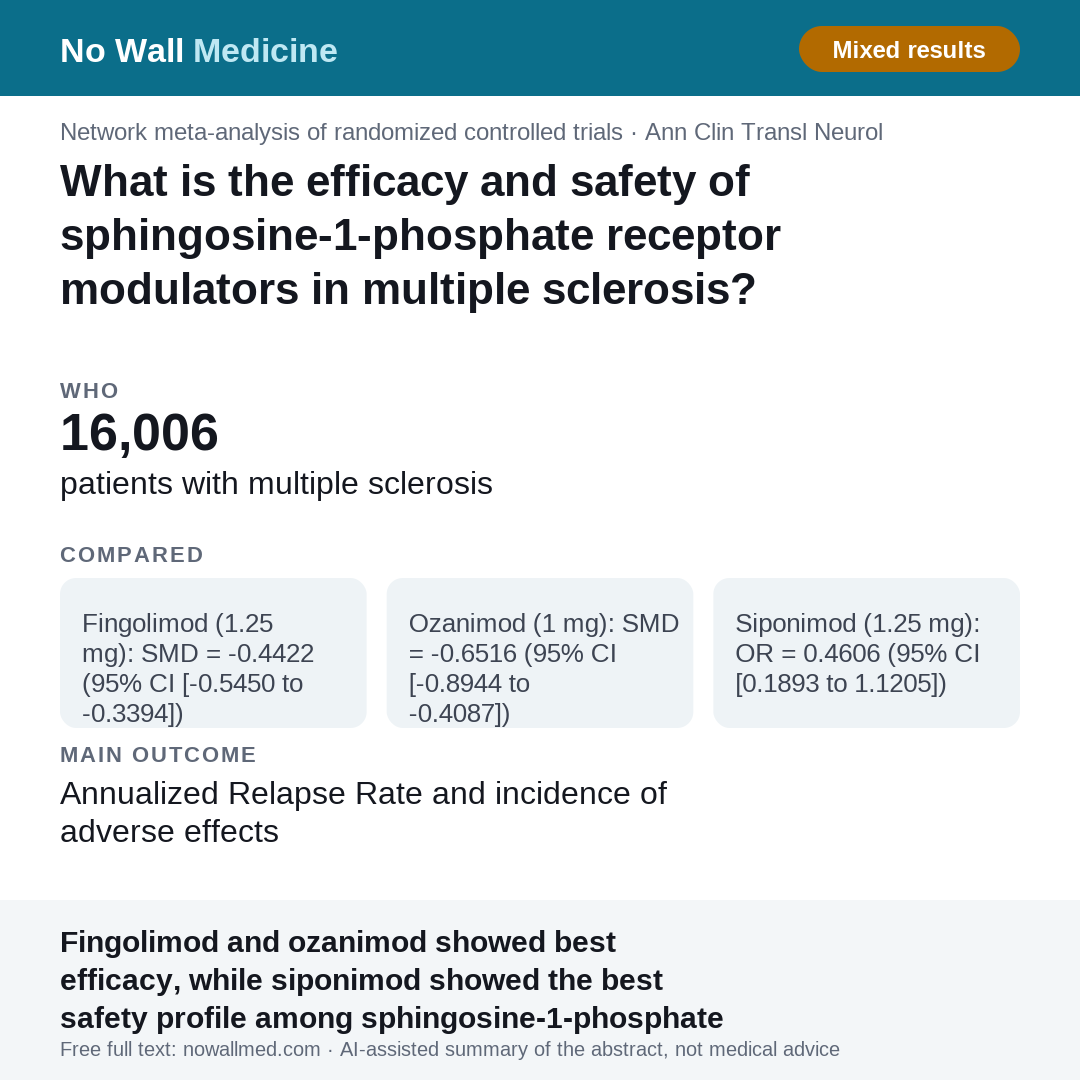
Clinical question: What is the efficacy and safety of sphingosine-1-phosphate receptor modulators in multiple sclerosis?
Why it matters: Different sphingosine-1-phosphate receptor modulators have different selectivity for receptor subtypes, and their comparative efficacy and safety in treating multiple sclerosis need to be understood.
Key points
- Researchers analyzed 17 randomized controlled trials involving 16,006 patients to compare different sphingosine-1-phosphate receptor modulators used for multiple sclerosis.
- Fingolimod (1.25 mg) was associated with a decreased annualized relapse rate (SMD = -0.4422, 95% CI = [-0.5450 to -0.3394], p-value < 0.0001).
- Ozanimod (1 mg) was associated with the lowest number of new Gadolinium-enhanced lesions (SMD = -0.6516, 95% CI = [-0.8944 to -0.4087], p-value < 0.0001).
Headline and key points written with AI from the paper’s abstract, with every number checked against it. Read the paper before relying on them.
Was this summary helpful?
Subject terms
Cite this article
Shahzad F, Rasheed T, Siddiqui MR, Hamid H, Khalid MB, Shabbir H. The Comparative Effectiveness and Tolerability of Sphingosine-1-Phosphate Receptor Modulators in Patients With Multiple Sclerosis: A Network Meta-Analysis of Randomized Controlled Trials. Ann Clin Transl Neurol. 2025. doi:10.1002/acn3.70122
Spotted a mistake? Suggest a correction
Top studies every Monday
The week’s key trials and guidelines in your specialties, plus any topics you follow. By email, free.
Get the weekly digest