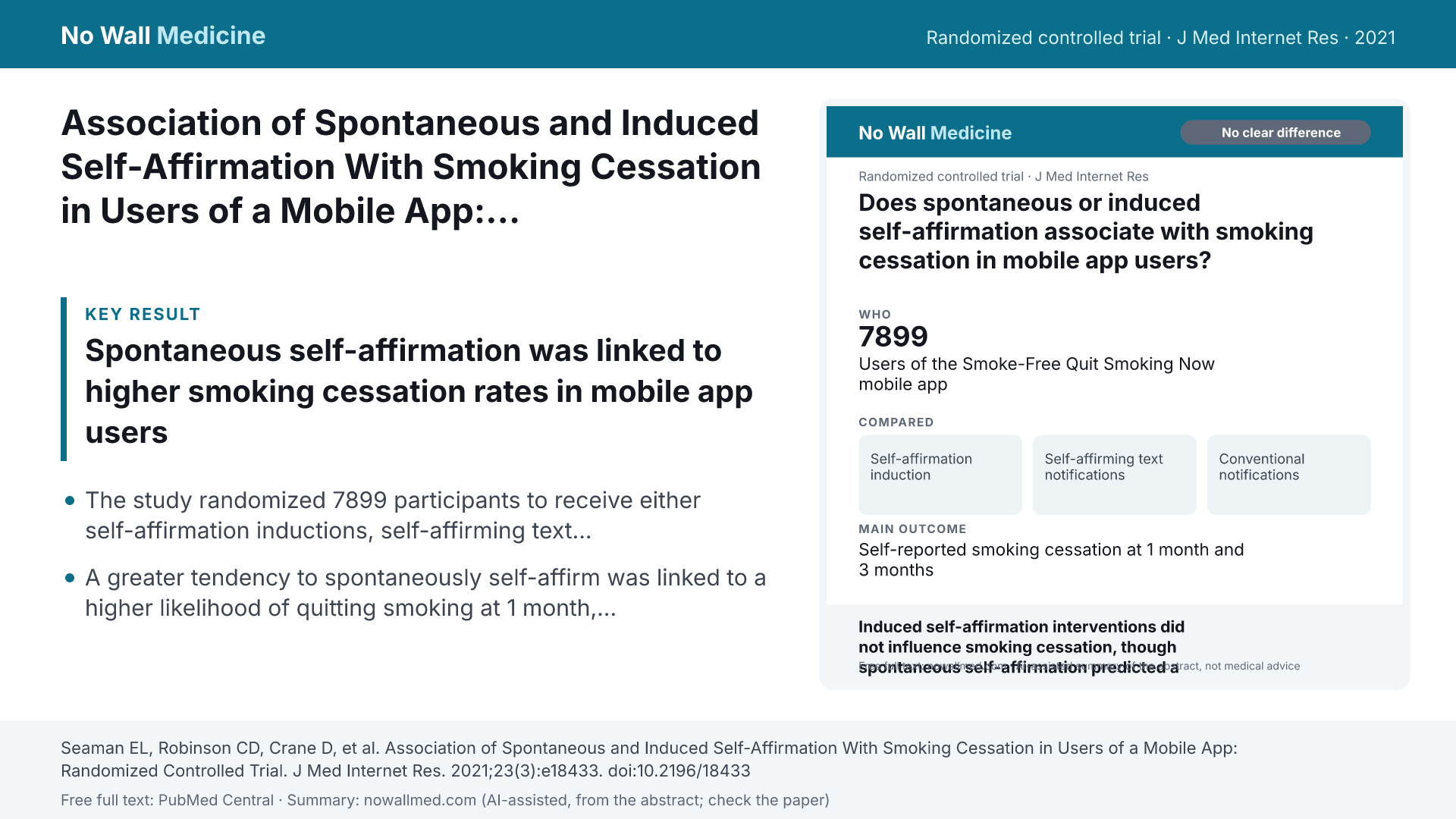
Spontaneous self-affirmation was linked to higher smoking cessation rates in mobile app users
Association of Spontaneous and Induced Self-Affirmation With Smoking Cessation in Users of a Mobile App: Randomized Controlled Trial
Randomized controlled trialNo clear difference
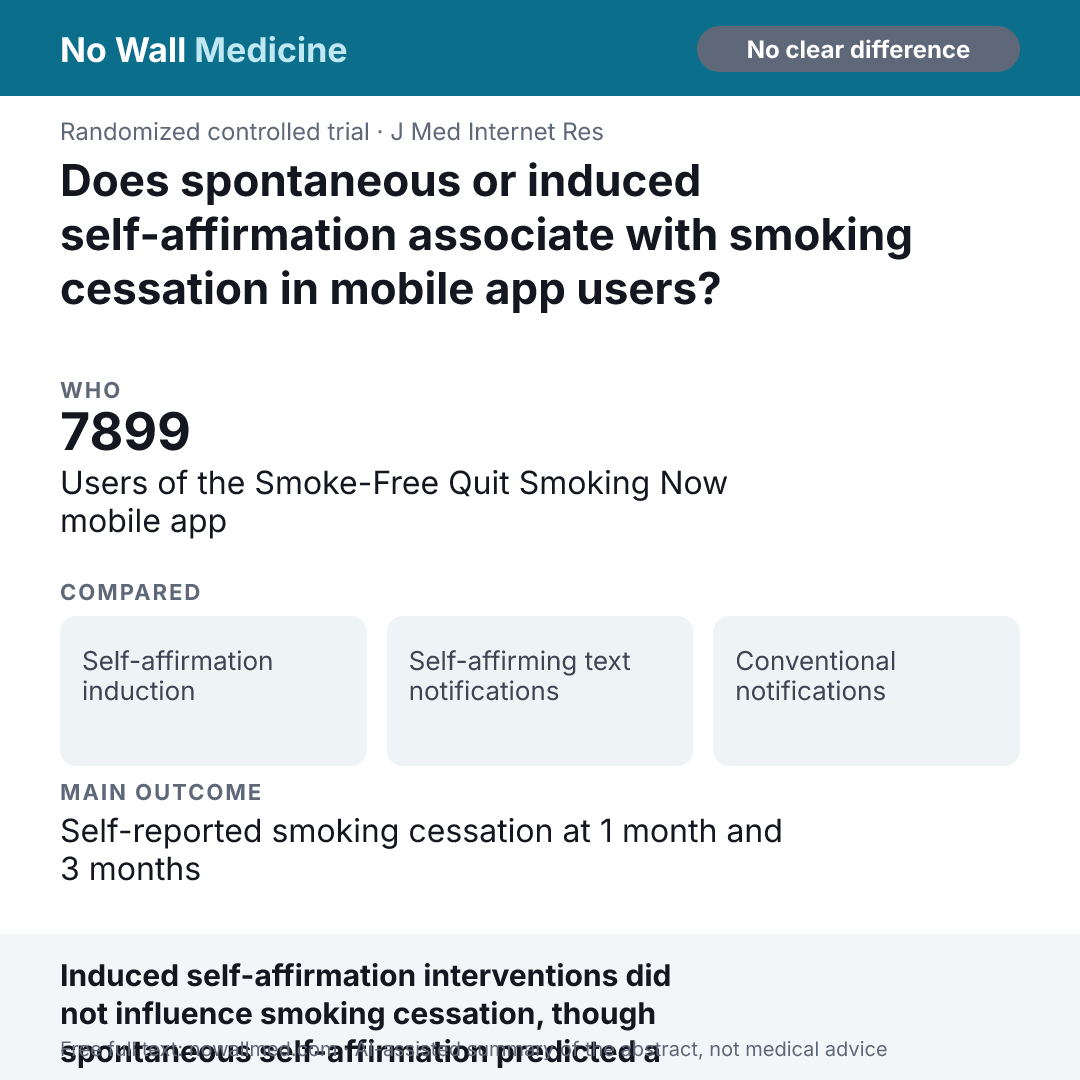
Does spontaneous or induced self-affirmation associate with smoking cessation in mobile app users?
Who
7899
Users of the Smoke-Free Quit Smoking Now mobile app
Compared
Self-affirmation induction
Self-affirming text notifications
Conventional notifications
Main outcome
Self-reported smoking cessation at 1 month and 3 months
Bottom line: Induced self-affirmation interventions did not influence smoking cessation, though spontaneous self-affirmation predicted a greater likelihood of quitting.
Limitation: Only 647 participants completed the 1-month follow-up.
J Med Internet Res · 2021-03-05 · Save PNG
Clinical question: Does spontaneous or induced self-affirmation associate with smoking cessation in mobile app users?
Key points
- The study randomized 7899 participants to receive either self-affirmation inductions, self-affirming text notifications, or conventional notifications via a mobile app.
- A greater tendency to spontaneously self-affirm was linked to a higher likelihood of quitting smoking at 1 month, while self-affirmation inductions did not influence cessation.
- Greater baseline sadness was associated with a lower likelihood of successful cessation, while optimism, happiness, and anger were linked to cessation at the 1-month follow-up.
Limitation the authors note: Only 647 participants completed the 1-month follow-up out of the 7899 who were enrolled.
Headline and key points written with AI from the paper’s abstract, with every number checked against it. Read the paper before relying on them.
Was this summary helpful?
Subject terms
Headline, design, result, key points, caveat and citation as plain text.
Cite this article
Seaman EL, Robinson CD, Crane D, et al. Association of Spontaneous and Induced Self-Affirmation With Smoking Cessation in Users of a Mobile App: Randomized Controlled Trial. J Med Internet Res. 2021;23(3):e18433. doi:10.2196/18433
Spotted a mistake? Suggest a correction