Electronic portal messaging with asynchronous care did not increase smoking quit attempts in a randomized trial
Effect of Electronic Portal Messaging With Embedded Asynchronous Care on Physician-Assisted Smoking Cessation Attempts: A Randomized Clinical Trial
Quality improvement randomized clinical trialNo clear difference
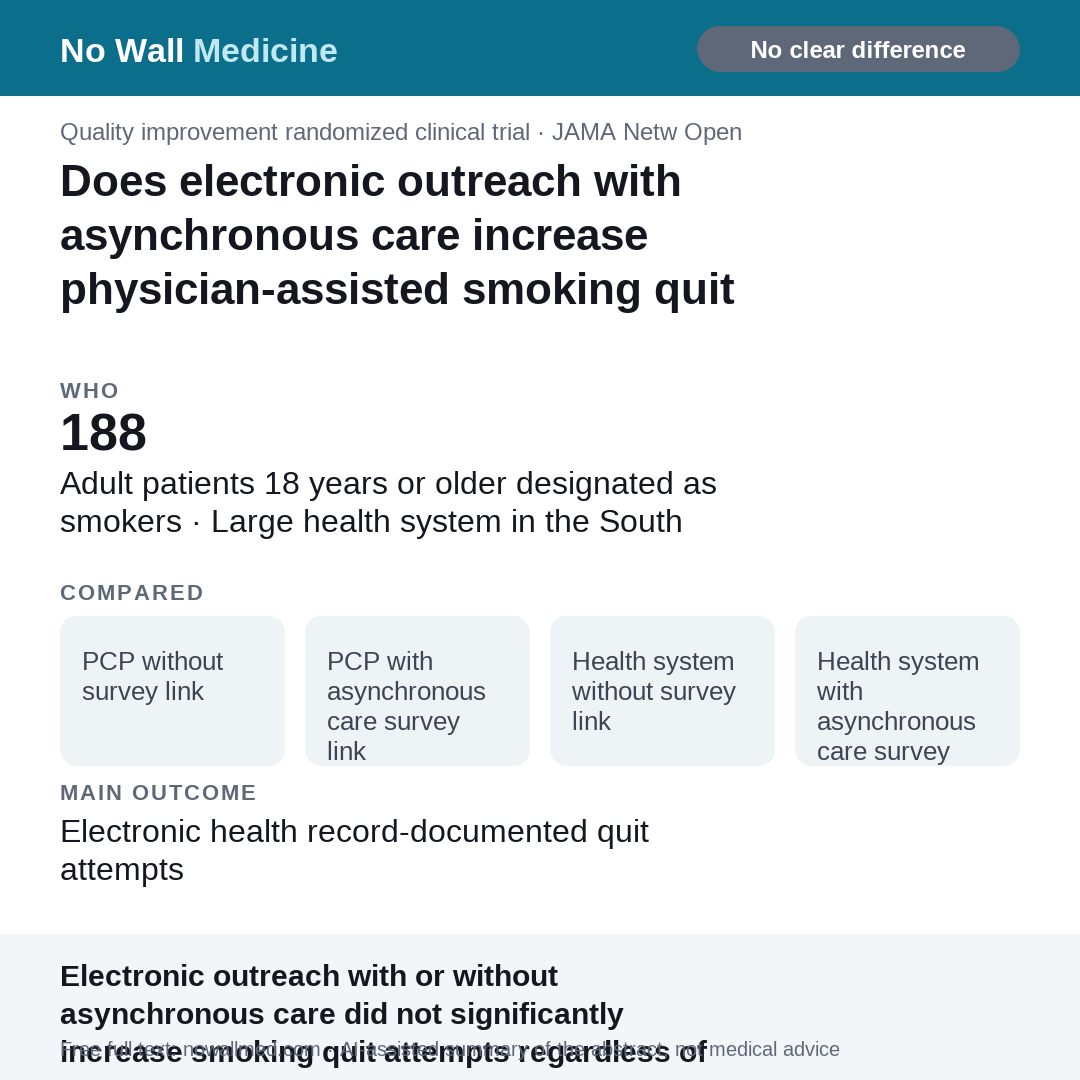
Does electronic outreach with asynchronous care increase physician-assisted smoking quit attempts?
Who
188
Adult patients 18 years or older designated as smokers · Large health system in the South Central US
Compared
PCP without survey link
PCP with asynchronous care survey link
Health system without survey link
Health system with asynchronous care survey link
Main outcome
Electronic health record-documented quit attempts
Result: odds ratio 2.50 (95% CI 0.72-8.72)
Bottom line: Electronic outreach with or without asynchronous care did not significantly increase smoking quit attempts regardless of the message sender.
JAMA Netw Open · 2022-02-01Download image
Clinical question: Does electronic outreach with asynchronous care increase physician-assisted smoking quit attempts?
Why it matters: It is unknown if electronic outreach using asynchronous care, which allows for non-real-time communication, can increase the number of smoking quit attempts in primary care.
Key points
- Researchers randomized 188 adult smokers to receive messages from either a primary care physician or a health system, with or without a link to asynchronous care.
- No statistically significant difference in documented quit attempts was found among the 4 study groups, including those receiving the asynchronous care survey link (odds ratio, 2.50 [95% CI, 0.72-8.72]).
- The quit attempt rate for those offered asynchronous care was 9.5% compared to 4.3% for those offered in-person care, though this was not statistically significant.
Headline and key points written with AI from the paper’s abstract, with every number checked against it. Read the paper before relying on them.
Was this summary helpful?
Subject terms
Cite this article
Erdmann M, Edwards B, Adewumi MT. Effect of Electronic Portal Messaging With Embedded Asynchronous Care on Physician-Assisted Smoking Cessation Attempts: A Randomized Clinical Trial. JAMA Netw Open. 2022. doi:10.1001/jamanetworkopen.2022.0348
Spotted a mistake? Suggest a correction
Top studies every Monday
The week’s key trials and guidelines in your specialties, plus any topics you follow. By email, free.
Get the weekly digest