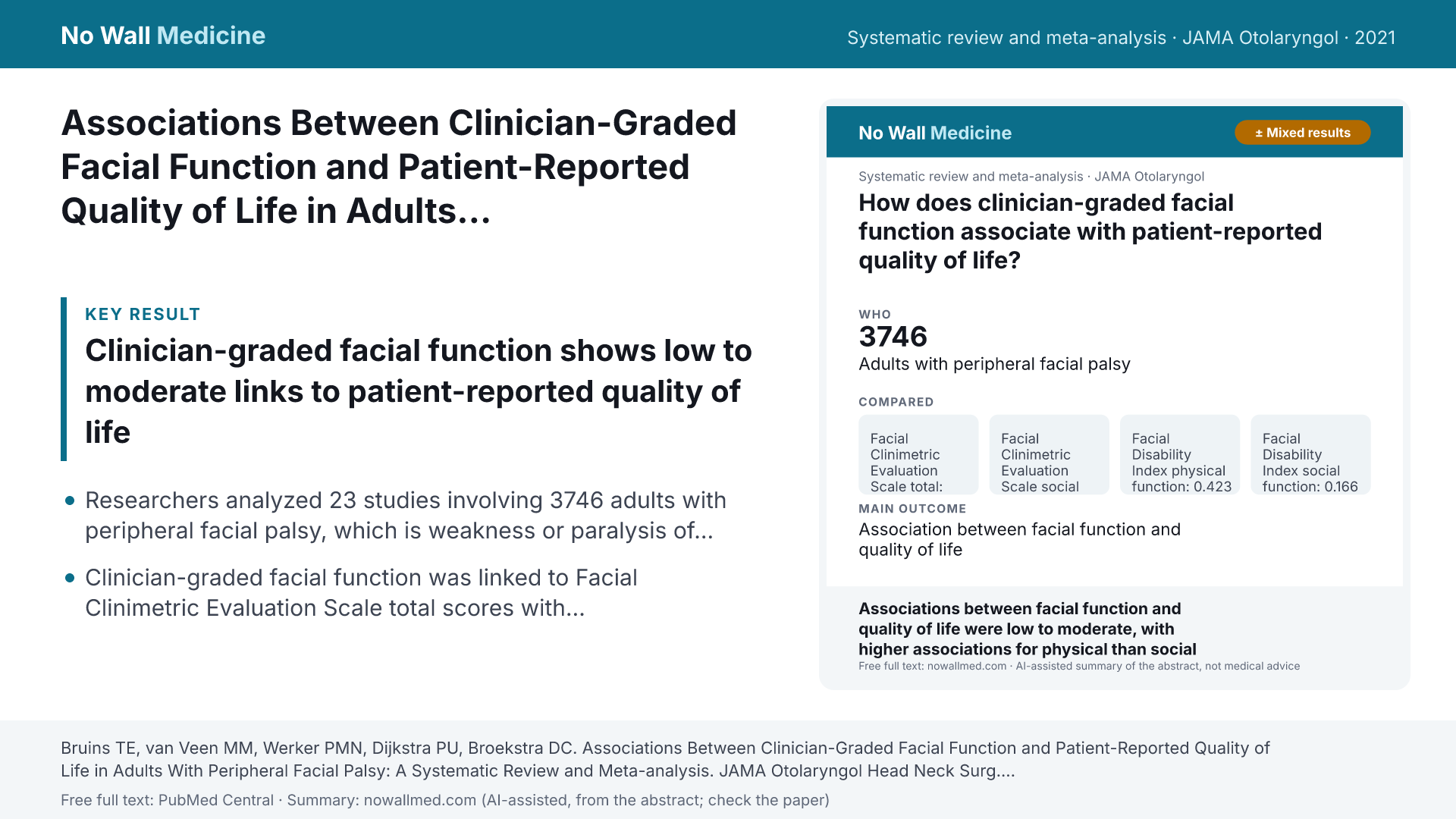
Clinician-graded facial function shows low to moderate links to patient-reported quality of life
Associations Between Clinician-Graded Facial Function and Patient-Reported Quality of Life in Adults With Peripheral Facial Palsy: A Systematic Review and Meta-analysis
Systematic review and meta-analysisMixed results
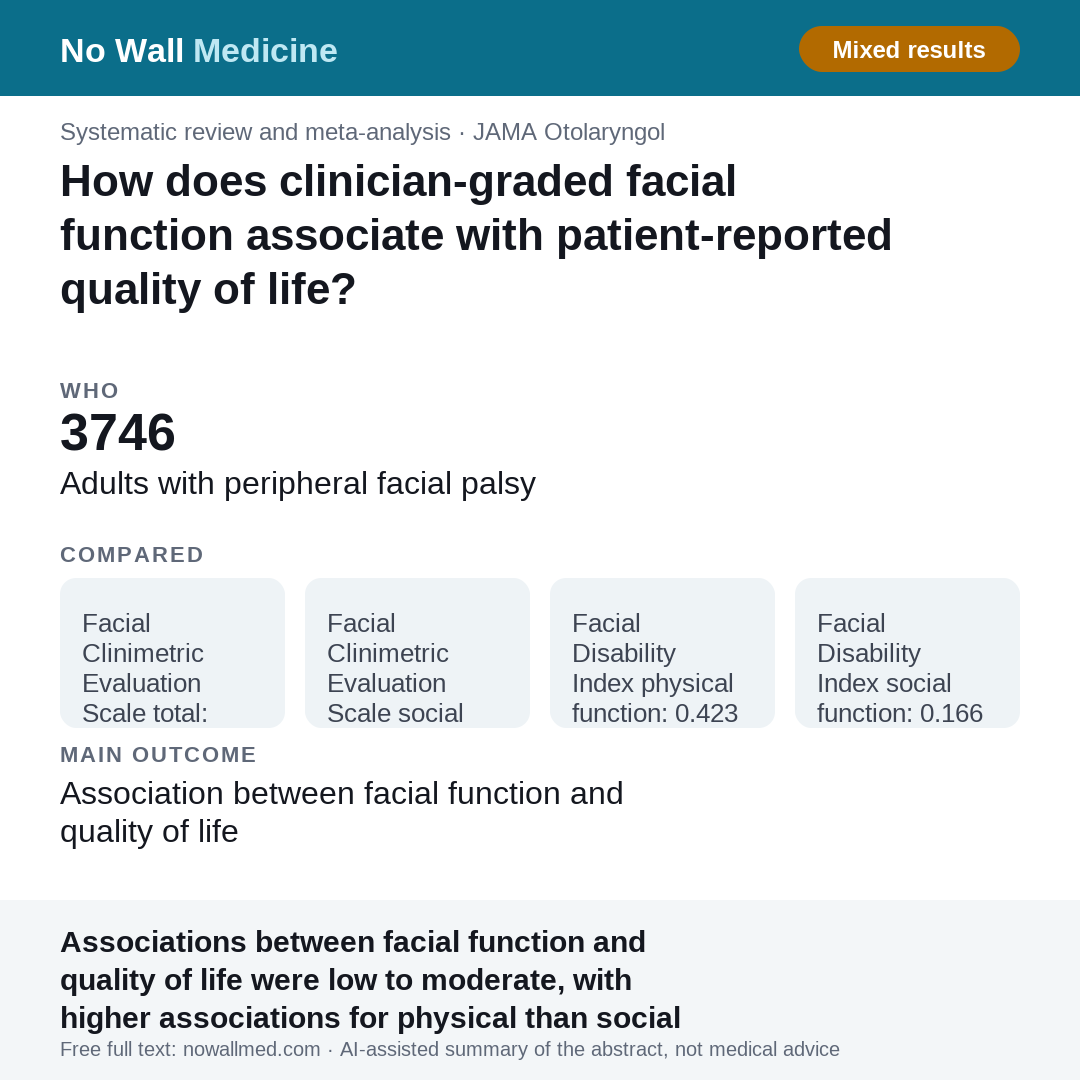
How does clinician-graded facial function associate with patient-reported quality of life?
Who
3746
Adults with peripheral facial palsy
Compared
Facial Clinimetric Evaluation Scale total: 0.424 (95% CI, 0.375-0.471) to 0.533 (95% CI, 0.447-0.610)
Facial Clinimetric Evaluation Scale social function: 0.324 (95% CI, 0.128-0.495) to 0.397 (95% CI, 0.242-0.532)
Facial Disability Index physical function: 0.423 (95% CI, 0.322-0.514) to 0.605 (95% CI, -0.124-0.910)
Facial Disability Index social function: 0.166 (95% CI, 0.044-0.283) to 0.208 (95% CI, 0.031-0.373)
Main outcome
Association between facial function and quality of life
Bottom line: Associations between facial function and quality of life were low to moderate, with higher associations for physical than social function.
JAMA Otolaryngol · 2021-07-02Download image
Clinical question: How does clinician-graded facial function associate with patient-reported quality of life?
Why it matters: It is unknown how well clinician-graded measures of facial movement reflect the actual quality of life experienced by adults with peripheral facial palsy.
Key points
- Researchers analyzed 23 studies involving 3746 adults with peripheral facial palsy, which is weakness or paralysis of the facial muscles.
- Clinician-graded facial function was linked to Facial Clinimetric Evaluation Scale total scores with pooled correlation coefficients of 0.424 (95% CI, 0.375-0.471) to 0.533 (95% CI, 0.447-0.610).
- The association between facial function and physical function was higher than the association with social function of quality of life.
Headline and key points written with AI from the paper’s abstract, with every number checked against it. Read the paper before relying on them.
Was this summary helpful?
Subject terms
Cite this article
Bruins TE, van Veen MM, Werker PMN, Dijkstra PU, Broekstra DC. Associations Between Clinician-Graded Facial Function and Patient-Reported Quality of Life in Adults With Peripheral Facial Palsy: A Systematic Review and Meta-analysis. JAMA Otolaryngol. 2021. doi:10.1001/jamaoto.2021.1290
Spotted a mistake? Suggest a correction