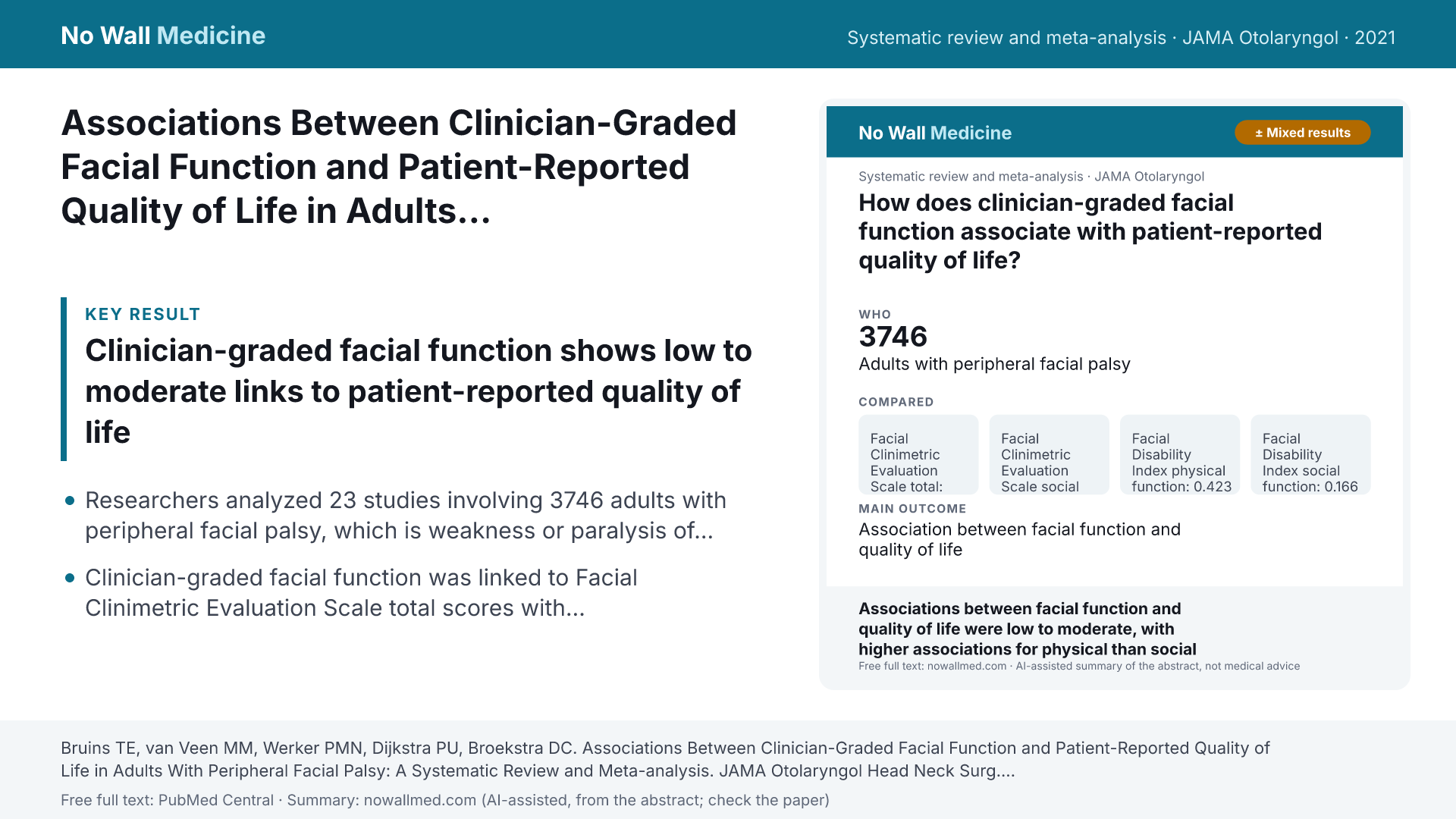
Associations Between Clinician-Graded Facial Function and Patient-Reported Quality of Life in Adults With Peripheral Facial Palsy: A Systematic Review and Meta-analysis
Key result: Clinician-graded facial function shows low to moderate links to patient-reported quality of life
Systematic review and meta-analysisMixed results
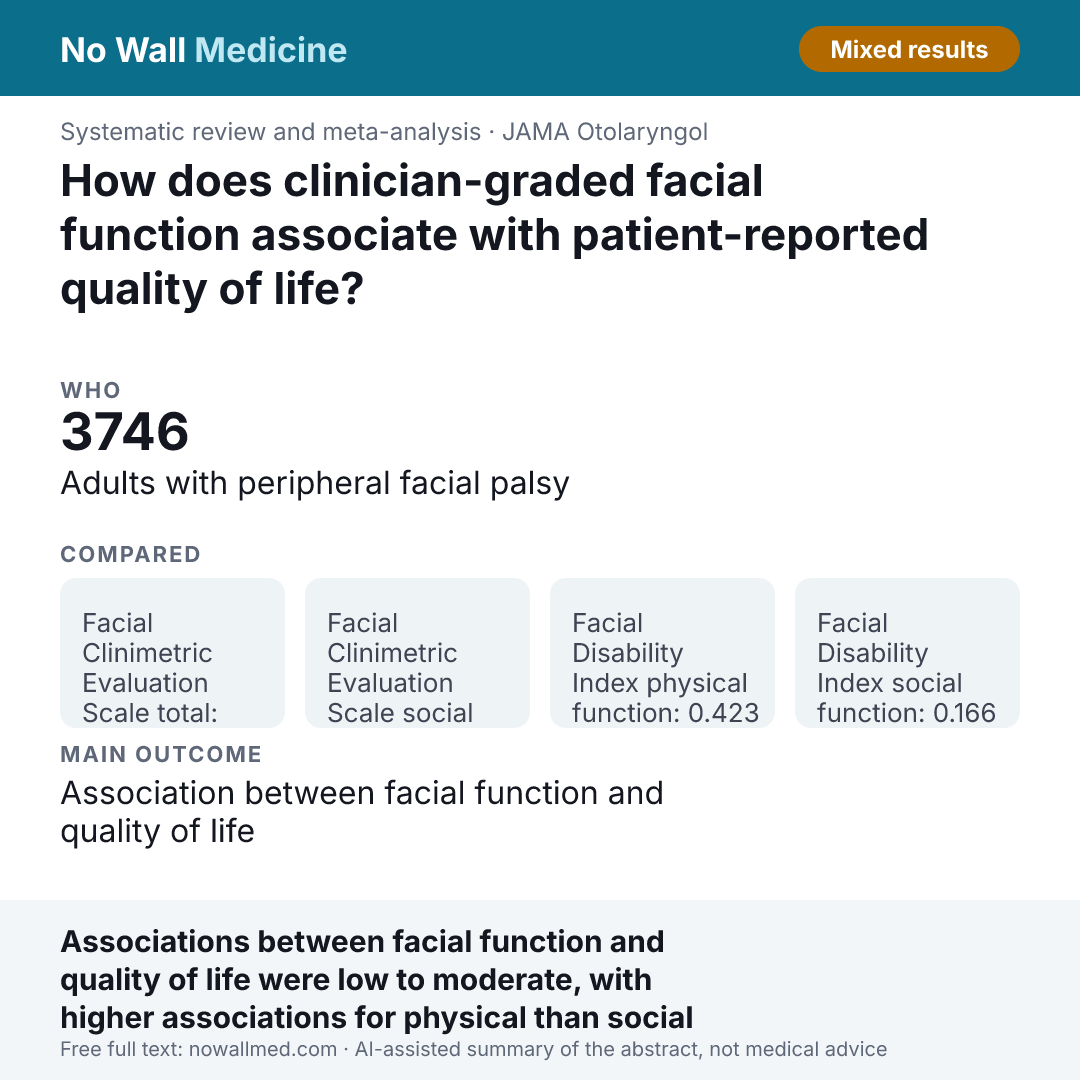
How does clinician-graded facial function associate with patient-reported quality of life?
Who
3746
Adults with peripheral facial palsy
Compared
Facial Clinimetric Evaluation Scale total: 0.424 (95% CI, 0.375-0.471) to 0.533 (95% CI, 0.447-0.610)
Facial Clinimetric Evaluation Scale social function: 0.324 (95% CI, 0.128-0.495) to 0.397 (95% CI, 0.242-0.532)
Facial Disability Index physical function: 0.423 (95% CI, 0.322-0.514) to 0.605 (95% CI, -0.124-0.910)
Facial Disability Index social function: 0.166 (95% CI, 0.044-0.283) to 0.208 (95% CI, 0.031-0.373)
Main outcome
Association between facial function and quality of life
Bottom line: Associations between facial function and quality of life were low to moderate, with higher associations for physical than social function.
JAMA Otolaryngol · 2021-07-02 · Save PNG
Key points
- Researchers analyzed 23 studies involving 3746 adults with peripheral facial palsy, which is weakness or paralysis of the facial muscles.
- Clinician-graded facial function was linked to Facial Clinimetric Evaluation Scale total scores with pooled correlation coefficients of 0.424 (95% CI, 0.375-0.471) to 0.533 (95% CI, 0.447-0.610).
- The association between facial function and physical function was higher than the association with social function of quality of life.
Discussion prompts
- Would these patients look like yours? Who was left out?
- Is the main outcome one that matters to patients?
- Is the difference large enough to change what you do?
Cite: Bruins TE, van Veen MM, Werker PMN, Dijkstra PU, Broekstra DC. Associations Between Clinician-Graded Facial Function and Patient-Reported Quality of Life in Adults With Peripheral Facial Palsy: A Systematic Review and Meta-analysis. JAMA Otolaryngol Head Neck Surg. 2021;147(8):717-728. doi:10.1001/jamaoto.2021.1290
Free full text: PubMed Central · Summary and visual abstract: nowallmed.com/a/associations-between-clinician-graded-facial-function-and-patient-2awhnh/ (AI-assisted from the abstract; check the paper before relying on it).