New York Heart Association classification shows overlap in objective measures and prognosis for mild heart failure
Associations Between New York Heart Association Classification, Objective Measures, and Long-term Prognosis in Mild Heart Failure: A Secondary Analysis of the PARADIGM-HF Trial
Secondary analysis of a randomized trialMixed results
How do NYHA classification and NT-proBNP levels associate with long-term prognosis in mild heart failure?
Who
8326
Patients with heart failure in New York Heart Association class II or higher · PARADIGM-HF trial
Compared
New York Heart Association class I
New York Heart Association class II
New York Heart Association class III
Main outcome
Cardiovascular death or first heart failure hospitalization
Result: NYHA III vs I, hazard ratio 1.84 (95% CI, 1.44-2.37)
Bottom line: New York Heart Association class I and II patients overlap in prognosis, potentially concealing patients at risk for adverse outcomes.
Limitation: New York Heart Association classification might be limited to differentiate mild forms of heart failure.
JAMA Cardiol · 2022-12-09Download image
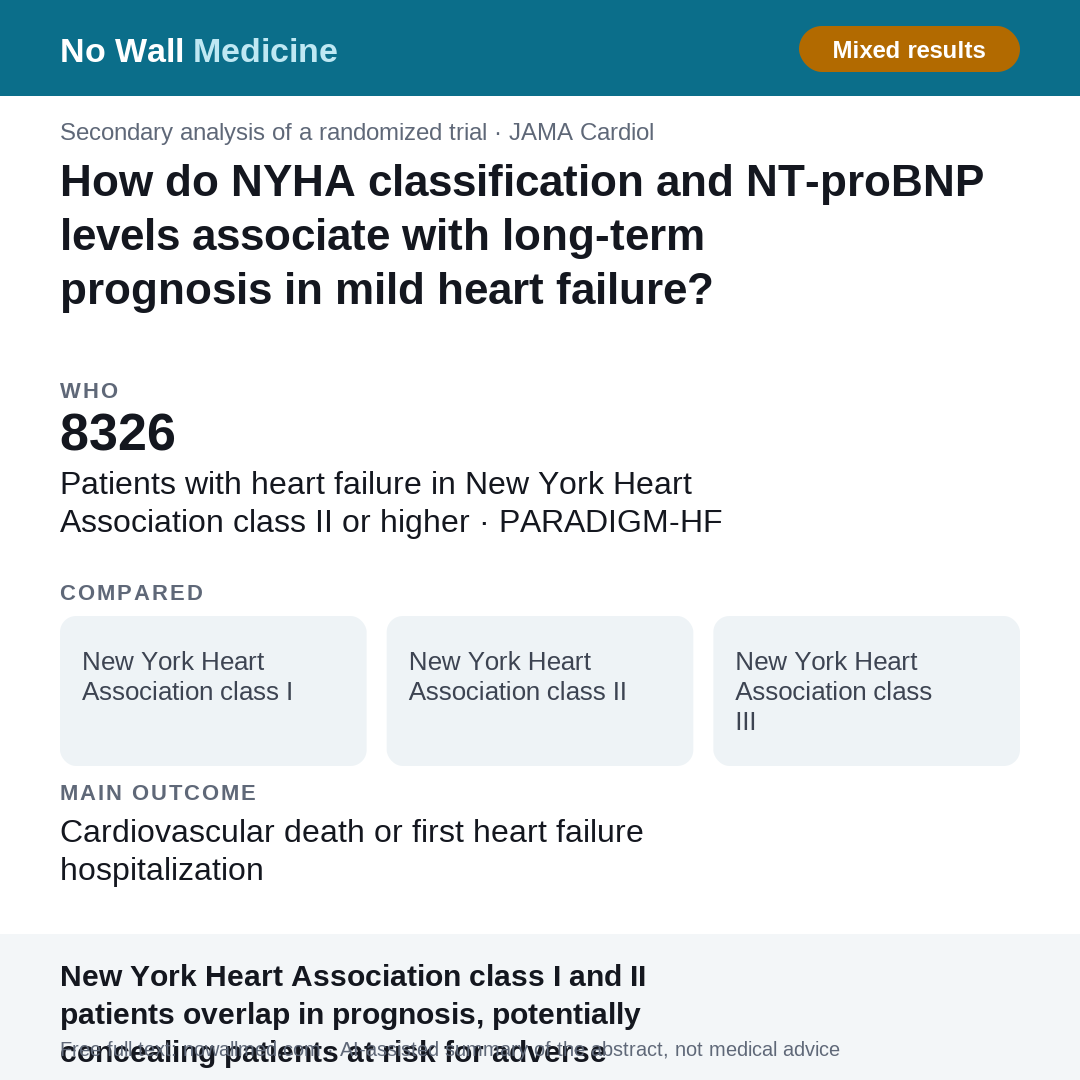
Clinical question: How do NYHA classification and NT-proBNP levels associate with long-term prognosis in mild heart failure?
Why it matters: Current treatment recommendations rely on New York Heart Association classification, which may not accurately identify patients at risk for adverse outcomes in mild heart failure.
Key points
- Researchers analyzed 8326 patients from the PARADIGM-HF trial to compare New York Heart Association functional classes and N-terminal pro-B-type natriuretic peptide levels.
- Patients in class I showed a 58% rate of changing functional class during the first year, while N-terminal pro-B-type natriuretic peptide levels had an area under the curve of 0.51 for distinguishing class I from class II.
- Class III patients were associated with higher rates of cardiovascular death or heart failure hospitalization compared to class I (hazard ratio, 1.84) and class II (hazard ratio, 1.49).
Headline and key points written with AI from the paper’s abstract, with every number checked against it. Read the paper before relying on them.
Was this summary helpful?
Subject terms
Cite this article
Rohde LE, Zimerman A, Vaduganathan M, Claggett BL, Packer M, Desai AS. Associations Between New York Heart Association Classification, Objective Measures, and Long-term Prognosis in Mild Heart Failure: A Secondary Analysis of the PARADIGM-HF Trial. JAMA Cardiol. 2022. doi:10.1001/jamacardio.2022.4427
Spotted a mistake? Suggest a correction
Top studies every Monday
The week’s key trials and guidelines in your specialties, plus any topics you follow. By email, free.
Get the weekly digest