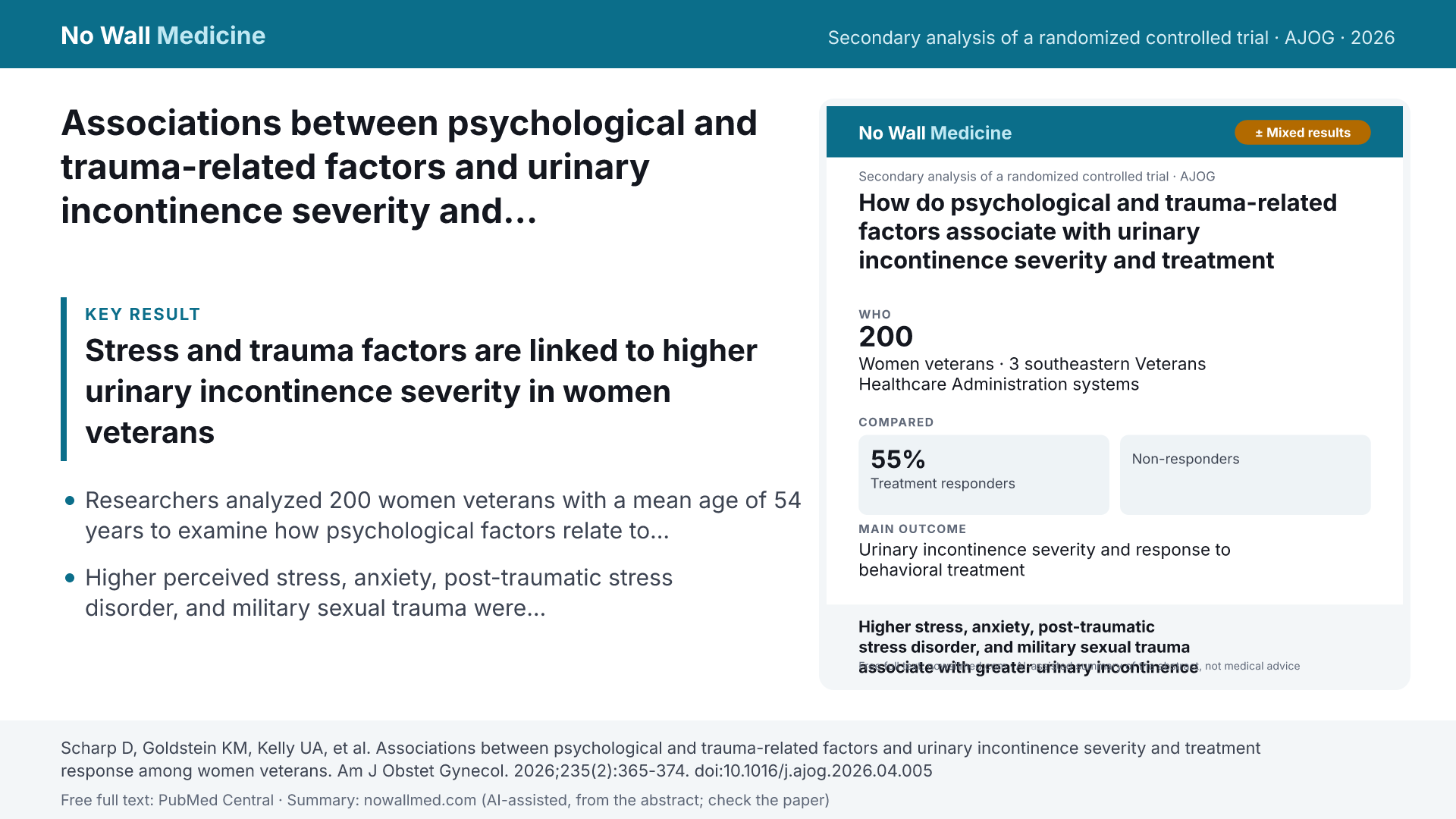
Stress and trauma factors are linked to higher urinary incontinence severity in women veterans
Associations between psychological and trauma-related factors and urinary incontinence severity and treatment response among women veterans
Secondary analysis of a randomized controlled trialMixed results
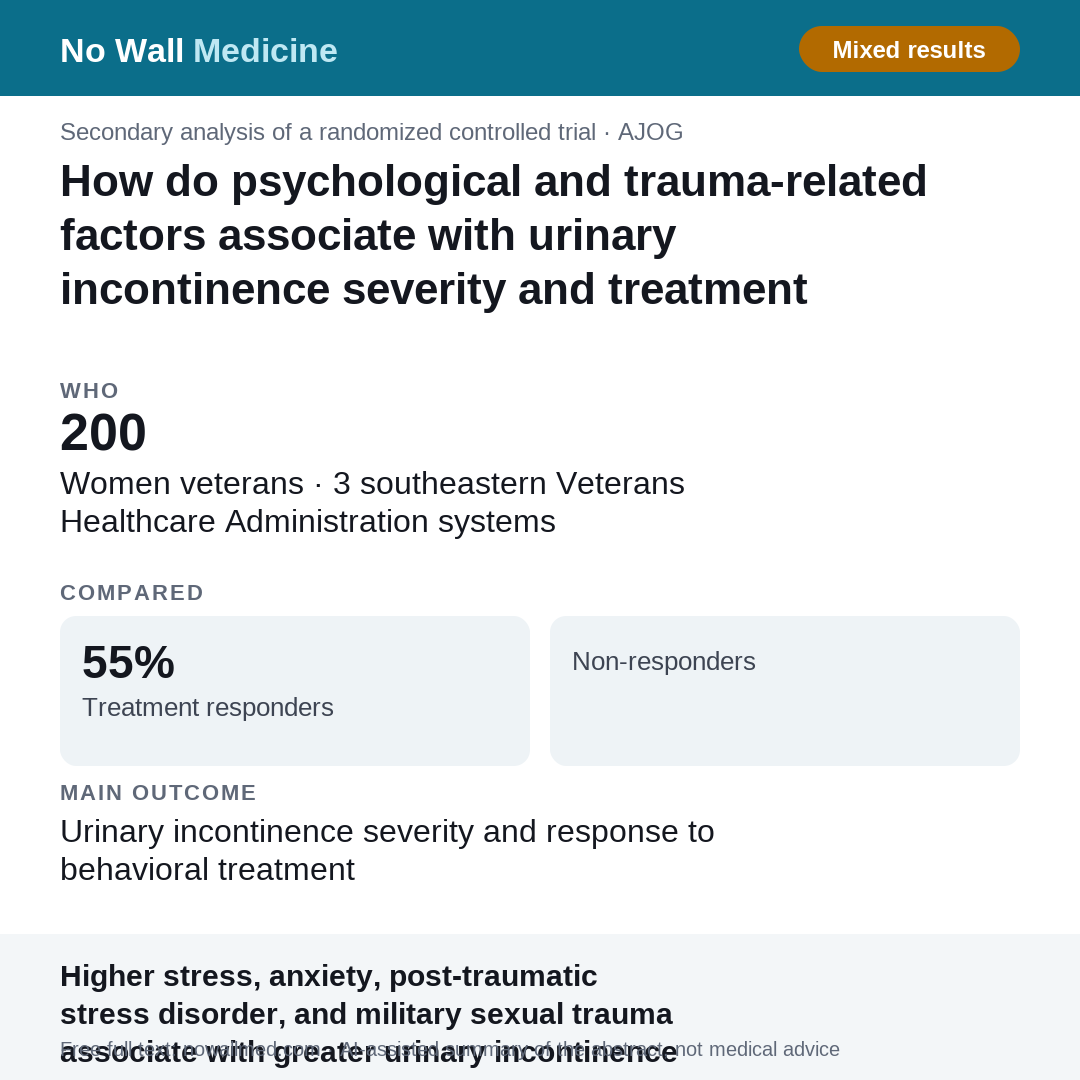
How do psychological and trauma-related factors associate with urinary incontinence severity and treatment response?
Who
200
Women veterans · 3 southeastern Veterans Healthcare Administration systems
Compared
55%Treatment responders (109/200)
Non-responders
Main outcome
Urinary incontinence severity and response to behavioral treatment
Result: adjusted odds ratio 0.98 (95% CI 0.97 to 0.99)
Bottom line: Higher stress, anxiety, post-traumatic stress disorder, and military sexual trauma associate with greater urinary incontinence severity.
AJOG · 2026-04-09Download image
Clinical question: How do psychological and trauma-related factors associate with urinary incontinence severity and treatment response?
Why it matters: It is unclear how psychological and trauma-related factors influence the severity of urinary incontinence and the effectiveness of behavioral treatments in women veterans.
Key points
- Researchers analyzed 200 women veterans with a mean age of 54 years to examine how psychological factors relate to urinary incontinence severity and treatment response.
- Higher perceived stress, anxiety, post-traumatic stress disorder, and military sexual trauma were significantly associated with greater urinary incontinence severity.
- Among the participants, 55% of women were classified as responders to behavioral treatment, but higher perceived stress was associated with lower odds of responding.
Headline and key points written with AI from the paper’s abstract, with every number checked against it. Read the paper before relying on them.
Was this summary helpful?
Subject terms
Cite this article
Scharp D, Goldstein KM, Kelly UA, et al. Associations between psychological and trauma-related factors and urinary incontinence severity and treatment response among women veterans. AJOG. 2026. doi:10.1016/j.ajog.2026.04.005
Spotted a mistake? Suggest a correction