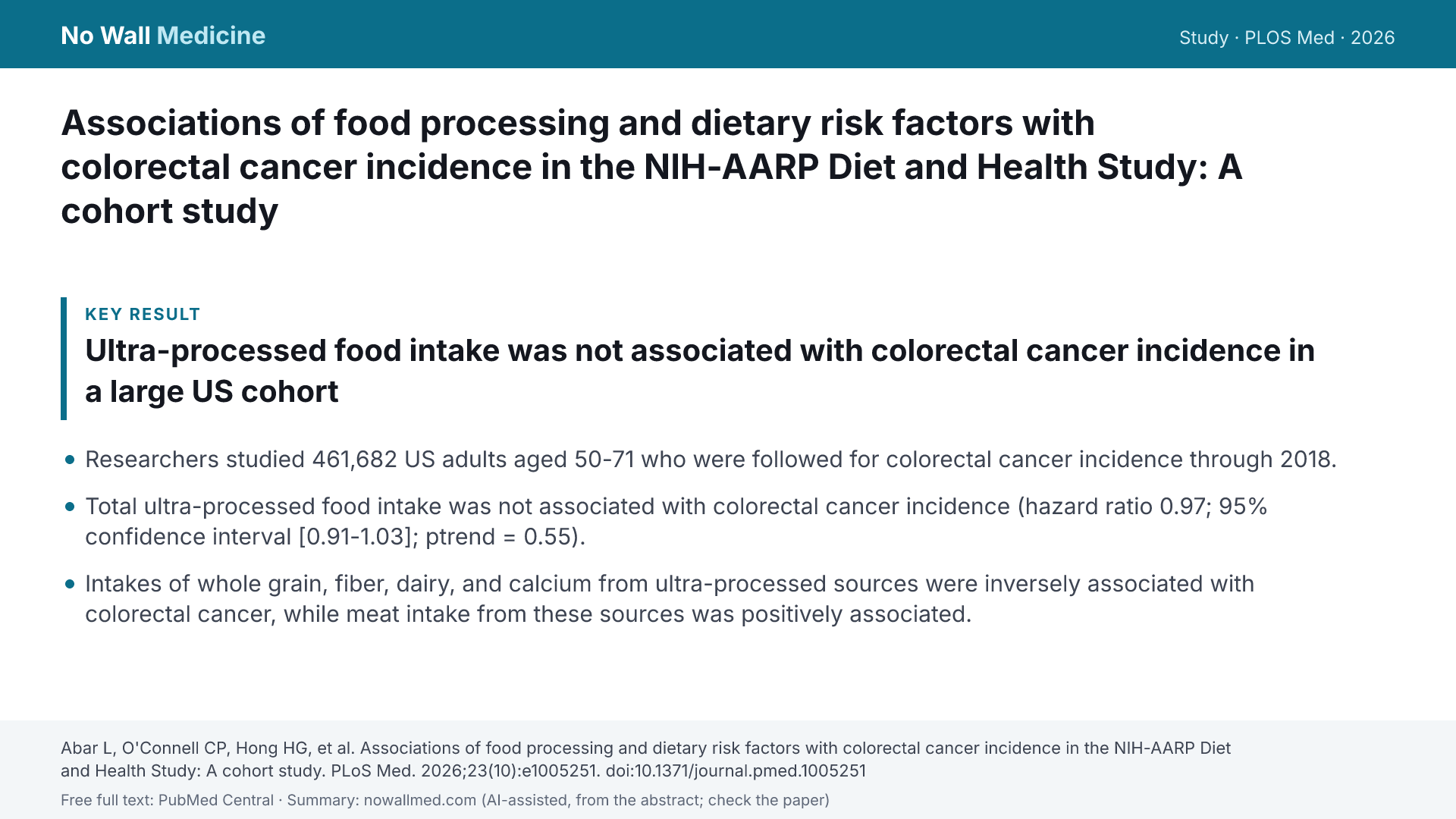
Ultra-processed food intake was not associated with colorectal cancer incidence in a large US cohort
Associations of food processing and dietary risk factors with colorectal cancer incidence in the NIH-AARP Diet and Health Study: A cohort study
Why it matters: Evidence is inconsistent regarding whether ultra-processed food intake is linked to colorectal cancer risk due to varying dietary components within these foods.
Key points
- Researchers studied 461,682 US adults aged 50-71 who were followed for colorectal cancer incidence through 2018.
- Total ultra-processed food intake was not associated with colorectal cancer incidence (hazard ratio 0.97; 95% confidence interval [0.91-1.03]; ptrend = 0.55).
- Intakes of whole grain, fiber, dairy, and calcium from ultra-processed sources were inversely associated with colorectal cancer, while meat intake from these sources was positively associated.
Limitation the authors note: The study's observational design may involve potential residual confounding and exposure misclassification from self-reported dietary data.
Study type: Observational study: it can show a link, but not prove that one thing causes another.
Headline and key points written with AI from the paper’s abstract, with every number checked against it. Read the paper before relying on them.
Was this summary helpful?
Subject terms
Cite this article
Abar L, O'Connell CP, Hong HG, et al. Associations of food processing and dietary risk factors with colorectal cancer incidence in the NIH-AARP Diet and Health Study: A cohort study. PLoS Med. 2026;23(10):e1005251. doi:10.1371/journal.pmed.1005251
Spotted a mistake? Suggest a correction