Associations of food processing and dietary risk factors with colorectal cancer incidence in the NIH-AARP Diet and Health Study: A cohort study
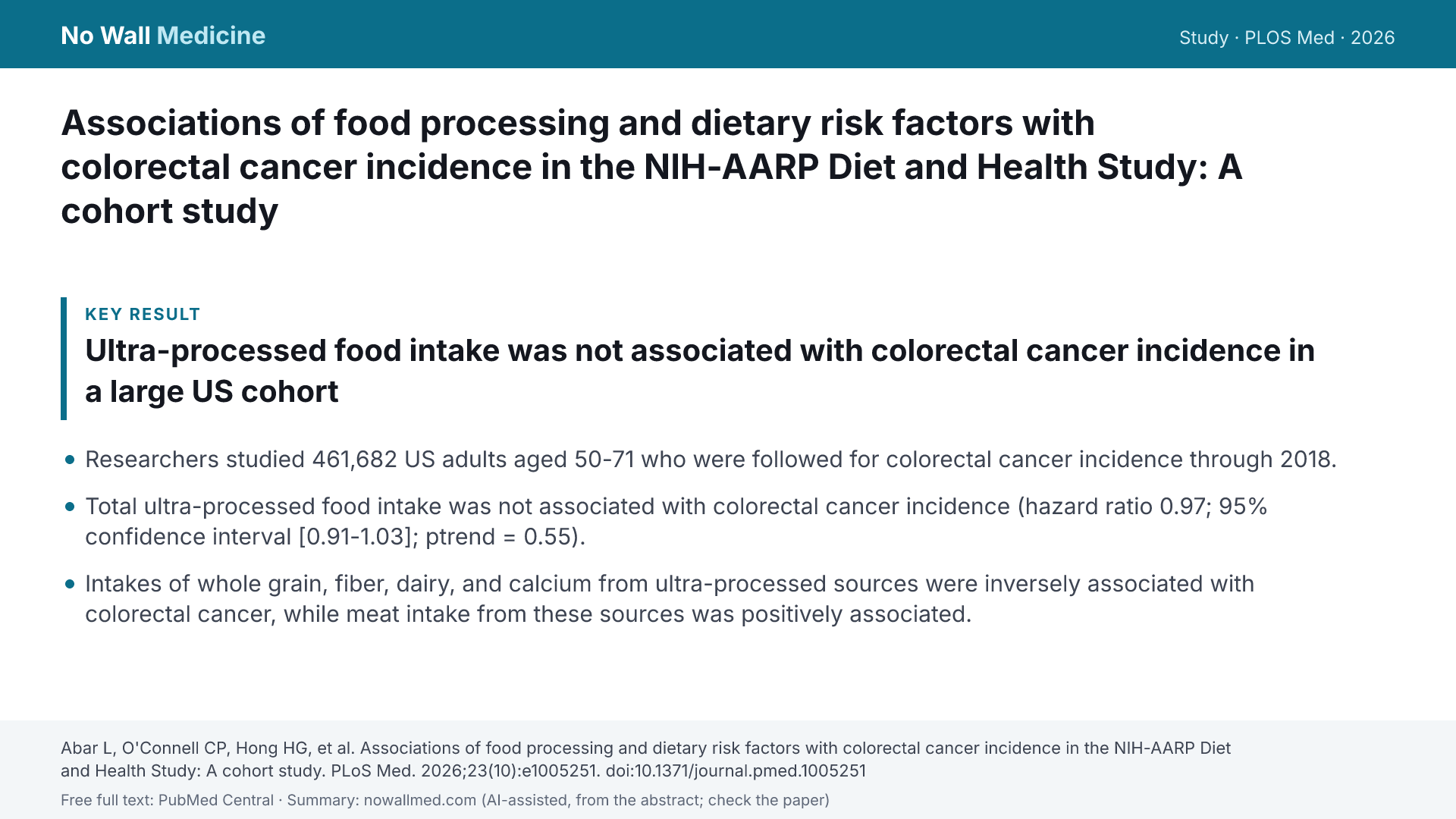
Key result: Ultra-processed food intake was not associated with colorectal cancer incidence in a large US cohort
Key points
- Researchers studied 461,682 US adults aged 50-71 who were followed for colorectal cancer incidence through 2018.
- Total ultra-processed food intake was not associated with colorectal cancer incidence (hazard ratio 0.97; 95% confidence interval [0.91-1.03]; ptrend = 0.55).
- Intakes of whole grain, fiber, dairy, and calcium from ultra-processed sources were inversely associated with colorectal cancer, while meat intake from these sources was positively associated.
Why it matters: Evidence is inconsistent regarding whether ultra-processed food intake is linked to colorectal cancer risk due to varying dietary components within these foods.
Limitation the authors note: The study's observational design may involve potential residual confounding and exposure misclassification from self-reported dietary data.
Discussion prompts
- Would these patients look like yours? Who was left out?
- Is the main outcome one that matters to patients?
- Is the difference large enough to change what you do?
Cite: Abar L, O'Connell CP, Hong HG, et al. Associations of food processing and dietary risk factors with colorectal cancer incidence in the NIH-AARP Diet and Health Study: A cohort study. PLoS Med. 2026;23(10):e1005251. doi:10.1371/journal.pmed.1005251
Free full text: PubMed Central · Summary and visual abstract: nowallmed.com/a/associations-of-food-processing-and-dietary-risk-factors-with-5avfru/ (AI-assisted from the abstract; check the paper before relying on it).