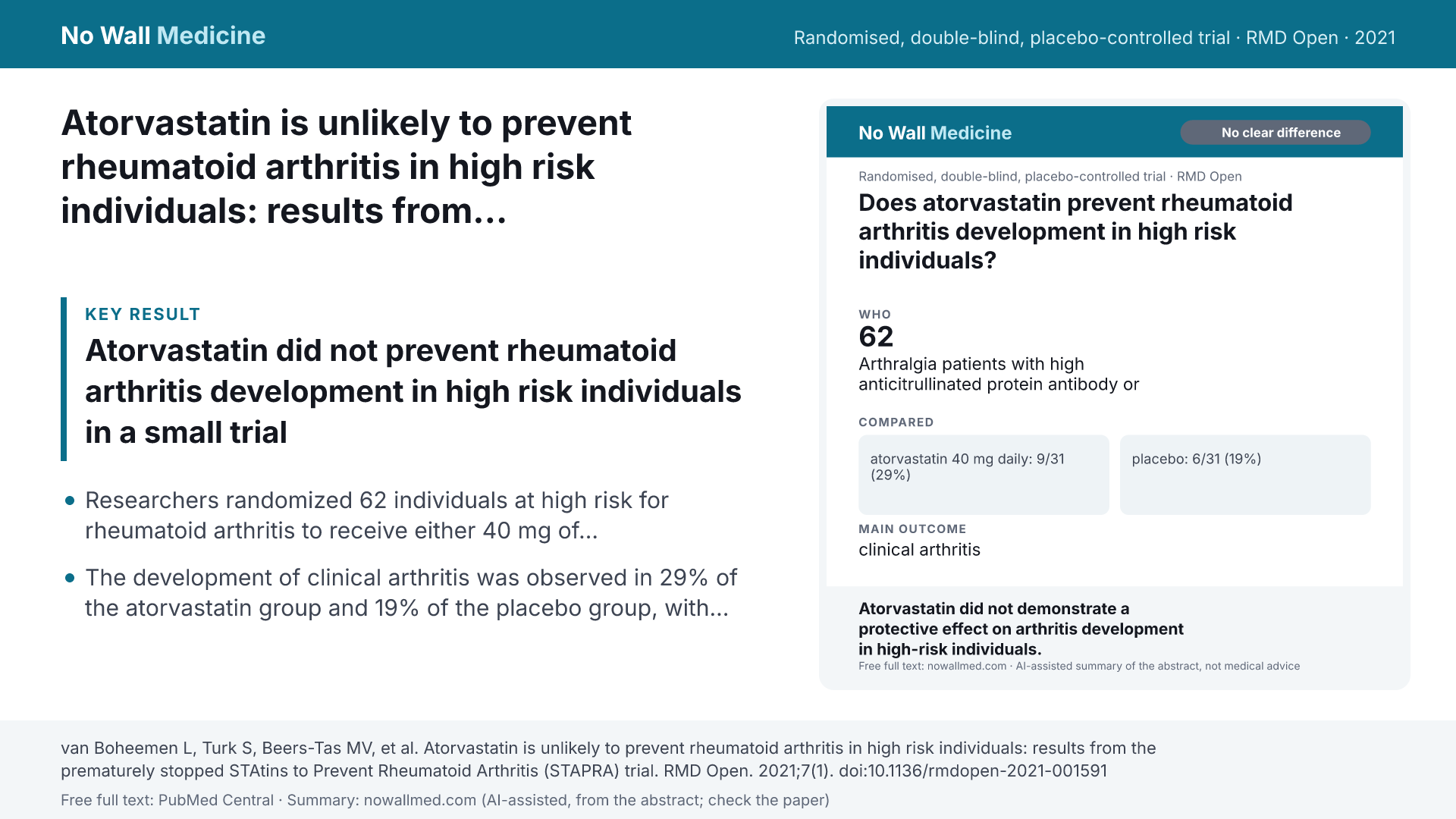
Atorvastatin did not prevent rheumatoid arthritis development in high risk individuals in a small trial
Atorvastatin is unlikely to prevent rheumatoid arthritis in high risk individuals: results from the prematurely stopped STAtins to Prevent Rheumatoid Arthritis (STAPRA) trial
Randomised, double-blind, placebo-controlled trialNo clear difference
Does atorvastatin prevent rheumatoid arthritis development in high risk individuals?
Who
62
Arthralgia patients with high anticitrullinated protein antibody or rheumatoid factor
Compared
atorvastatin 40 mg daily: 9/31 (29%)
placebo: 6/31 (19%)
Main outcome
clinical arthritis
Result: hazard ratio 1.40, 95% CI 0.50 to 3.95
Bottom line: Atorvastatin did not demonstrate a protective effect on arthritis development in high-risk individuals.
RMD Open · 2021-03-09 · Save PNG
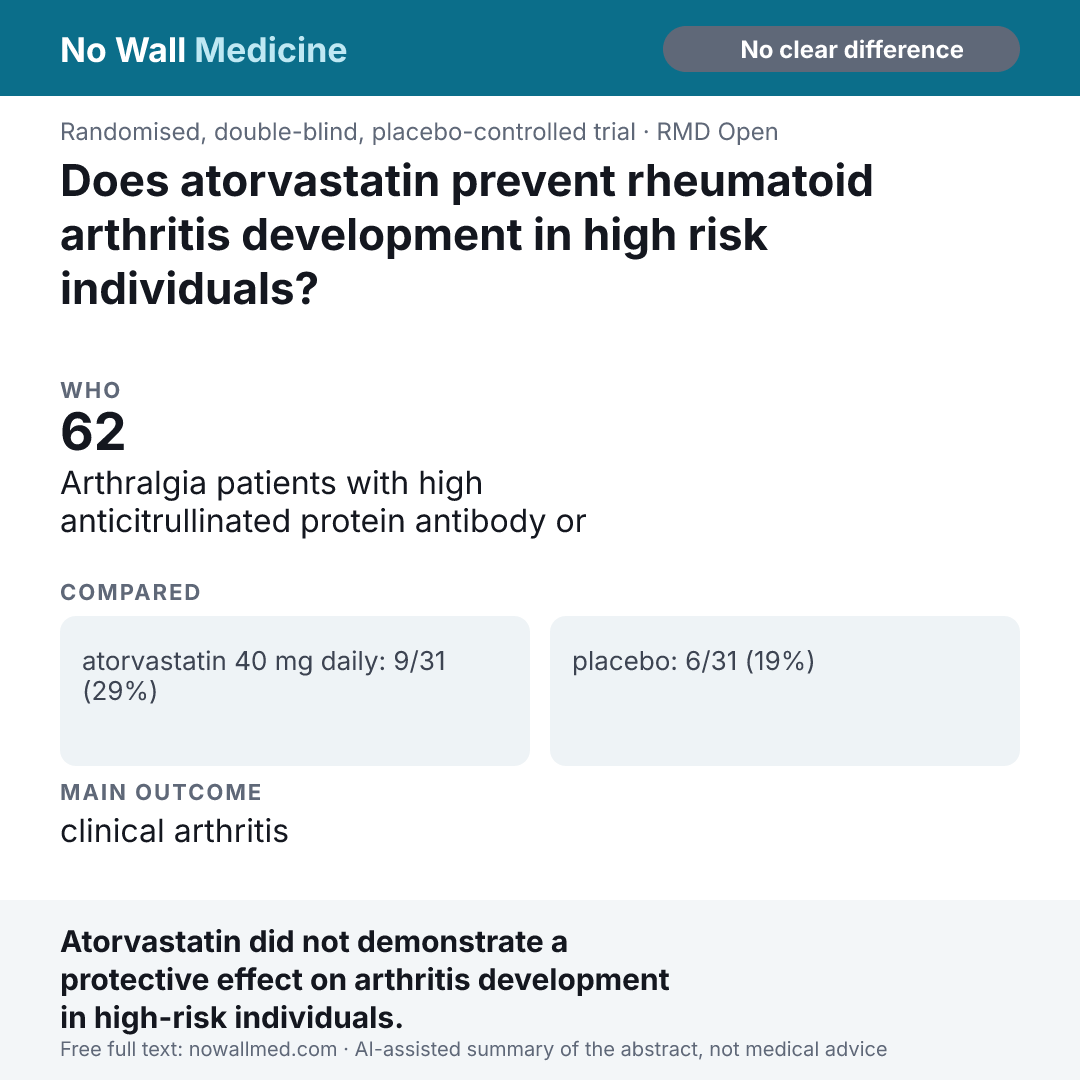
Clinical question: Does atorvastatin prevent rheumatoid arthritis development in high risk individuals?
Key points
- Researchers randomized 62 individuals at high risk for rheumatoid arthritis to receive either 40 mg of atorvastatin daily or a placebo for a median of 14 months.
- The development of clinical arthritis was observed in 29% of the atorvastatin group and 19% of the placebo group, with a hazard ratio of 1.40 (95% CI 0.50 to 3.95).
- The trial was stopped prematurely because of a low inclusion rate caused by participant unwillingness to join the study.
Limitation the authors note: The trial was stopped prematurely due to a low inclusion rate caused by participant unwillingness to participate.
Headline and key points written with AI from the paper’s abstract, with every number checked against it. Read the paper before relying on them.
Was this summary helpful?
Abstract
Objectives
Persons at high risk of rheumatoid arthritis (RA) might benefit from a low-risk pharmacological intervention aimed at primary prevention. Previous studies demonstrated disease-modifying effects of statins in patients with RA as well as an association between statin use and a decreased risk of RA development. A randomised, double-blind, placebo-controlled trial investigated whether atorvastatin could prevent arthritis development in high-risk individuals. Methods
Arthralgia patients with anticitrullinated protein antibody (ACPA) >3 xULN or ACPA and rheumatoid factor, without (a history of) arthritis, were randomised to receive atorvastatin 40 mg daily or placebo for 3 years. The calculated sample size was 220 participants. The primary endpoint was clinical arthritis. Cox regression analysis was used to determine the effect of atorvastatin on arthritis development. Results
Due to a low inclusion rate, mainly because of an unwillingness to participate, the trial was prematurely stopped. Data of the 62 randomised individuals were analysed. Median follow-up was 14 (inner quartiles 6-35) months. Fifteen individuals (24%) developed arthritis: 9/31 (29%) in the atorvastatin group; 6/31 (19%) in the placebo group: HR 1.40, 95% CI 0.50 to 3.95. Conclusions
In this small set of randomised high-risk individuals, we did not demonstrate a protective effect of atorvastatin on arthritis development. The main reason for the low inclusion was unwillingness to participate; this may also impede other RA prevention trials. Further research to investigate and solve barriers for prevention trial participation is needed.
Abstract reproduced under the article’s CC BY NC licence.
Subject terms
Headline, design, result, key points, caveat and citation as plain text.
Cite this article
van Boheemen L, Turk S, Beers-Tas MV, et al. Atorvastatin is unlikely to prevent rheumatoid arthritis in high risk individuals: results from the prematurely stopped STAtins to Prevent Rheumatoid Arthritis (STAPRA) trial. RMD Open. 2021;7(1). doi:10.1136/rmdopen-2021-001591
Spotted a mistake? Suggest a correction