Dazodalibep showed greater reduction in rheumatoid arthritis disease activity than placebo in phase II trial
The MIDORA trial: a phase II, randomised, double-blind, placebo-controlled, mechanistic insight and dosage optimisation study of the efficacy and safety of dazodalibep in patients with rheumatoid arthritis
Randomized, double-blind, placebo-controlled trialBenefit found
What are the efficacy and safety of different dazodalibep dosing regimens in rheumatoid arthritis?
Who
78
Adult patients with moderate-to-severe active rheumatoid arthritis
Compared
Dazodalibep groups: -1.83±0.28 to -1.90±0.27
Placebo: -1.06±0.26
Main outcome
Change from baseline in Disease Activity Score-28 with C reactive protein
Bottom line: Dazodalibep significantly reduced disease activity compared to placebo in patients with rheumatoid arthritis.
RMD Open · 2023-08-05Download image
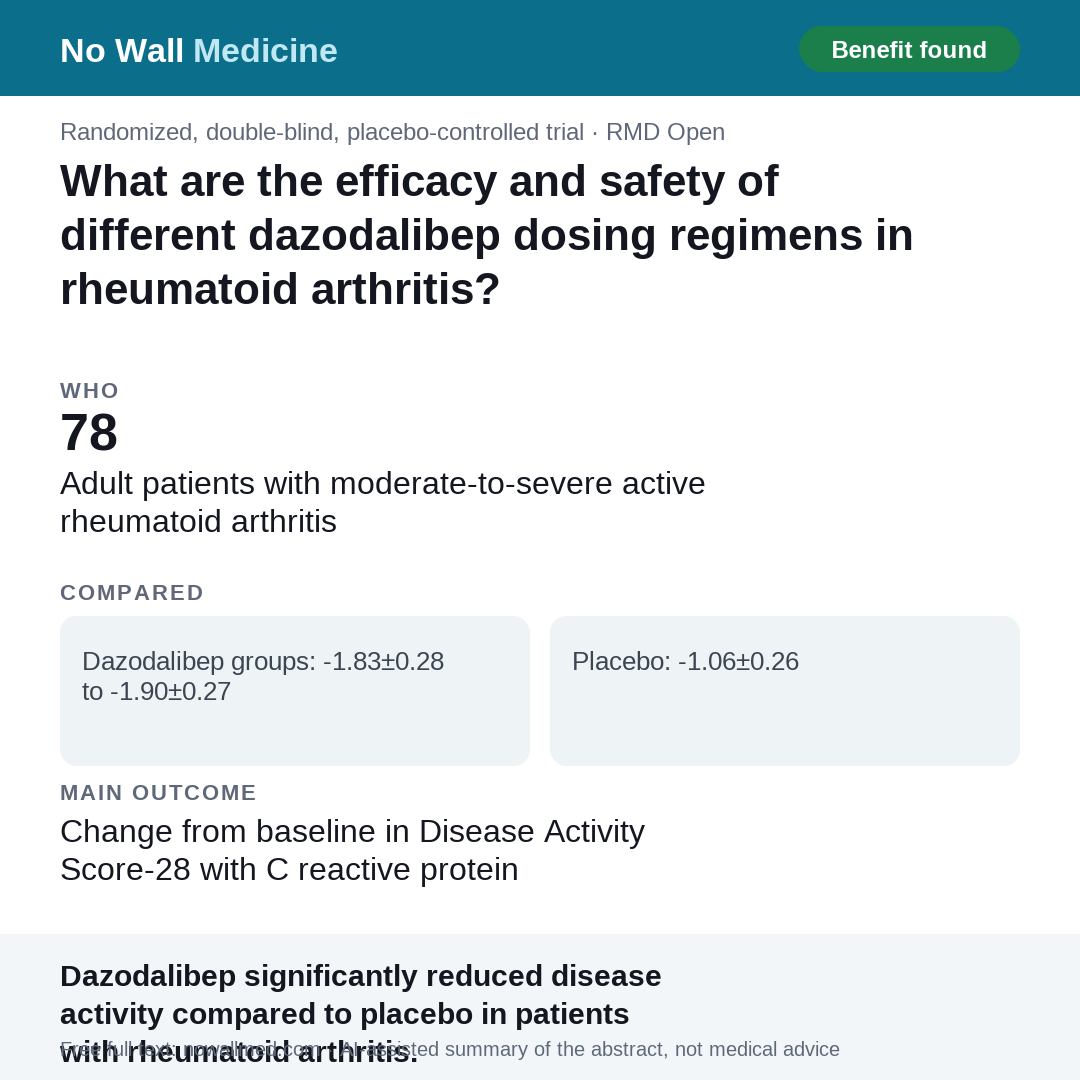
Clinical question: What are the efficacy and safety of different dazodalibep dosing regimens in rheumatoid arthritis?
Why it matters: The optimal dosing regimens and safety of dazodalibep, a non-antibody biological antagonist of CD40L, were unknown for patients with rheumatoid arthritis.
Key points
- The study randomized 78 adult patients with moderate-to-severe active rheumatoid arthritis to receive either intravenous infusions of dazodalibep or a placebo.
- At day 113, the change in the Disease Activity Score-28 with C reactive protein was -1.83±0.28 to -1.90±0.27 for dazodalibep groups compared to -1.06±0.26 for placebo.
- Adverse events were reported in 74% of the dazodalibep groups and 63% of the placebo group, with four serious adverse events deemed unrelated to the medication.
Headline and key points written with AI from the paper’s abstract, with every number checked against it. Read the paper before relying on them.
Was this summary helpful?
Abstract
Objectives
To evaluate the safety, efficacy and response duration of four different dosing regimens of dazodalibep (DAZ), a non-antibody biological antagonist of CD40L, in patients with rheumatoid arthritis (RA). Methods
This double-blind study included adult patients with moderate-to-severe active RA with a positive test for serum rheumatoid factor and/or anticitrullinated protein antibodies, an inadequate response to methotrexate, other conventional disease-modifying antirheumatic drugs or tumour necrosis factor-α inhibitors, and no prior treatment with B-cell depleting agents. Eligible participants were randomised equally to five groups receiving intravenous infusions of DAZ or placebo. The primary endpoint was the change from baseline in the Disease Activity Score-28 with C reactive protein (DAS28-CRP) at day 113. Participants were followed through day 309. Results
The study randomised 78 eligible participants. The change from baseline in DAS28-CRP (least squares means±SE) at day 113 was significantly greater for all DAZ groups (-1.83±0.28 to -1.90±0.27; p<0.05) relative to PBO (-1.06±0.26); significant reductions in DAS28-CRP were also observed for all DAZ groups at day 309. The distribution of adverse events was generally balanced among DAZ and PBO groups (74% and 63%, respectively). There were four serious adverse events deemed by investigators to be unrelated to study medication. Conclusions
DAZ treatment for all dosage regimens significantly reduced DAS28-CRP at day 113 relative to PBO. The safety data suggest an acceptable safety and tolerability profile. Treatment effects at day 113 and the prolonged duration of responses after DAZ cessation support the use of longer dosing intervals. Trial registration number
NCT04163991.
Abstract reproduced under the article’s CC BY NC licence.
Subject terms
Cite this article
Kivitz A, Wang L, Alevizos I, Gunsior M, Falloon J, Illei G. The MIDORA trial: a phase II, randomised, double-blind, placebo-controlled, mechanistic insight and dosage optimisation study of the efficacy and safety of dazodalibep in patients with rheumatoid arthritis. RMD Open. 2023. doi:10.1136/rmdopen-2023-003317
Spotted a mistake? Suggest a correction
Top studies every Monday
The week’s key trials and guidelines in your specialties, plus any topics you follow. By email, free.
Get the weekly digest