Adding tumor necrosis factor inhibitors or triple therapy showed similar reductions in arterial inflammation
Reducing cardiovascular risk with immunomodulators: a randomised active comparator trial among patients with rheumatoid arthritis
Randomized active comparator trialNo clear difference
Does adding tumor necrosis factor inhibitor or triple therapy reduce arterial inflammation in rheumatoid arthritis?
Who
115
Patients with active rheumatoid arthritis despite methotrexate use
Compared
-0.24Addition of tumor necrosis factor inhibitor (SD=0.51)
-0.19Addition of sulfasalazine and hydroxychloroquine triple therapy (SD=0.51)
Main outcome
Change in arterial target-to-background ratio in carotid arteries and aorta
Result: difference in Δs: -0.02, 95% CI -0.19 to 0.15
Bottom line: Adding either tumor necrosis factor inhibitor or triple therapy improves vascular inflammation similarly in rheumatoid arthritis patients.
Ann Rheum Dis · 2022-11-30Download image
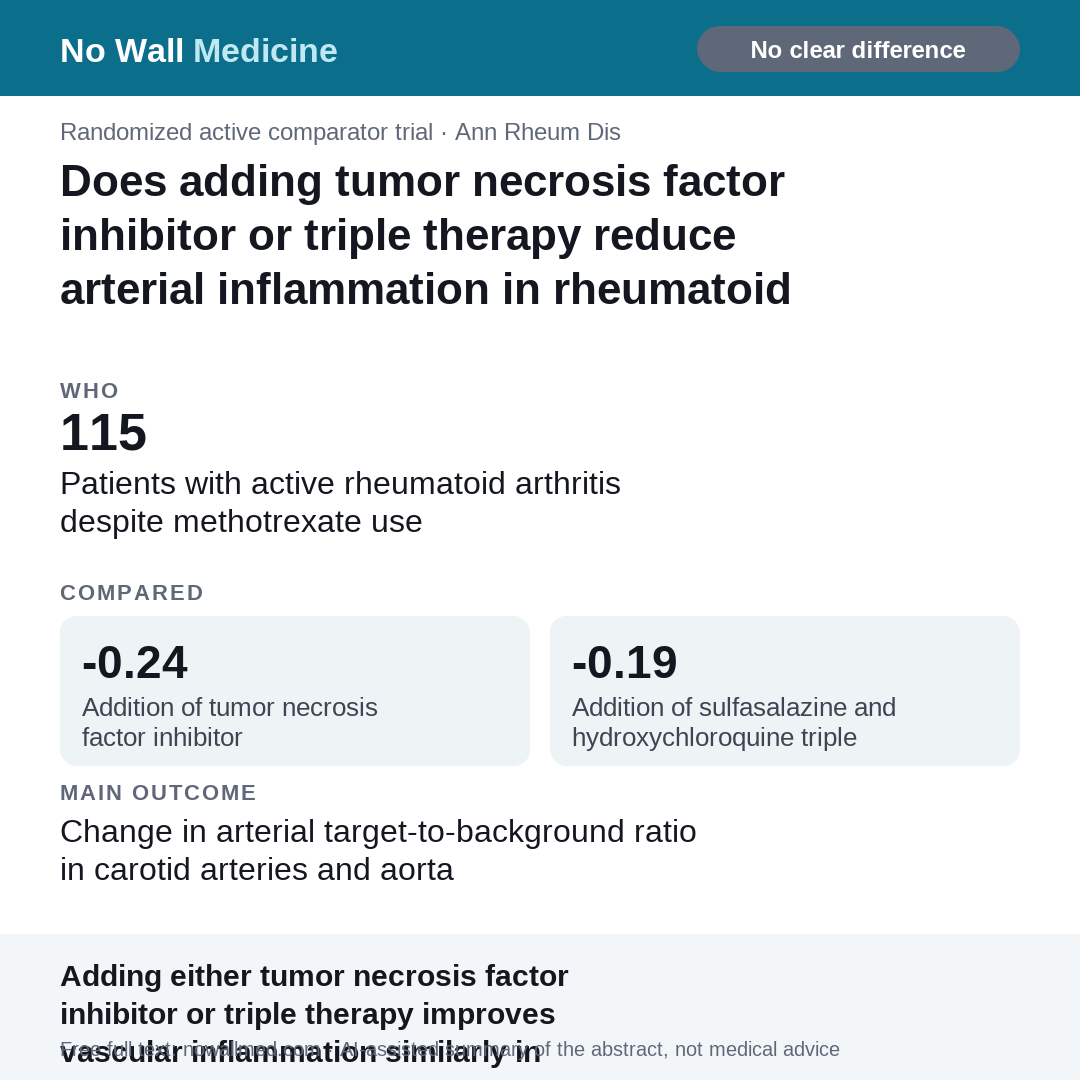
Clinical question: Does adding tumor necrosis factor inhibitor or triple therapy reduce arterial inflammation in rheumatoid arthritis?
Why it matters: It is uncertain if immunomodulators reduce cardiovascular risk in rheumatoid arthritis patients or if specific treatment strategies are more effective at reducing arterial inflammation.
Key points
- Researchers studied 115 patients with active rheumatoid arthritis who were randomly assigned to receive either a tumor necrosis factor inhibitor or triple therapy consisting of sulfasalazine and hydroxychloroquine.
- Both treatment groups showed significant reductions in arterial inflammation, measured by the target-to-background ratio in the carotid arteries and aorta, with no significant difference between the two groups.
- Reductions in disease activity were not associated with changes in the arterial inflammation index.
Headline and key points written with AI from the paper’s abstract, with every number checked against it. Read the paper before relying on them.
Was this summary helpful?
Abstract
Objective
Recent large-scale randomised trials demonstrate that immunomodulators reduce cardiovascular (CV) events among the general population. However, it is uncertain whether these effects apply to rheumatoid arthritis (RA) and if certain treatment strategies in RA reduce CV risk to a greater extent. Methods
Patients with active RA despite use of methotrexate were randomly assigned to addition of a tumour necrosis factor (TNF) inhibitor (TNFi) or addition of sulfasalazine and hydroxychloroquine (triple therapy) for 24 weeks. Baseline and follow-up 18F-fluorodeoxyglucose-positron emission tomography/CT scans were assessed for change in arterial inflammation, an index of CV risk, measured as an arterial target-to-background ratio (TBR) in the carotid arteries and aorta. Results
115 patients completed the protocol. The two treatment groups were well balanced with a median age of 58 years, 71% women, 57% seropositive and a baseline disease activity score in 28 joints of 4.8 (IQR 4.0, 5.6). Baseline TBR was similar across the two groups. Significant TBR reductions were observed in both groups-ΔTNFi: -0.24 (SD=0.51), Δtriple therapy: -0.19 (SD=0.51)-without difference between groups (difference in Δs: -0.02, 95% CI -0.19 to 0.15, p=0.79). While disease activity was significantly reduced across both treatment groups, there was no association with change in TBR (β=0.04, 95% CI -0.03 to 0.10). Conclusion
We found that addition of either a TNFi or triple therapy resulted in clinically important improvements in vascular inflammation. However, the addition of a TNFi did not reduce arterial inflammation more than triple therapy. Trial registration number
NCT02374021.
Abstract reproduced under the article’s CC BY NC licence.
Subject terms
Cite this article
Solomon DH, Giles JT, Liao KP, Ridker PM, Rist PM, Glynn RJ. Reducing cardiovascular risk with immunomodulators: a randomised active comparator trial among patients with rheumatoid arthritis. Ann Rheum Dis. 2022. doi:10.1136/ard-2022-223302
Spotted a mistake? Suggest a correction
Top studies every Monday
The week’s key trials and guidelines in your specialties, plus any topics you follow. By email, free.
Get the weekly digest