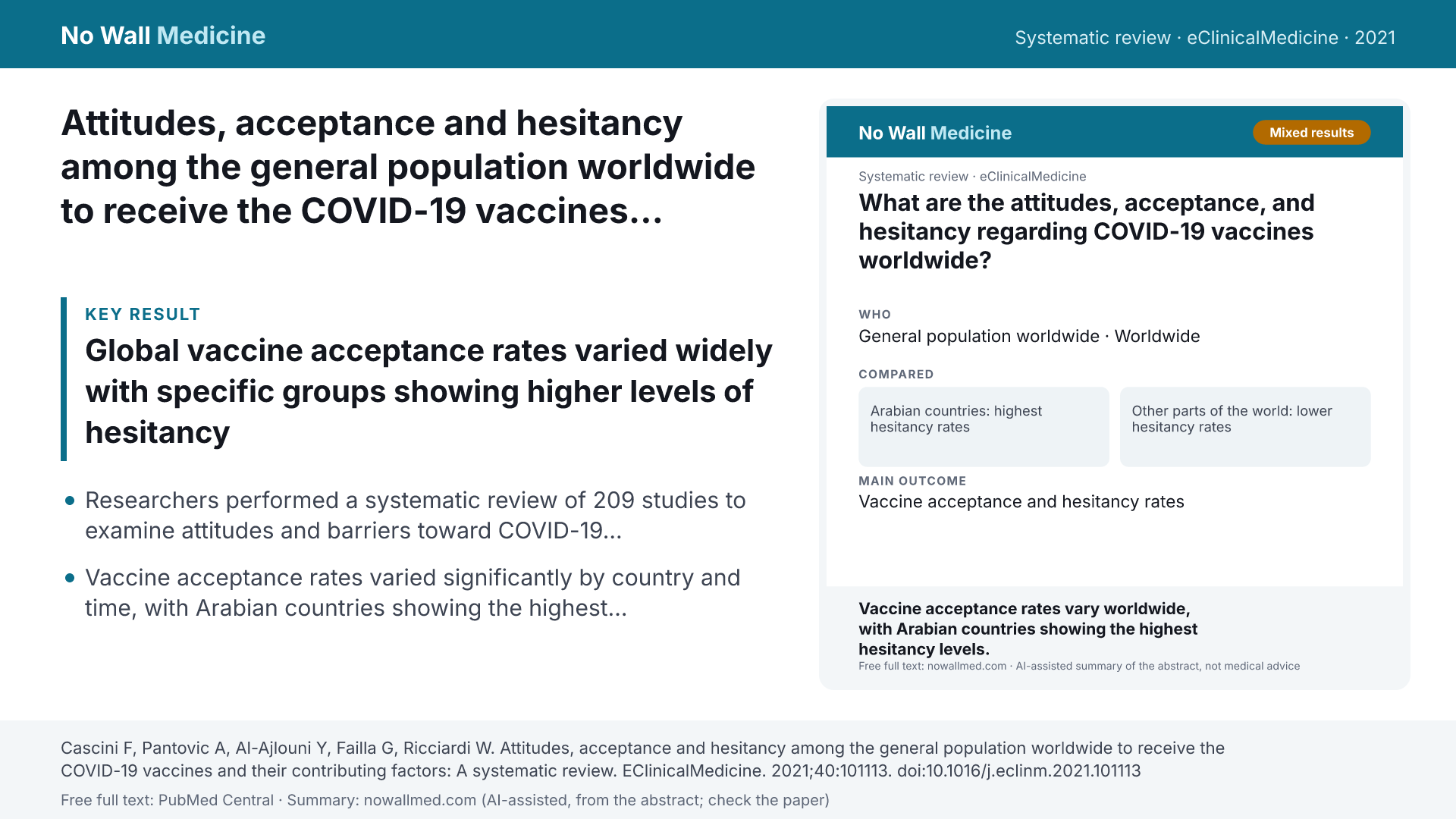
Global vaccine acceptance rates varied widely with specific groups showing higher levels of hesitancy
Attitudes, acceptance and hesitancy among the general population worldwide to receive the COVID-19 vaccines and their contributing factors: A systematic review
Systematic reviewMixed results
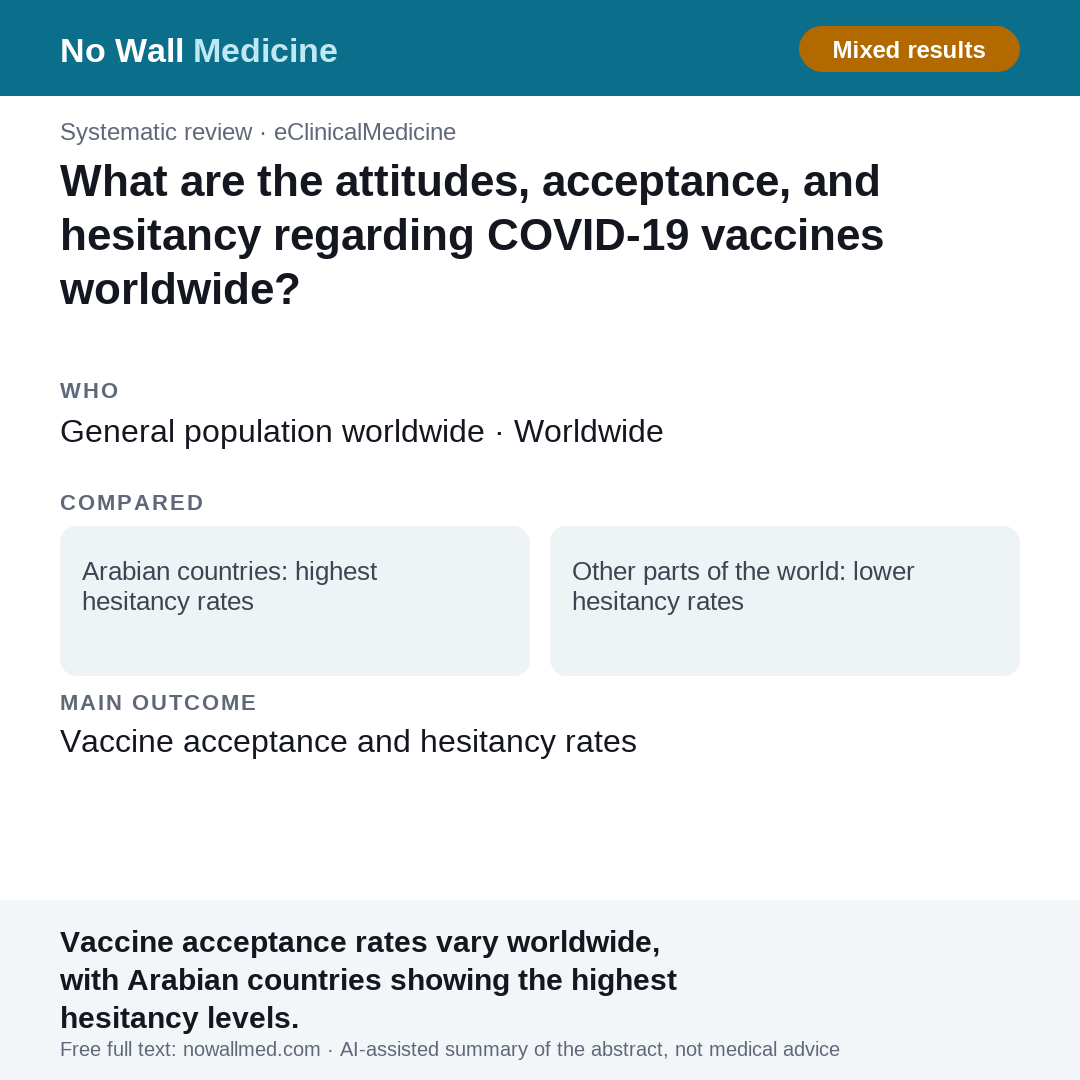
What are the attitudes, acceptance, and hesitancy regarding COVID-19 vaccines worldwide?
Who
General population worldwide · Worldwide
Compared
Arabian countries: highest hesitancy rates
Other parts of the world: lower hesitancy rates
Main outcome
Vaccine acceptance and hesitancy rates
Bottom line: Vaccine acceptance rates vary worldwide, with Arabian countries showing the highest hesitancy levels.
eClinicalMedicine · 2021-09-02Download image
Clinical question: What are the attitudes, acceptance, and hesitancy regarding COVID-19 vaccines worldwide?
Why it matters: Vaccine hesitancy is a major barrier to achieving herd immunity and stopping the evolution of the COVID-19 pandemic.
Key points
- Researchers performed a systematic review of 209 studies to examine attitudes and barriers toward COVID-19 vaccination worldwide.
- Vaccine acceptance rates varied significantly by country and time, with Arabian countries showing the highest hesitancy rates.
- Increased hesitancy was associated with being female, younger, less educated, lower income, having no insurance, living in rural areas, or being a racial/ethnic minority.
Headline and key points written with AI from the paper’s abstract, with every number checked against it. Read the paper before relying on them.
Was this summary helpful?
Cite this article
Cascini F, Pantovic A, Al-Ajlouni Y, Failla G, Ricciardi W. Attitudes, acceptance and hesitancy among the general population worldwide to receive the COVID-19 vaccines and their contributing factors: A systematic review. eClinicalMedicine. 2021. doi:10.1016/j.eclinm.2021.101113
Spotted a mistake? Suggest a correction
Top studies every Monday
The week’s key trials and guidelines in your specialties, plus any topics you follow. By email, free.
Get the weekly digest