Attitudes, acceptance and hesitancy among the general population worldwide to receive the COVID-19 vaccines and their contributing factors: A systematic review
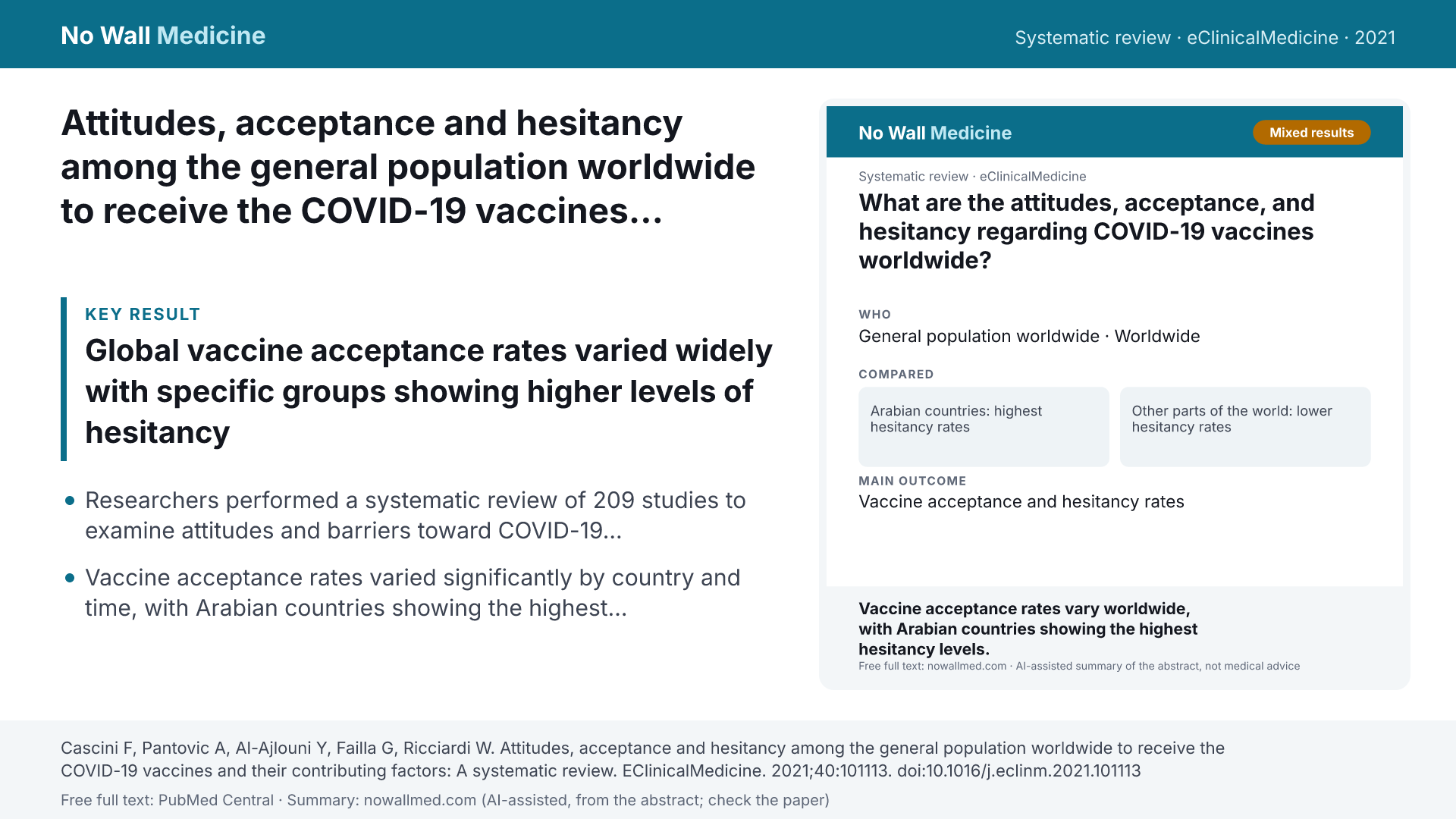
Key result: Global vaccine acceptance rates varied widely with specific groups showing higher levels of hesitancy
Systematic reviewMixed results
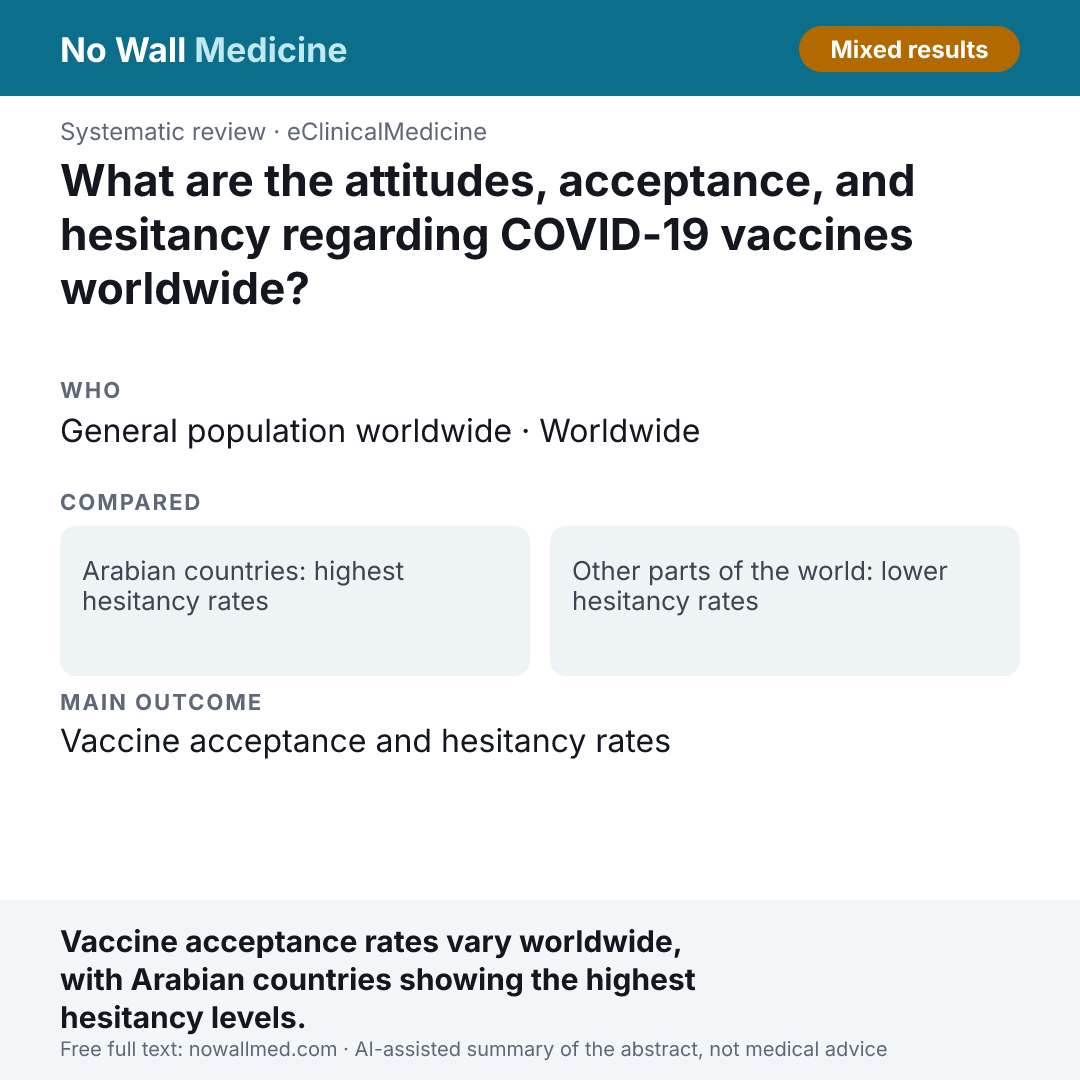
What are the attitudes, acceptance, and hesitancy regarding COVID-19 vaccines worldwide?
Who
General population worldwide · Worldwide
Compared
Arabian countries: highest hesitancy rates
Other parts of the world: lower hesitancy rates
Main outcome
Vaccine acceptance and hesitancy rates
Bottom line: Vaccine acceptance rates vary worldwide, with Arabian countries showing the highest hesitancy levels.
eClinicalMedicine · 2021-09-02 · Save PNG
Key points
- Researchers performed a systematic review of 209 studies to examine attitudes and barriers toward COVID-19 vaccination worldwide.
- Vaccine acceptance rates varied significantly by country and time, with Arabian countries showing the highest hesitancy rates.
- Increased hesitancy was associated with being female, younger, less educated, lower income, having no insurance, living in rural areas, or being a racial/ethnic minority.
Why it matters: Vaccine hesitancy is a major barrier to achieving herd immunity and stopping the evolution of the COVID-19 pandemic.
Discussion prompts
- Would these patients look like yours? Who was left out?
- Is the main outcome one that matters to patients?
- Is the difference large enough to change what you do?
Cite: Cascini F, Pantovic A, Al-Ajlouni Y, Failla G, Ricciardi W. Attitudes, acceptance and hesitancy among the general population worldwide to receive the COVID-19 vaccines and their contributing factors: A systematic review. eClinicalMedicine. 2021. doi:10.1016/j.eclinm.2021.101113
Free full text: PubMed Central · Summary and visual abstract: nowallmed.com/a/attitudes-acceptance-and-hesitancy-among-the-general-population-td3xl5/ (AI-assisted from the abstract; check the paper before relying on it).