Audiovisual Augmentation of Electronic Consent to Improve Consent Rates and Comprehension: A Randomized Clinical Trial
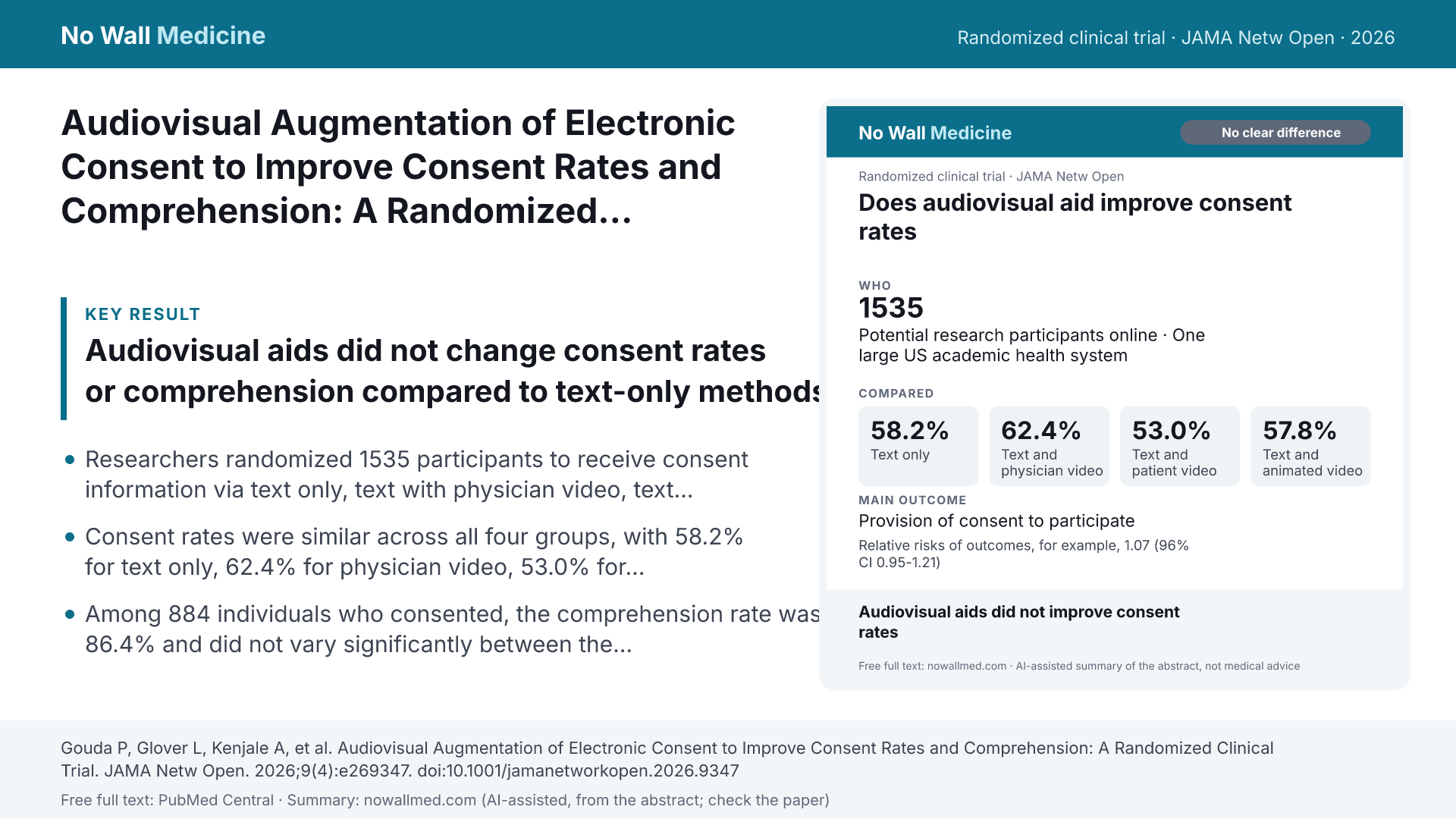
Key result: Audiovisual aids did not change consent rates or comprehension compared to text-only methods
Randomized clinical trialNo clear difference
Does audiovisual aid improve consent rates
Who
1535
Potential research participants online · One large US academic health system
Compared
58.2%Text only (221/380)
62.4%Text and physician video (241/386)
53.0%Text and patient video (203/383)
57.8%Text and animated video (223/386)
Main outcome
Provision of consent to participate
Result: Relative risks of outcomes, for example, 1.07 (96% CI 0.95-1.21)
Bottom line: Audiovisual aids did not improve consent rates
Limitation: No follow-up undertaken
JAMA Netw Open · 2026-04-01
Key points
- Researchers randomized 1535 participants to receive consent information via text only, text with physician video, text with patient video, or text with animated video.
- Consent rates were similar across all four groups, with 58.2% for text only, 62.4% for physician video, 53.0% for patient video, and 57.8% for animated video.
- Among 884 individuals who consented, the comprehension rate was 86.4% and did not vary significantly between the different delivery strategies.
Discussion prompts
- Would these patients look like yours? Who was left out?
- Is the main outcome one that matters to patients?
- Is the difference large enough to change what you do?
Cite: Gouda P, Glover L, Kenjale A, et al. Audiovisual Augmentation of Electronic Consent to Improve Consent Rates and Comprehension: A Randomized Clinical Trial. JAMA Netw Open. 2026;9(4):e269347. doi:10.1001/jamanetworkopen.2026.9347
Free full text: PubMed Central · Summary and visual abstract: nowallmed.com/a/audiovisual-augmentation-of-electronic-consent-to-improve-consent-1gl3w43/ (AI-assisted from the abstract; check the paper before relying on it).