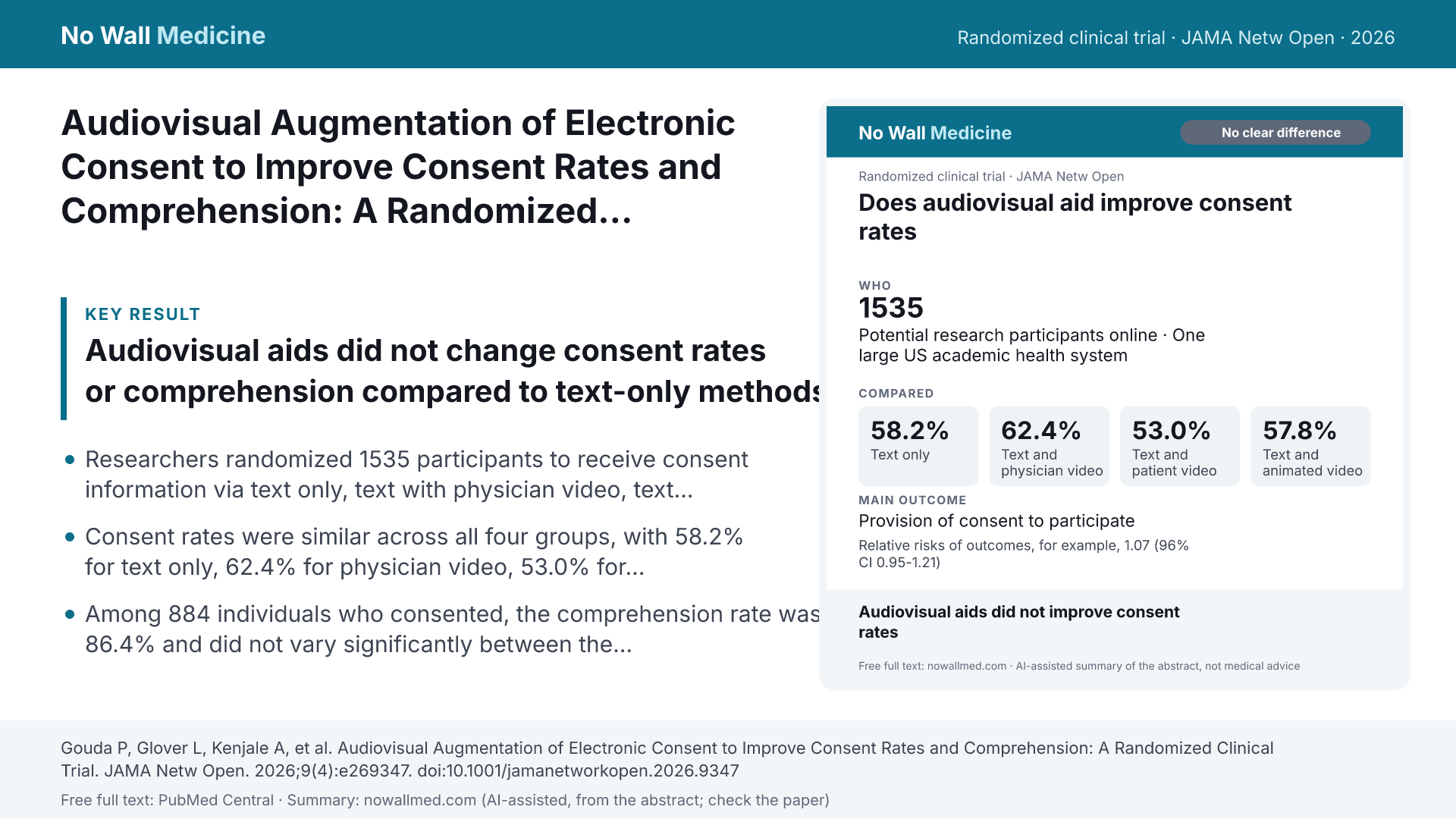
Audiovisual aids did not change consent rates or comprehension compared to text-only methods
Audiovisual Augmentation of Electronic Consent to Improve Consent Rates and Comprehension: A Randomized Clinical Trial
Randomized clinical trialNo clear difference
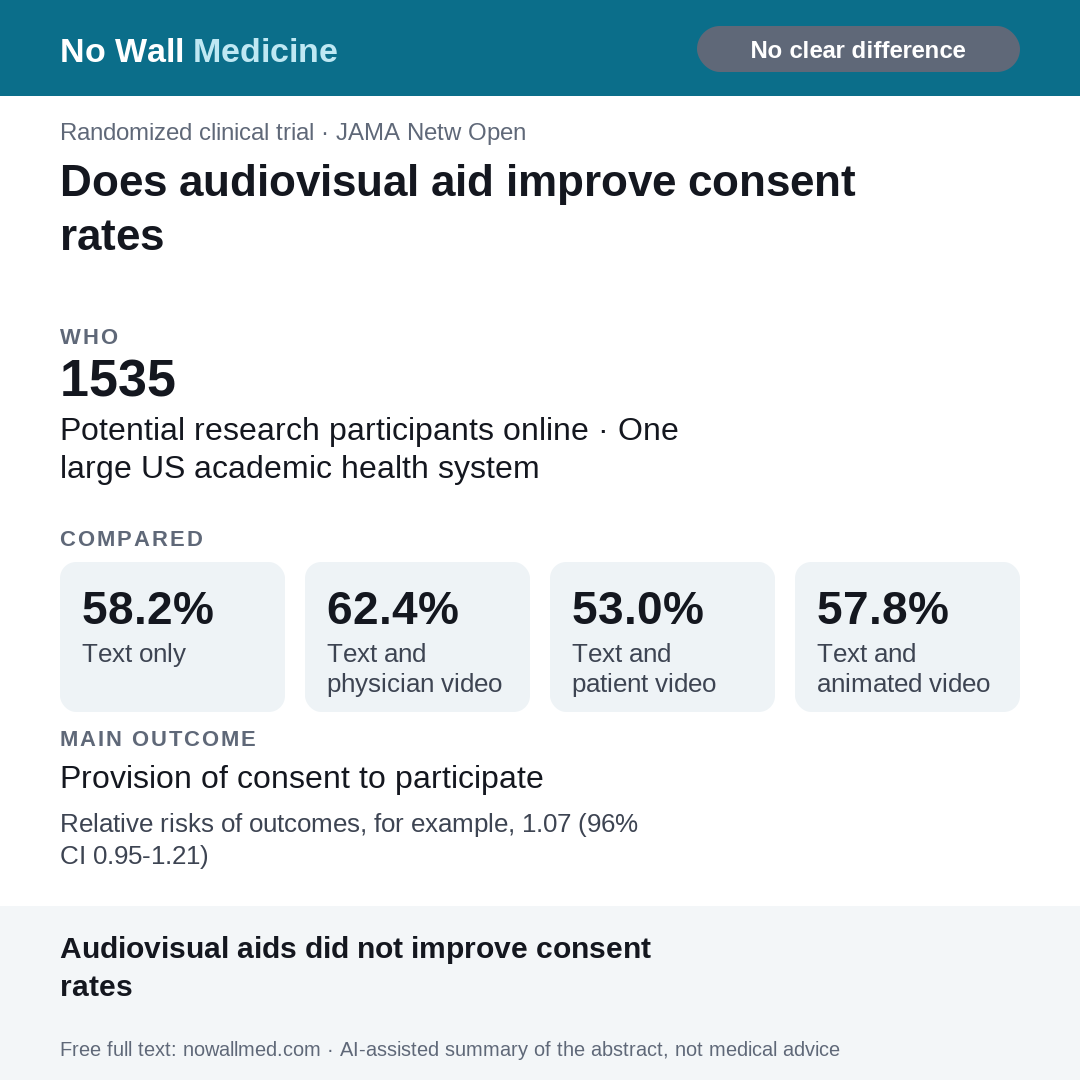
Does audiovisual aid improve consent rates
Who
1535
Potential research participants online · One large US academic health system
Compared
58.2%Text only (221/380)
62.4%Text and physician video (241/386)
53.0%Text and patient video (203/383)
57.8%Text and animated video (223/386)
Main outcome
Provision of consent to participate
Result: Relative risks of outcomes, for example, 1.07 (96% CI 0.95-1.21)
Bottom line: Audiovisual aids did not improve consent rates
Limitation: No follow-up undertaken
JAMA Netw Open · 2026-04-01Download image
Why it matters: Data are lacking regarding whether using audiovisual aids can improve how much people understand and their willingness to participate in research studies.
Key points
- Researchers randomized 1535 participants to receive consent information via text only, text with physician video, text with patient video, or text with animated video.
- Consent rates were similar across all four groups, with 58.2% for text only, 62.4% for physician video, 53.0% for patient video, and 57.8% for animated video.
- Among 884 individuals who consented, the comprehension rate was 86.4% and did not vary significantly between the different delivery strategies.
Headline and key points written with AI from the paper’s abstract, with every number checked against it. Read the paper before relying on them.
Was this summary helpful?
Subject terms
Cite this article
Gouda P, Glover L, Kenjale A, et al. Audiovisual Augmentation of Electronic Consent to Improve Consent Rates and Comprehension: A Randomized Clinical Trial. JAMA Netw Open. 2026. doi:10.1001/jamanetworkopen.2026.9347
Spotted a mistake? Suggest a correction