Study information videos were as effective as paper sheets for research consent among youth
Acceptability and effectiveness of a study information video in improving the research consent process for youth: a non-inferiority trial
Cluster-randomised non-inferiority trialBenefit found
Is a study information video non-inferior to participant information sheets for youth consent?
Who
921
Youth aged 18-24 years in Zimbabwe · Zimbabwe
Compared
Study information video: 25.4/30
Standard participant information sheets: 25.4/30
Main outcome
Comprehension of the study using a questionnaire
Result: mean difference -0.02 (95% CI -0.51 to 0.47)
Bottom line: A study information video is non-inferior to paper-based information sheets for improving comprehension among youth.
Limitation: High volume of information in both arms reduced acceptability.
BMJ Glob Health · 2025-01-19Download image
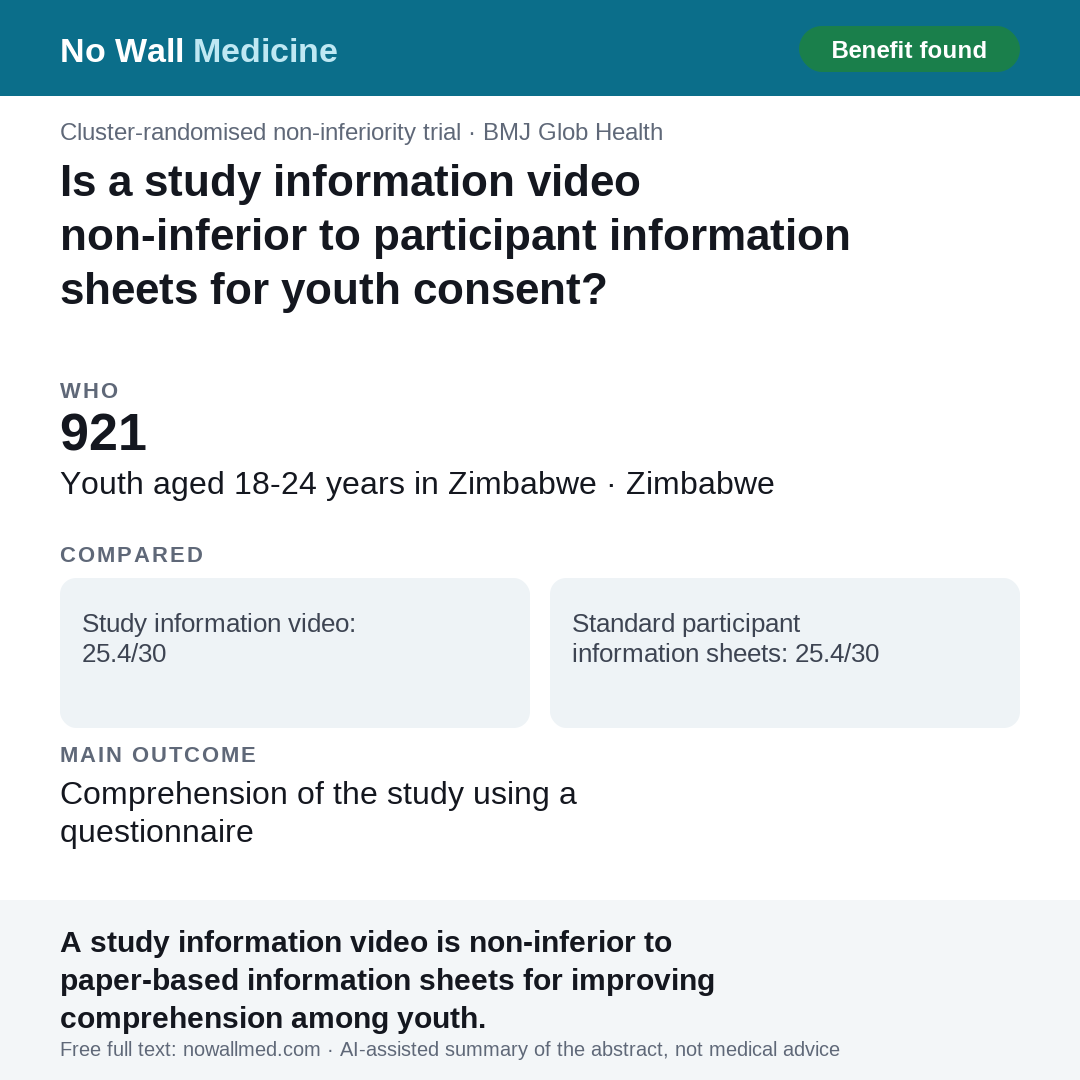
Clinical question: Is a study information video non-inferior to participant information sheets for youth consent?
Why it matters: Standard research information sheets are often long and may be difficult for participants to understand during the informed consent process.
Key points
- Researchers studied 921 participants aged 18-24 years in Zimbabwe to compare video-based consent with standard paper information sheets.
- The mean comprehension score was 25.4/30 in both groups, with a mean difference of -0.02 (95% CI -0.51 to 0.47) showing the video was non-inferior.
- While youth found the video exciting and trustworthy, the high volume of information in both methods reduced overall acceptability.
Headline and key points written with AI from the paper’s abstract, with every number checked against it. Read the paper before relying on them.
Abstract
Introduction
Obtaining informed consent for research includes the use of information sheets, which are often long and may be difficult for participants to understand. We conducted a trial to investigate whether consent procedures using a study information video coupled with electronic consent were non-inferior to standard consent procedures using participant information sheets (PIS) among youth aged 18-24 years in Zimbabwe. Methods
The trial was nested within an endline population-based survey for a cluster-randomised trial from October 2021 to June 2022. Randomisation of participants to video or paper-based consent was at household level. We assessed non-inferiority in comprehension of the study using a questionnaire. The video method was accepted as non-inferior to standard consent procedures if the 95% CIs of the mean difference did not fall below the prespecified margin of 1.98. Thematic analysis was conducted on brief qualitative discussions with randomly selected youth to explore the acceptability of video and PIS within consent methods. Results
Overall, 921 participants were enrolled (54% female). The median age was 20 (IQR 18-24) years. The mean comprehension score was 25.4/30 in both arms. The mean difference in comprehension between arms was -0.02 (95% CI -0.51 to 0.47) showing non-inferiority of the intervention in comprehension of study information. Youth (N=90) described both consent methods as interactive and inclusive. Those in the video consent arm felt it was exciting and youth focused. The use of imagery to explain procedures strengthened the perceived trustworthiness of the research. However, the high volume of information in both arms reduced acceptability. Conclusion
Comprehension of study information using an information video is non-inferior to a paper-based consent method. Using information videos for consent processes shows promise as a person-centred and context-sensitive approach to enhance the informed consent process and should be encouraged by ethics committees.
Abstract reproduced under the article’s CC BY licence.
Topics
Cite this article
Mwaturura TC, Simms V, Dauya E, Shrestha SK, Ferrand S, Shavani T. Acceptability and effectiveness of a study information video in improving the research consent process for youth: a non-inferiority trial. BMJ Glob Health. 2025. doi:10.1136/bmjgh-2023-014481
Spotted a mistake? Suggest a correction