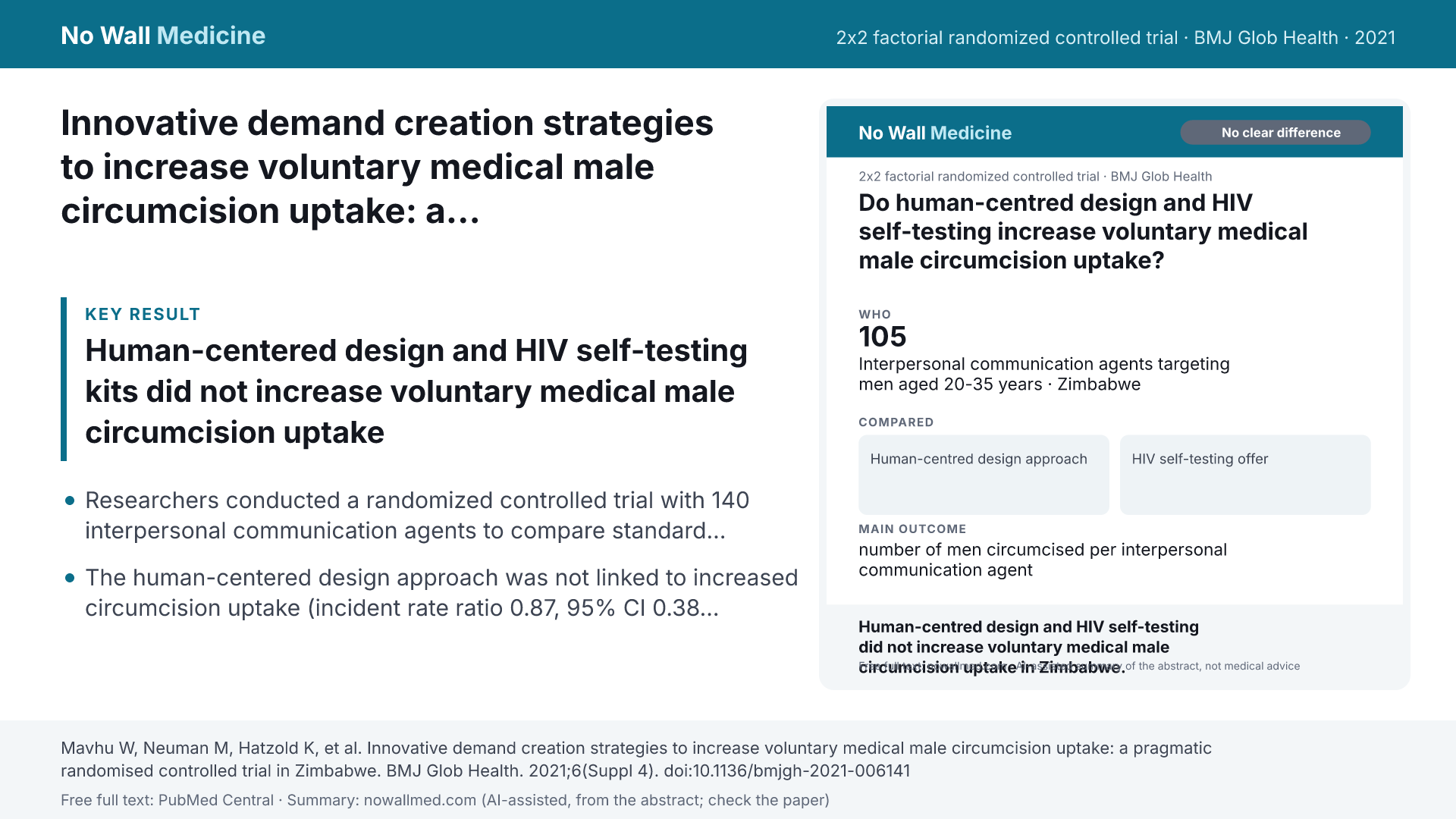
Human-centered design and HIV self-testing kits did not increase voluntary medical male circumcision uptake
Innovative demand creation strategies to increase voluntary medical male circumcision uptake: a pragmatic randomised controlled trial in Zimbabwe
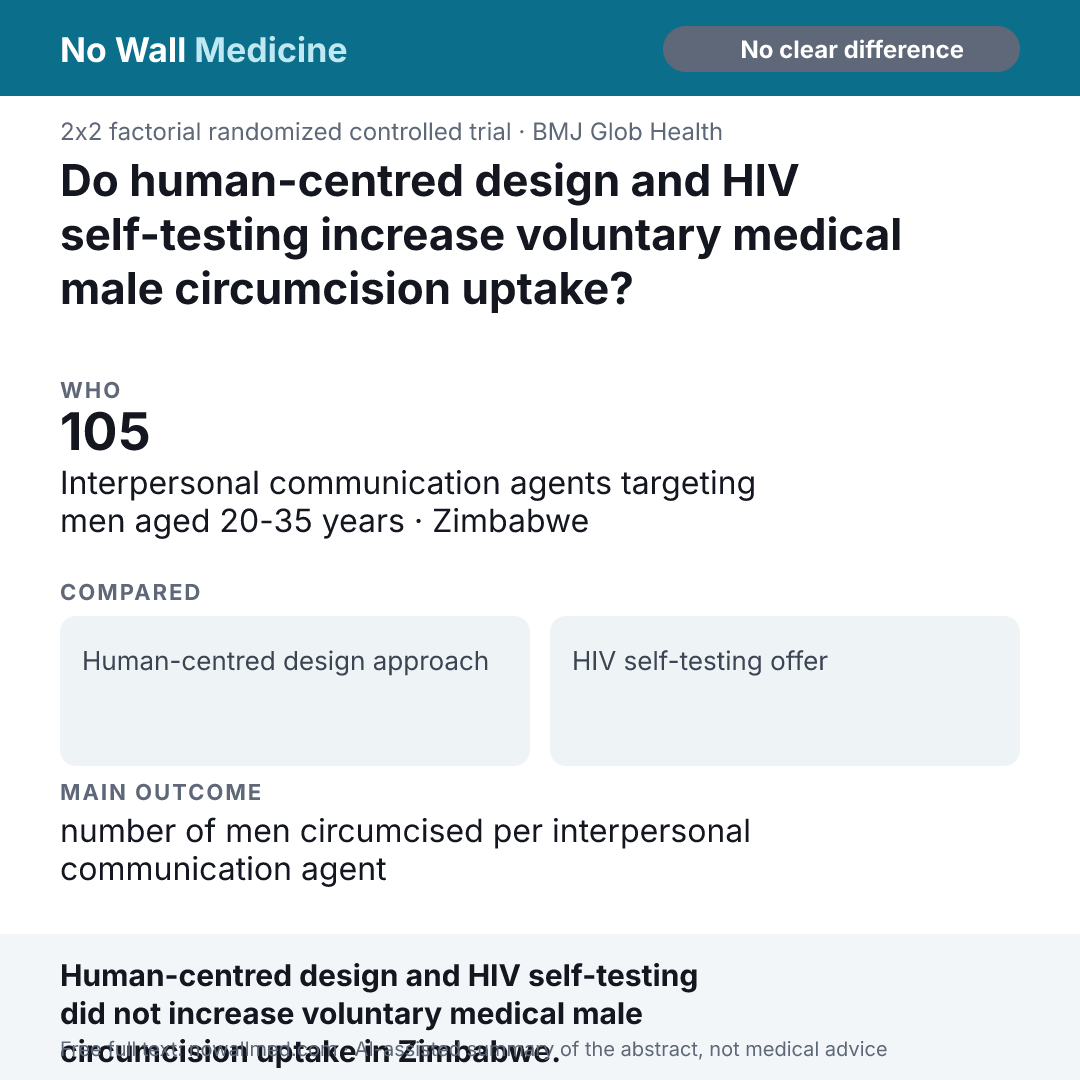
2x2 factorial randomized controlled trialNo clear difference
Do human-centred design and HIV self-testing increase voluntary medical male circumcision uptake?
Who
105
Interpersonal communication agents targeting men aged 20-35 years · Zimbabwe
Compared
Human-centred design approach
HIV self-testing offer
Main outcome
number of men circumcised per interpersonal communication agent
Result: incident rate ratio 0.87 (95% CI 0.38 to 2.02); IRR 0.65 (95% CI 0.28 to 1.50)
Bottom line: Human-centred design and HIV self-testing did not increase voluntary medical male circumcision uptake in Zimbabwe.
BMJ Glob Health · 2021-07-19
Why it matters: It is a challenge to reach men aged 20-35 years, who are at the greatest risk of HIV, with voluntary medical male circumcision.
Headline and visual abstract written with AI from the paper’s abstract, with every number checked against it. Read the paper before relying on them.
Was this summary helpful?
Subject terms
Cite this article
Mavhu W, Neuman M, Hatzold K, et al. Innovative demand creation strategies to increase voluntary medical male circumcision uptake: a pragmatic randomised controlled trial in Zimbabwe. BMJ Glob Health. 2021;6(Suppl 4). doi:10.1136/bmjgh-2021-006141
Spotted a mistake? Suggest a correction